
Benzodiazepines and Opioids: The Deadly Respiratory Risk
Benzodiazepine-Opioid Risk Assessment Tool
This tool calculates your risk of dangerous respiratory depression when taking both benzodiazepines and opioids together, based on CDC research and medical guidelines.
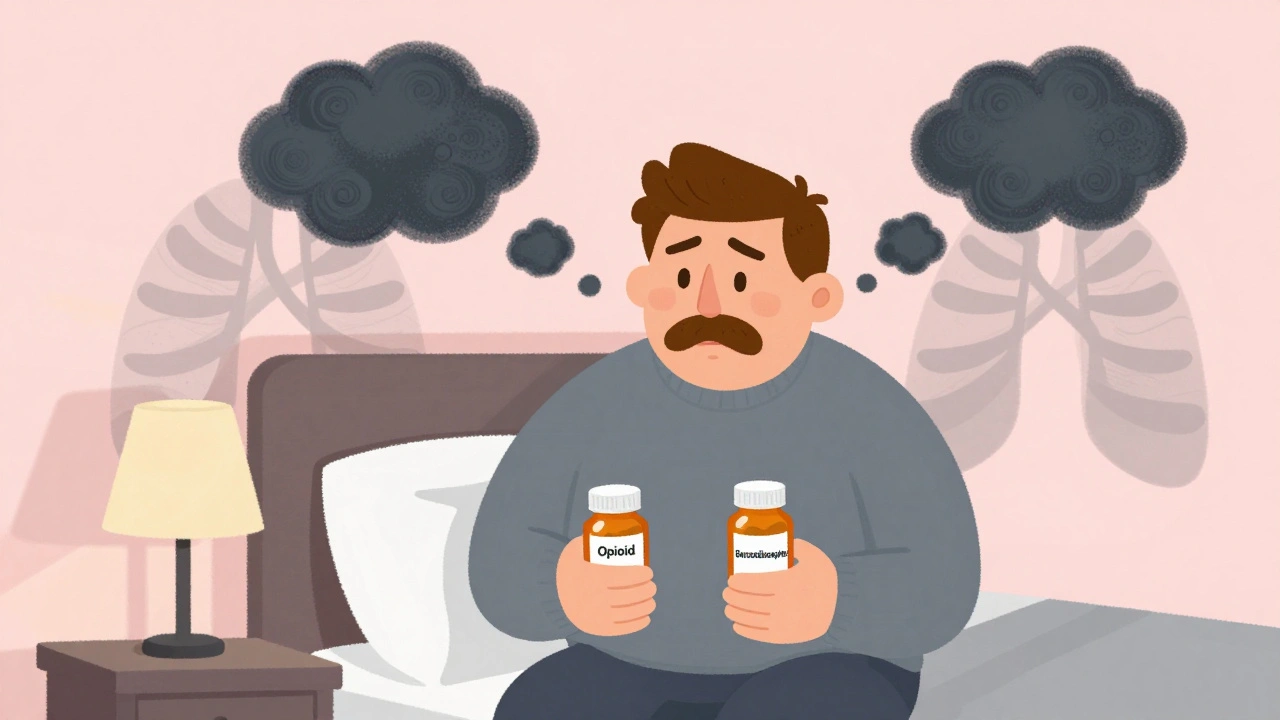
When you take opioids for pain and benzodiazepines for anxiety, you might think you’re managing two separate problems. But together, these drugs can shut down your breathing - quietly, dangerously, and sometimes fatally. This isn’t a rare accident. It’s a predictable outcome backed by years of research and real-world death data. The Centers for Disease Control and Prevention (CDC) found that in 2019, benzodiazepines were present in 17% of all opioid overdose deaths. By 2020, that number hadn’t dropped. In fact, for people aged 45 to 64, the death rate from this combo hit 22.3 per 100,000. That’s not a statistic. That’s someone’s parent, sibling, or neighbor.
How These Drugs Kill Together
Opioids like oxycodone, hydrocodone, and fentanyl slow breathing by targeting specific brainstem areas that control when you inhale and exhale. They mute the signals that tell your body to breathe, especially during sleep or when you’re sedated. But they don’t work alone. Benzodiazepines - drugs like diazepam, alprazolam, and lorazepam - boost a natural calming chemical in your brain called GABA. This makes your entire nervous system less active, including the parts that keep your lungs moving. The problem isn’t that each drug causes a little breathing trouble. It’s that together, they don’t just add up - they multiply. A 2018 study showed that when fentanyl and midazolam were given together, minute ventilation dropped by 78%. Fentanyl alone? 45%. Midazolam alone? 28%. That’s not a linear effect. It’s a collapse. This happens because the two drugs attack breathing from different angles. Opioids hit the Kölliker-Fuse and preBötzinger Complex - two key brainstem hubs that control the rhythm and length of each breath. Benzodiazepines flood the same areas with extra inhibition, silencing neurons that should be firing. The result? Longer pauses between breaths, weaker inhales, and a failure to wake up when oxygen drops. In some cases, people stop breathing entirely and never regain the urge to breathe again.Why Naloxone Isn’t Enough
If you’ve ever heard of naloxone - the overdose reversal drug - you might think it can save anyone who overdoses on drugs. But naloxone only reverses opioids. It does nothing to counteract the respiratory depression caused by benzodiazepines. So if someone overdoses on a mix of fentanyl and Xanax, giving them naloxone might wake them up briefly, but their breathing can still stop again because the benzodiazepine is still active in their system. That’s why emergency responders now treat mixed overdoses differently. They don’t just rely on naloxone. They also provide oxygen, ventilate with a bag-valve mask, and sometimes use sedative reversal agents like flumazenil - though that’s risky because it can trigger seizures in people with long-term benzodiazepine use. There’s no magic bullet yet. And until there is, the combination remains one of the deadliest in modern medicine.The Numbers Don’t Lie
Between 2010 and 2021, opioid-related deaths in the U.S. jumped from 21,089 to over 80,000. The National Institute on Drug Abuse says 75 to 80% of those deaths involved more than one drug. And in nearly a quarter of those cases, benzodiazepines were part of the mix. The FDA saw this coming. In 2016, they slapped a black box warning - the strongest possible alert - on both opioid and benzodiazepine labels. It said clearly: Combining these drugs can cause coma or death. The warning worked - sort of. A 2022 study showed that after the FDA alert, doctors prescribed opioids and benzodiazepines together 14.5% less often. But here’s the catch: 8.7% of long-term opioid users were still getting both drugs. That’s hundreds of thousands of people still at risk. Why? Because many of them were prescribed benzodiazepines for anxiety or insomnia - conditions doctors assumed were harmless to treat alongside pain meds. They weren’t told about the breathing risk. Or worse, they were told, but didn’t understand how quickly it could turn deadly.
Who’s Most at Risk?
It’s not just people using drugs illegally. Many of the deaths happen to patients on legitimate prescriptions. People with chronic pain who also have anxiety or PTSD. Older adults taking multiple medications. Those with sleep apnea or COPD. Even people who take one drug as directed and the other occasionally - like taking Xanax for a panic attack while still on an opioid for back pain - are in danger. The CDC found that the highest death rates from this combo were in people aged 45 to 64. That’s not a coincidence. This group is more likely to be on long-term opioids for arthritis, back injuries, or post-surgery pain. They’re also more likely to be prescribed benzodiazepines for insomnia or anxiety - conditions that become more common with age. And they’re less likely to know that mixing them is like playing Russian roulette with their lungs.What Should You Do?
If you’re on an opioid for pain, ask your doctor this: Do I really need a benzodiazepine? There are safer alternatives. For anxiety, SSRIs like sertraline or escitalopram work without suppressing breathing. For insomnia, cognitive behavioral therapy (CBT-I) is more effective long-term than sleeping pills. For muscle spasms, physical therapy or non-benzodiazepine muscle relaxants like baclofen may be options. If you’re already taking both, don’t stop suddenly. Withdrawal from either drug can be dangerous. Talk to your doctor about tapering one or both. If you can’t stop, make sure someone close to you knows the risks. Keep naloxone on hand - even if it won’t fix everything, it might buy you time. And consider wearing a medical alert bracelet that lists your medications.
What’s Being Done?
Public health systems are starting to respond. Twenty states now have prescription drug monitoring programs (PDMPs) that flag doctors who prescribe opioids and benzodiazepines together. Medicare Part D requires pharmacies to screen for dangerous combinations before filling prescriptions. The NIH has poured $15.7 million into research on reversing dual-drug respiratory depression. Scientists are testing new drugs like CX1739 - an ampakine that restored breathing in animal studies when both opioids and benzodiazepines were present. But none of this helps if patients don’t know the danger. Too many people still think, “I’ve been taking both for years - nothing’s happened.” That’s not luck. That’s waiting for the next time.Bottom Line
Benzodiazepines and opioids are not a harmless pair. Their combination doesn’t just increase risk - it creates a new, deadlier threat. The science is clear. The warnings are loud. The deaths are real. You don’t need to be a drug user to be at risk. You just need to be prescribed both. If you or someone you care about is taking these drugs together, talk to a doctor today. Ask about alternatives. Ask about naloxone. Ask about breathing risks. Don’t wait for a crisis to learn the answer.Can you overdose on benzodiazepines alone?
Yes, but it’s rare in healthy adults at therapeutic doses. Benzodiazepines alone rarely cause fatal respiratory depression unless taken in very high amounts or mixed with other depressants like alcohol or opioids. Most deaths involving benzodiazepines occur when they’re combined with other CNS depressants.
Is naloxone effective for benzodiazepine overdose?
No. Naloxone only reverses opioid effects. It has no impact on benzodiazepines. In a mixed overdose, naloxone may help with the opioid component but won’t fix the breathing suppression caused by the benzodiazepine. Emergency support like oxygen and ventilation is critical.
Are there safe alternatives to benzodiazepines for anxiety while on opioids?
Yes. SSRIs like sertraline or escitalopram, SNRIs like venlafaxine, and non-benzodiazepine options like buspirone are safer for anxiety in people taking opioids. Non-drug treatments like cognitive behavioral therapy (CBT) are also highly effective and carry no respiratory risk.
Why do doctors still prescribe both drugs together?
Some doctors prescribe both out of habit, lack of awareness, or because they believe the patient needs immediate relief. Others may not realize how dangerous the combination is, especially in patients with sleep apnea, COPD, or older age. While guidelines strongly warn against it, enforcement and education remain inconsistent.
How can I tell if someone is experiencing respiratory depression from this combo?
Signs include slow, shallow, or irregular breathing; blue lips or fingertips; extreme drowsiness or inability to wake up; confusion; and unresponsiveness. If someone is breathing fewer than 8 times per minute or stops breathing entirely, it’s a medical emergency. Call 911 immediately and administer naloxone if available.
14 Comments
just found out my dad’s been on oxycodone and xanax for years… i had no idea this was a thing. i’m gonna call him right after this. 💔
my aunt overdosed last year and they said it was the mix. no one told her. doctors just scribbled scripts like they were ordering coffee. so many people are just… walking time bombs. 😔
thank you for posting this. i’ve been on gabapentin for nerve pain and klonopin for anxiety and i’ve been terrified to ask my dr if i can switch. this made me feel less alone. 🫂
the science here is solid but the real issue is how normalized this is in primary care. i’ve seen prescriptions for both written on the same day by the same doctor who didn’t even blink. it’s systemic.
the pharmacodynamics are fascinating - opioid mu-receptor agonism plus GABA-A receptor positive allosteric modulation creates a synergistic depression of the preBötzinger complex. it’s not just additive, it’s multiplicative. we’re talking about a loss of respiratory drive at the level of the central pattern generator. naloxone’s ineffectiveness here isn’t a flaw - it’s a biological inevitability.
THIS IS A PUBLIC HEALTH EMERGENCY AND NO ONE IS TALKING ABOUT IT. I’M A NURSE. I’VE SEEN IT. PEOPLE DIE SILENTLY IN THEIR SLEEP. IF YOU’RE ON THESE DRUGS, TALK TO YOUR DOCTOR TODAY. DON’T WAIT UNTIL IT’S TOO LATE. 🚨
you think this is bad? wait till you find out the FDA knew about this in 2005 but didn’t act because pharma lobbyists paid off the advisory board. this isn’t negligence - it’s murder by committee. and they’re still prescribing it. they’re all complicit.
my grandma took both for 12 years. she never knew. i’m glad i read this. i’m gonna get her on CBT-I and sertraline. she deserves to breathe easy. 🌿
so… what’s the alternative? just suffer in pain and anxiety? brilliant. thanks for the life advice, doctor.
the real tragedy isn’t the drugs - it’s the medical system’s failure to treat pain and mental health as interconnected, not as separate boxes to check. we’ve outsourced care to pills because we don’t have time, money, or will to do better.
wait… so you’re saying the government is hiding this? what if this is all a psyop to control the population? maybe the drugs are fine and the real danger is the fear they’re selling us…
my cousin died from this. i hate how people act like it’s just ‘bad luck.’ it’s not. it’s stupid. they should’ve known. now he’s gone. and i’m stuck cleaning up his mess.
to anyone reading this: you’re not alone. i was on both too. switched to CBT and an SSRI. i sleep better now. i breathe better now. it’s scary to change, but you can do it. i believe in you. 💪🌸
the fact that you’re even considering alternatives like SSRIs shows a fundamental misunderstanding of neuropharmacology. benzodiazepines are GABAergics - they’re the gold standard for acute anxiety. SSRIs take weeks to work and have a 30% dropout rate. you’re trading one risk for another, but with less efficacy. this post is dangerously oversimplified.