
Best Reliable Online Resources for Generic Drug Information
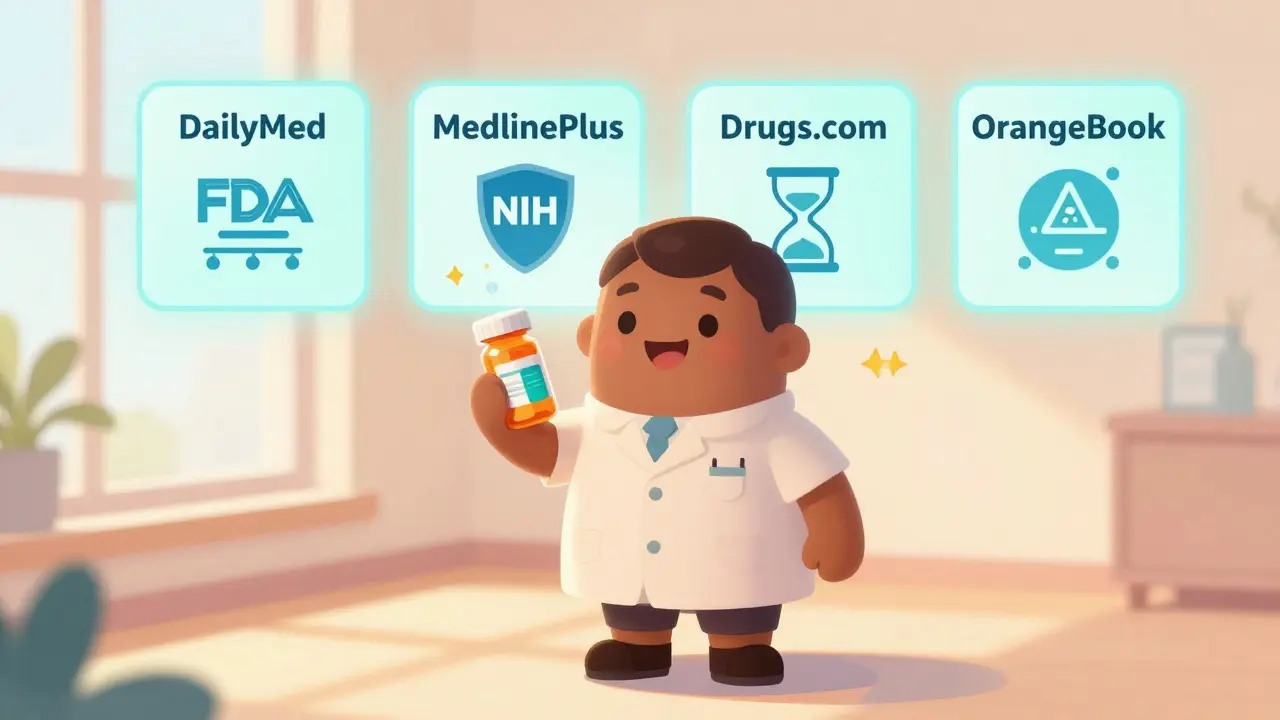
When you’re taking a generic drug, you need to know exactly what you’re on - not just the name, but how it works, what it interacts with, and whether it’s truly the same as the brand version. With over 78% of all prescriptions in the U.S. filled with generics, getting accurate info isn’t just helpful - it’s critical. But not every website you find online is trustworthy. Some are full of ads, outdated data, or even dangerous misinformation. So where should you go? Here are the only reliable online resources for generic drug information you need to know.
DailyMed: The Official FDA Drug Label Source
DailyMed is the only website that gives you the exact, legally approved labeling from the FDA. It’s not a summary. It’s the full text that drug companies submit to the government - including dosing, warnings, side effects, and storage instructions. Every update gets posted within 72 hours of FDA approval. If a drug gets a new black box warning or a dosage change, DailyMed reflects it faster than most pharmacies can update their systems.
It’s used by 89% of hospital pharmacists and is the go-to for anyone needing regulatory proof - like when a pharmacist has to justify why two generics aren’t interchangeable. The catch? It’s not built for patients. The language is technical, the layout is clunky, and the mobile experience is poor. But if you need the truth straight from the source, DailyMed is it. No other site has 100% compliance with FDA labeling.
MedlinePlus: Patient-Friendly, Vetted by the NIH
If you’re a patient or caregiver trying to understand what a generic drug does, MedlinePlus is your best friend. Run by the National Library of Medicine (part of the NIH), it turns complex drug info into plain English - written at a 6th to 8th grade reading level. There are over 17,500 drug monographs, all reviewed by medical experts and updated 15 to 20 times a day.
It’s available in Spanish too, and includes videos, illustrations, and even audio guides. People love it: 89% of Google reviews praise how easy it is to understand. But it’s not perfect. It doesn’t cover every specialty generic - only about 65% of them. And if you need exact dosing schedules or interaction details for five different meds, you’ll still need to check another source. Still, for basic education, it’s the only free resource trusted by the Institute for Safe Medication Practices.
Drugs.com: The Fast, Free All-in-One Tool
Drugs.com is the middle ground - fast, free, and surprisingly thorough. It pulls data from FDA labels, AHFS Drug Information, and Micromedex, updating hourly. It’s got a pill identifier that works 89% of the time, an interaction checker that catches 92% of serious drug combos, and a side effect tracker that lets you filter by severity.
Doctors and pharmacists use it daily. One ER nurse told a Reddit thread, “I use DailyMed for legal stuff, but Drugs.com at 3 a.m. when I’m tired.” Its mobile app is rated 4.6 out of 5 by over 28,000 users. The downside? Ads. A lot of them. And while the core info is reliable, the site sometimes mixes in sponsored content. Stick to the drug monographs and interaction tools - skip the blogs and “top 10” lists.
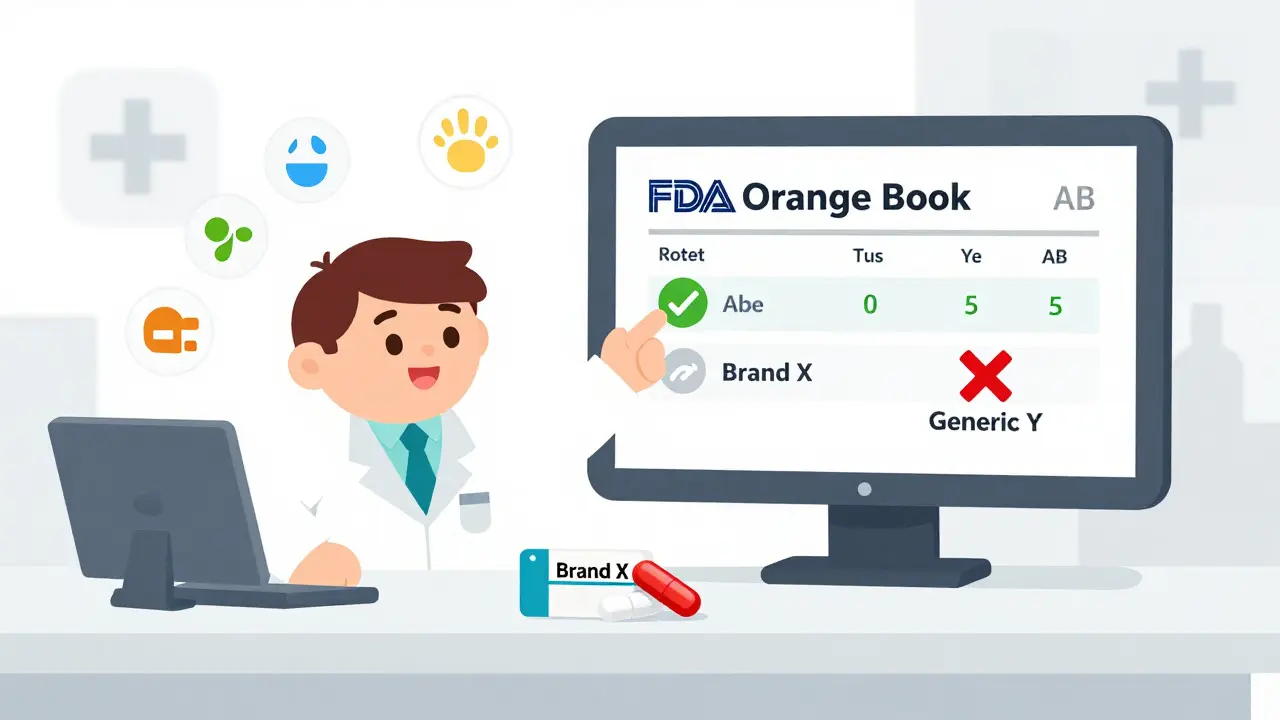
The FDA’s Orange Book: Know Which Generics Are Truly Equivalent
Not all generics are created equal. The Orange Book is the official list of FDA-approved generic drugs and their therapeutic equivalence ratings. It tells you if a generic is rated AB (bioequivalent and interchangeable), AX (not interchangeable due to formulation issues), or other codes.
For drugs like levothyroxine, warfarin, or certain seizure meds, even small differences in absorption can cause real harm. The Orange Book helps you spot those. As of November 2023, it listed over 20,000 generic products across nearly 15,000 brand-name drugs. You can search by generic name, brand name, or active ingredient. It’s updated monthly. The website is basic, but the data is gold. If you’re switching generics and your doctor says “it’s the same,” check the Orange Book to make sure it’s rated AB.
How Professionals Use These Tools Together
Most pharmacists don’t rely on just one. They use a triad: DailyMed for compliance, MedlinePlus for patient explanations, and Drugs.com for quick checks. Hospitals pay for Lexicomp or Clinical Pharmacology for advanced features like pharmacogenomics or off-label use data - but those cost hundreds per year.
Community pharmacists, who often work with tight budgets, use free tools more. A 2022 survey found 84% use DailyMed, 61% use MedlinePlus, and 57% use Drugs.com daily. Meanwhile, patients who search for drug info online are 3 times more likely to trust MedlinePlus than a commercial site - even if the commercial site has more details.
What’s Missing - and What’s Coming
Free resources still have gaps. DailyMed’s updates can lag by 12 hours during urgent safety alerts. MedlinePlus doesn’t cover rare generics or complex dosing regimens. Drugs.com doesn’t explain why two AB-rated generics might behave differently in real life.
The FDA is fixing some of this. In 2024, the Orange Book will start using real-world data to refine equivalence ratings. MedlinePlus is getting multilingual safety alerts in 15 languages by late 2024. And DailyMed now has an API that connects directly to electronic health records - meaning doctors will soon see live FDA labels inside their patient charts.
But here’s the bottom line: No single free tool gives you everything. You need to use them together. For accuracy, go to DailyMed. For understanding, use MedlinePlus. For speed and interactions, turn to Drugs.com. And always check the Orange Book when switching generics for high-risk drugs.
What to Avoid
Don’t use Wikipedia for drug info. Don’t trust random blogs or forums unless they cite official sources. Avoid sites that sell supplements alongside drug info - they’re not neutral. And never rely on a drug app that doesn’t say where its data comes from.
If a site doesn’t mention the FDA, NIH, or a recognized pharmacy organization as its source, it’s not reliable. Generic drugs save billions every year - but only if people know how to use them safely. Stick to the sources that are backed by science, not ads.
Can I trust generic drug info from Google search results?
No. Google shows ads and commercial sites at the top, which may not be accurate. Always look for government (.gov) or nonprofit (.org) domains like MedlinePlus, DailyMed, or the FDA’s site. These are the only sources guaranteed to be up-to-date and free from commercial bias.
Is Drugs.com really free and reliable?
Yes, the core drug information on Drugs.com is free and reliable. It pulls data directly from the FDA, AHFS, and Micromedex. But the site is ad-supported, so avoid clicking on sponsored links or supplement promotions. Stick to the drug monographs, interaction checker, and pill identifier - those are trustworthy.
Why does my pharmacy say two generics are interchangeable when the Orange Book says they’re not?
Pharmacies are required to substitute generics unless the doctor says “dispense as written.” But the Orange Book ratings are the legal standard. If a generic is rated AX (not interchangeable), your pharmacist should alert you - but they often don’t. Always check the Orange Book yourself if you’re on a narrow therapeutic index drug like thyroid medicine, blood thinners, or seizure meds.
How often is MedlinePlus updated?
MedlinePlus updates its drug information 15 to 20 times per day. Its team of 12 medical editors monitors FDA alerts, new safety warnings, and clinical guidelines daily. If a drug gets a new boxed warning, MedlinePlus adds it within hours - faster than most pharmacy databases.
Do I need to pay for better drug info?
For most people, no. DailyMed, MedlinePlus, Drugs.com, and the Orange Book cover everything you need for safety and understanding. Hospitals and clinics pay for Lexicomp or Clinical Pharmacology because they handle complex cases, off-label uses, and drug interactions in ICU settings. But for personal use, the free tools are sufficient - if you know how to use them together.
Are there apps for these resources?
Drugs.com has a top-rated mobile app with 1-tap lookups and offline access. MedlinePlus works well on mobile browsers. DailyMed’s website is not mobile-friendly, but you can save pages as PDFs. The FDA’s Orange Book has no official app, but third-party tools like Epocrates (now part of Athenahealth) include it - though they require registration. For patients, the Drugs.com app is the most practical free option.
Next Steps: How to Use These Resources Daily
- When you get a new generic prescription, check the Orange Book to confirm it’s rated AB.
- Before taking a new med, look up side effects and interactions on MedlinePlus - it’s designed for you.
- If you’re unsure about a change in how the pill looks or feels, use Drugs.com’s pill identifier.
- For legal or professional reasons, always refer back to DailyMed for the official label.
- Set up a bookmark folder with these four sites: DailyMed, MedlinePlus, Drugs.com, and the FDA Orange Book.
Generic drugs work - but only if you know how to use them safely. These tools are free, authoritative, and updated daily. Use them, and you’ll never have to guess what’s in your medicine again.
9 Comments
OMG I just found out about DailyMed last week and my life changed. I was on a new generic thyroid med and started feeling weird, so I checked the label and saw a dosage change that my pharmacist never mentioned. Thank you for this guide-finally, someone who gets it.
Now I check every new prescription on Drugs.com first, then cross-reference with MedlinePlus for the plain English version. And yes, the Orange Book? Non-negotiable for anything with a narrow therapeutic index. I’ve even printed out the AB ratings and taped them to my pill organizer.
Also, the Drugs.com app is a godsend at 2 a.m. when you’re panic Googling side effects. No ads can ruin that peace.
Why does no one talk about this stuff? Everyone’s just trusting their pharmacy like it’s magic. Spoiler: it’s not.
So… we’re just supposed to trust the FDA? The same agency that let Big Pharma push opioids? And now you want me to believe their labeling is ‘truth’? Come on.
Also, DailyMed’s interface looks like it was designed in 2003. If I have to click through 7 menus just to find the ‘side effects’ section, it’s not ‘reliable’-it’s a bureaucratic obstacle course.
And Drugs.com? With ads? Please. If it’s got a ‘Sponsored by’ tag, it’s not information-it’s marketing in a lab coat.
Maybe the real answer is: don’t take generics at all. Or better yet-don’t take any drugs. Just eat turmeric and meditate. Problem solved.
…But I still use Drugs.com. Hypocrite? Maybe. Realistic? Definitely.
YESSSS this is the exact info I needed 😭 I’ve been using MedlinePlus for years and never knew about DailyMed-thank you!!
Also, the Orange Book thing? Mind. Blown. I switched my blood thinner generic last year and had no idea they weren’t all equal. Now I check before every refill.
Drugs.com app is my emergency button. I keep it on my home screen. 🙏
PS: if you’re on levothyroxine, DO NOT swap generics without checking the Orange Book. I’ve seen what happens when you do. Not pretty.
This is actually really helpful. I’m a nurse and I’ve been using DailyMed for work, but I never showed my patients how to use it. I’ll be sharing this with my clinic next week.
Also, I didn’t realize MedlinePlus updates that often. That’s impressive. Most health sites update once a month and call it ‘current.’
Thanks for laying this out clearly. I wish more people knew about these tools-especially older folks who just trust whatever the pharmacist says.
And yes, I agree about avoiding Wikipedia. I’ve seen patients come in quoting it like it’s gospel. 😅
It’s irresponsible to recommend Drugs.com. It’s ad-supported. That alone makes it morally compromised. You’re telling people to rely on a platform that profits from their health anxiety.
And yet you call it ‘reliable’? That’s not reliability-it’s convenience disguised as trustworthiness.
If you want real safety, use only .gov sites. Anything else is a gamble with your life.
Also, why is no one talking about the fact that generic manufacturers aren’t required to test for long-term effects? The FDA only approves bioequivalence, not clinical outcomes.
These tools are band-aids on a bullet wound.
Thank you for this comprehensive breakdown. As someone who works with non-English-speaking patients daily, I’m especially grateful for the mention of MedlinePlus in Spanish.
I’ve had patients come in confused because their new pill looked different-sometimes they’d stop taking it entirely, fearing it was counterfeit. Now I print out the pill images from Drugs.com and the Orange Book ratings and hand them physical copies.
One elderly woman cried when she realized she could check this herself. That’s the power of accessible information.
Also, I’ve noticed that even pharmacists sometimes overlook the Orange Book ratings-especially in busy retail settings. Patients need to be their own advocates.
And yes, DailyMed is clunky, but it’s the law. If you’re in a legal dispute over a medication error, that’s your evidence.
Keep sharing this. It matters.
Is it just me, or is the whole ‘reliable drug info’ thing a modern myth? We live in an age where truth is curated, filtered, and monetized-even by government sites.
DailyMed is ‘official’-but who writes the labels? Pharma companies. The FDA just approves them. So it’s not ‘truth,’ it’s negotiated truth.
MedlinePlus is sweet, but it’s curated by bureaucrats who prioritize simplicity over nuance. What about patients on 7 meds? The ‘6th grade reading level’ is a kindness, not a feature.
Drugs.com? A corporate shell wrapped in open-source vibes. And the Orange Book? It’s a spreadsheet. It doesn’t tell you why two AB-rated generics cause different side effects in real life.
Maybe the real answer isn’t ‘which site to trust’-but ‘why do we need to trust anyone at all?’
…I still use them all. But I do it with a grain of salt. And a cup of tea.
It is deeply concerning that in the United States-a nation with the most advanced medical infrastructure on Earth-citizens must rely on a patchwork of free, ad-ridden, inconsistently updated websites to access basic pharmacological information.
Compare this to the United Kingdom, where the NHS provides a unified, rigorously vetted, and legally mandated drug database accessible to all via a single portal. No ads. No confusion. No guesswork.
Here, we have a system where patients are expected to become amateur pharmacologists because corporate interests have hollowed out public health infrastructure.
These ‘resources’ are not solutions-they are damage control. And the fact that you treat them as authoritative is a symptom of a much deeper failure.
Until the FDA mandates a single, unified, non-commercial drug information portal, we are merely rearranging deck chairs on the Titanic.
Bro. Drugs.com has ads everywhere. Like, I opened it on my phone and got 3 popups before I could even search ‘ibuprofen.’
And DailyMed? It’s like using a fax machine in 2024. The UI is straight out of Windows XP. I had to screenshot it just to show my mom how to use it.
Also, the Orange Book doesn’t tell you if the generic is made in China or India. I don’t trust that. I’ve seen too many recalls.
And MedlinePlus? Cute. But what if you’re on a weird combo med? It’s useless.
Real talk: if you’re not on a paid clinical database, you’re playing Russian roulette with your meds.
Also, ‘AB-rated’ is a lie. I’ve had two different AB generics of the same drug-one gave me migraines, the other didn’t. So yeah. Trust the system? Nah.