
Biosimilar or Generic? How to Choose the Right Medication for Your Treatment

When your doctor suggests switching from a brand-name drug to a cheaper version, you might hear two terms: generic and biosimilar. They sound alike-both promise savings-but they’re not the same. Choosing the wrong one could mean confusion, unnecessary worry, or even a treatment that doesn’t work as well. The truth? Most people don’t know the difference. And that’s dangerous when your health is on the line.
What’s the Real Difference Between Generics and Biosimilars?
Generics are exact chemical copies of brand-name pills. Think of them like a photocopy of a printed page. If you take a generic version of atorvastatin (the cholesterol drug Lipitor), you’re getting the exact same molecule, in the exact same dose, with the exact same effect. The FDA requires generics to prove they work the same way in your body-measured by how fast and how much of the drug enters your bloodstream. If the numbers fall within 80-125% of the brand, it’s approved. That’s it.
Biosimilars? They’re not copies. They’re very close imitations of complex biological drugs made from living cells. These drugs-like Humira for arthritis or Herceptin for breast cancer-are proteins, sometimes bigger than a single cell. You can’t just mix chemicals to make them. They’re grown in labs using living organisms like hamster or yeast cells. Even tiny changes in temperature, pH, or nutrients during production can alter their structure slightly. That’s why biosimilars aren’t called “identical”-they’re “highly similar.” The FDA says they must show no clinically meaningful difference in safety or effectiveness. But they’re not exact.
Here’s the simple breakdown:
- Generics: Small molecules. Made in a lab. Chemically identical to the brand.
- Biosimilars: Large proteins. Made in living cells. Nearly identical, but not exact.
Why Cost Savings Are Very Different
Both save money-but not the same way.
Generics cost 80-85% less than their brand-name versions. A 30-day supply of generic levothyroxine (for thyroid issues) might cost $4. The brand? $75. That’s not a discount. That’s a revolution in access.
Biosimilars? They save 15-20%. That sounds less impressive, but consider this: a single dose of Humira can cost over $2,000. A 20% discount still means you’re paying $400-$500 less per month. For patients on lifelong treatments, that adds up to tens of thousands saved over time.
Why the big gap? Generics are cheap to make. Development costs are around $2-3 million. Biosimilars? $100-250 million. Why? Because you need advanced labs, specialized equipment, and years of testing to prove your protein behaves like the original. You’re not just copying a recipe-you’re rebuilding a living organism’s product.
Can You Switch Them at the Pharmacy?
With generics, you often don’t even know you’re getting a different version. In 49 states, pharmacists can swap a brand-name drug for a generic without telling you-unless your doctor writes “dispense as written.” It’s automatic. Safe. Routine.
Biosimilars? Not so simple.
Only “interchangeable” biosimilars can be swapped at the pharmacy without the prescriber’s permission. And even then, 28 states require the pharmacist to notify your doctor within 72 hours. Why? Because switching back and forth between a reference biologic and a biosimilar raises questions. What if your body reacts differently after multiple switches? Is there a hidden immune response? The science says no-studies with infliximab biosimilars show no increase in side effects-but regulators are cautious. And rightly so. Biologics are powerful. Mistakes cost lives.
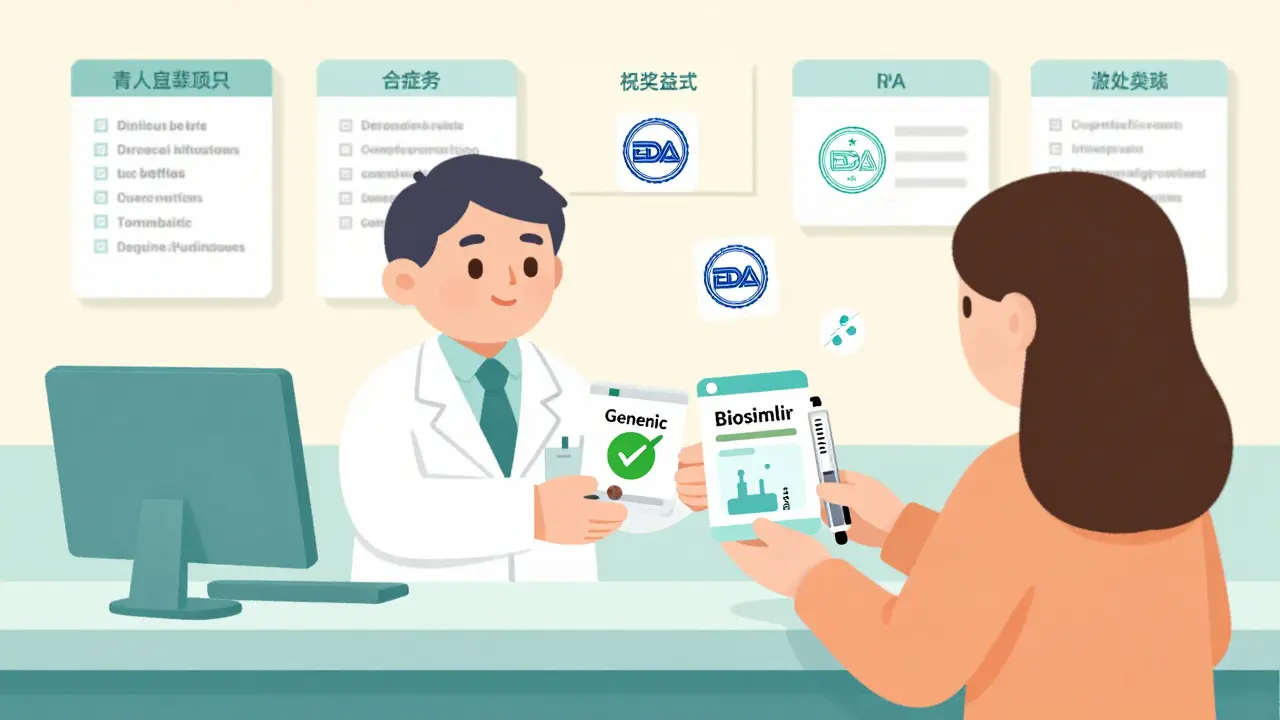
Are They Safe? Real-World Evidence
Let’s talk about fear. Many patients worry: “If it’s not the same, will it work?”
For generics, the answer is clear. A 2019 JAMA study analyzed 47 trials involving over 200,000 patients on cardiovascular drugs. No difference in heart attacks, strokes, or death between brand and generic. The same goes for antidepressants, diabetes meds, and blood pressure pills. Generics are proven, reliable, and safe.
Biosimilars? The data is newer but just as strong. A 2022 review of 128 studies on infliximab biosimilars-used for Crohn’s, rheumatoid arthritis, and psoriasis-tracked 38,547 patients. No difference in effectiveness or safety. The FDA’s own adverse event reports show biosimilars have slightly lower rates of side effects than the originals.
But real life isn’t a clinical trial. One patient on Reddit said their insulin biosimilar (Basaglar) worked fine, but the pen device felt different-and elderly patients accidentally misused it. Another patient with Crohn’s disease reported anxiety after switching, even though their lab markers stayed stable. Emotions matter. Trust matters. If you’re scared, your body reacts. That’s why education is as important as science.
Which One Should You Choose?
Here’s how to decide:
- Check what drug you’re taking. If it’s a pill-like metformin, lisinopril, or sertraline-it’s a small molecule. You’ll get a generic. No biosimilar exists.
- If it’s an injection or infusion-like Humira, Enbrel, or Rituxan-it’s a biologic. Only biosimilars are available. No generics here. Ever.
- Ask your doctor: “Is there a biosimilar for my drug?” If yes, ask if it’s interchangeable. If not, ask why.
- Ask your pharmacist: “Can you substitute this?” If you’re on a biosimilar, make sure you know if it’s the reference product or the biosimilar. Write it down.
- Don’t assume cost equals quality. A $5 generic isn’t “weaker” than a $50 brand. A $1,600 biosimilar isn’t “less effective” than a $2,000 biologic. The science says they’re equivalent.

What’s Changing Right Now?
The landscape is shifting fast. In 2023, the FDA approved the first interchangeable biosimilar for Humira (Cyltezo). That’s huge. It means pharmacists can now swap it without asking the doctor-just like generics.
The Inflation Reduction Act of 2022 removed financial penalties for doctors who prescribe biosimilars in Medicare. That’s already boosting adoption. Hospitals are switching to biosimilars for 89% of infliximab prescriptions. Insurance companies are pushing them too.
Next up? Biosimilars for Stelara (ustekinumab), expected in 2024. That’s a $5 billion-a-year drug. If it gets a biosimilar, millions of psoriasis and Crohn’s patients could save thousands.
But there’s a catch. Patent lawsuits are delaying biosimilars. One biologic drug can have over 100 patents. Companies fight for years to block competition. That’s why biosimilars still make up only 35% of the U.S. market-compared to 65% in Europe. The system is broken. But it’s fixing.
What You Need to Do Now
You don’t need to be a scientist. But you do need to be informed.
- Keep a list of your medications. Know which are biologics and which are small molecules.
- Ask your doctor: “Is there a cheaper version of this?”
- Ask your pharmacist: “Is this a biosimilar or a generic?”
- Don’t panic if you’re switched. Ask for data. Ask for studies. Ask for reassurance.
- Use the FDA’s Purple Book to check if your biosimilar is approved and interchangeable.
Cost shouldn’t force you to skip treatment. But confusion should never be the reason you avoid a better option. Generics and biosimilars aren’t second choices. They’re smart choices. And for millions of people, they’re the only way to stay alive.
Are biosimilars as safe as brand-name biologics?
Yes. The FDA requires biosimilars to prove no clinically meaningful difference in safety, purity, or potency compared to the original biologic. Real-world studies involving tens of thousands of patients show identical rates of side effects and treatment success. Adverse event reports from the FDA confirm biosimilars are as safe as the originals.
Can I switch from a biologic to a biosimilar without my doctor’s approval?
Only if the biosimilar is officially designated as “interchangeable” by the FDA, and only in states that allow pharmacy-level substitution. Even then, 28 states require the pharmacist to notify your doctor within 72 hours. Always confirm with your prescriber before switching.
Why are biosimilars more expensive than generics?
Biosimilars are made from living cells, not chemicals. Manufacturing them requires complex bioreactors, strict temperature controls, and years of testing to ensure consistency. Development costs range from $100-250 million. Generics cost $2-3 million to develop because they’re chemically identical and easier to replicate.
Do biosimilars work for all conditions?
No. Biosimilars only exist for biologic drugs-mostly used in cancer, autoimmune diseases like rheumatoid arthritis and Crohn’s, and chronic conditions like diabetes. They don’t replace small-molecule drugs like antibiotics, blood pressure pills, or antidepressants. For those, generics are the cheaper option.
How do I know if my medication is a biosimilar or a generic?
Check the drug name. Generics have the same name as the brand (e.g., metformin for Glucophage). Biosimilars have a unique brand name plus a four-letter suffix (e.g., adalimumab-atto for Humira). Ask your pharmacist or check the FDA’s Purple Book online for official listings.
What Comes Next?
If you’re on a biologic and haven’t explored biosimilars, talk to your doctor. Ask about cost, coverage, and switching. If you’re on a generic, don’t second-guess it. It’s not a compromise-it’s a win.
The future of medicine isn’t about brand names. It’s about access. Generics opened the door for millions to afford basic care. Biosimilars are doing the same for complex, life-saving treatments. The science is solid. The savings are real. The only thing left to do is stop fearing the difference-and start understanding it.
10 Comments
This post made me cry. Not because I’m sad-because I finally understand why my insulin pen felt weird after the switch. It wasn’t me. It was the damn device. Thank you.
Look, I’ve been on Humira for 12 years and I’ve seen every biosimilar come and go-Cyltezo, Hadlima, Amjevita-and honestly? The only difference I noticed was the packaging. My rheumatologist said it’s like swapping one brand of coffee for another-same beans, different bag. But here’s the thing nobody talks about: insurance companies force the switch without telling you, and then when you have a flare-up, they blame your ‘non-compliance.’ I’ve had three hospitalizations since switching, and no one’s问责. The system is rigged. Biosimilars aren’t the problem-the profit motive is. You think they care if you live? They care if the stock price goes up. And don’t get me started on how they bury the long-term studies behind paywalls while pushing ads for the ‘new, improved’ version. This isn’t healthcare. It’s a financial instrument wrapped in a stethoscope.
Let’s be real-this article is pure corporate propaganda. Biosimilars are not equivalent. The FDA’s ‘no clinically meaningful difference’ is a legal loophole, not a scientific guarantee. Studies are short-term. Patients are guinea pigs. And the fact that pharmacists can swap them without consent? That’s not progress-that’s medical negligence. I’ve seen people go from stable to hospitalized after a switch. This isn’t about cost-it’s about control. And the people pushing this don’t have to live with the consequences.
It’s fascinating how we equate ‘identical’ with ‘safe’ and ‘similar’ with ‘risky.’ But life itself is never identical. Our cells change every day. Our microbiomes shift. Even the same drug, taken at different times, behaves differently. Maybe the real question isn’t whether biosimilars are ‘the same’-but whether we’ve been too obsessed with sameness in the first place. Perhaps the goal isn’t to replicate a molecule perfectly, but to understand the system it operates within. The body isn’t a machine. It’s a conversation. And sometimes, the most effective medicine is the one that listens.
As a nurse practitioner with 20 years in oncology I can tell you without hesitation biosimilars are safe effective and life changing for patients who otherwise couldn't afford treatment The science is robust the data is overwhelming and the ethical imperative to reduce cost while maintaining quality is non negotiable Stop fearmongering and start supporting access
Big thank you for this breakdown 🙌 I was terrified to switch from Enbrel to its biosimilar but after reading this I asked my doc and we did it. No issues. My joints feel the same. My wallet feels better. Also-check out the FDA Purple Book, it’s like a cheat sheet for meds. Super helpful. Don’t let fear make you miss out on savings that could literally save your life.
You’re all being naive. This isn’t about science-it’s about capitalism. The FDA approves these because Big Pharma owns them. Biosimilars are just the next phase of monopolistic control. They’re not cheaper for you-they’re cheaper for the insurers. And when the biosimilar fails? You’re the one who pays with your health. I’ve seen it happen. And no one in this thread has the guts to say it: the system is designed to make you trust the switch, even when it’s not safe. Wake up.
Let’s unpack this at the molecular level: generics are like cloning a JPEG-pixel-perfect. Biosimilars are like re-growing a coral reef from a fragment. The genome’s the blueprint, but the microenvironment? The chaperone proteins? The glycosylation patterns? Those are stochastic, emergent phenomena. You can’t replicate them like a 3D print. That’s why we need long-term immunogenicity tracking. And why ‘interchangeable’ is a regulatory fantasy. The body doesn’t care about FDA labels-it cares about epitope exposure. If you’re on a biologic, track your CRP and ESR. If they drift, speak up. Don’t let the pharmacy decide your biology.
I’ve been a type 1 diabetic for 28 years. I switched from Lantus to Basaglar three years ago. My A1c stayed the same. My insurance saved $300/month. I didn’t lose sleep. But I did ask my pharmacist to write down the exact name on my script. That’s it. Knowledge is power. No drama. No fear. Just facts. And if you’re scared? Talk to your doc. Not Reddit. Not your cousin. Your doctor. They’re paid to help you-not sell you a narrative.
How quaint. You all treat medicine like a consumer product. You think a biosimilar is like choosing between Coke and Pepsi. But this isn’t about taste-it’s about ontological integrity. The original biologic is a unique artifact of biological production, shaped by decades of proprietary cell line optimization. A biosimilar is a simulacrum-a copy of a copy. And in the realm of complex proteins, the copy is never the original. The FDA’s criteria are not epistemological-they’re economic. We’ve reduced life-saving therapy to a supply chain optimization problem. And we wonder why patients feel alienated. The tragedy isn’t the cost. It’s that we’ve stopped asking: what does it mean to heal?