
Blue Light and Eye Health: Screen Filters and Habits That Actually Work
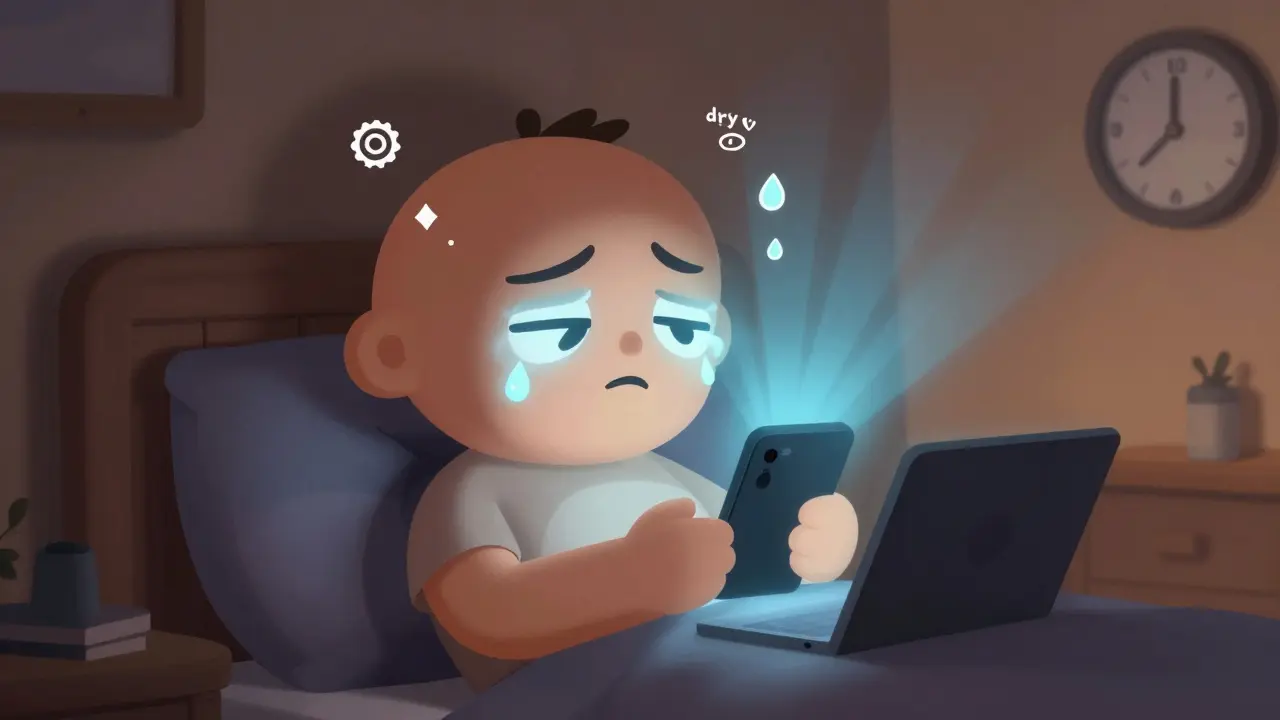
It’s 11 p.m. You’re scrolling on your phone, the screen glowing bright against your bedroom wall. Your eyes feel dry, your head aches, and you can’t sleep no matter how tired you are. You’ve heard about blue light-how it’s bad for your eyes, messes with your sleep, and might even cause permanent damage. But is it true? And if so, what actually helps?
What Is Blue Light, Really?
Blue light isn’t just from your phone. It’s part of natural sunlight-and it’s what keeps you alert during the day. But when you’re staring at screens for hours, especially after sunset, that same light becomes a problem. Blue light refers to wavelengths between 415 and 455 nanometers. It’s high-energy, short-wavelength light that penetrates deep into your eye, past the cornea and lens, all the way to the retina.
Studies show this light can trigger oxidative stress in eye cells. One 2018 NIH review found that 24 hours of exposure to 450 nm blue light at moderate intensity reduced corneal cell viability by over 37%. That’s not a guess-it’s lab data. And it’s not just about damage. Blue light scatters more than other colors, forcing your eyes to work harder to focus. That’s why your vision gets blurry after a long day of screens.
But here’s the twist: blue light isn’t inherently evil. In fact, the American Academy of Ophthalmology says there’s no proof it causes permanent eye damage from screens. So why do so many people feel worse after using devices?
The Real Culprit: Eye Strain and Sleep Disruption
The biggest problems from screen use aren’t retinal burns-they’re eye strain and sleep chaos. You’re not staring at a book. You’re staring at a glowing rectangle, often at arm’s length or closer. Your eyes are constantly adjusting focus. Your blink rate drops from 17 times per minute to just 5. That’s dry eyes waiting to happen.
And then there’s sleep. Blue light suppresses melatonin-the hormone that tells your body it’s time to rest. Harvard research showed that 6.5 hours of blue light at night suppressed melatonin for 105 minutes. Green light? Just 52 minutes. That’s why your phone at bedtime makes you feel wired even when you’re exhausted.
Surveys back this up. A 2022 Vision Council study found 61% of American adults have digital eye strain. Symptoms? Dry eyes (64.7%), blurred vision (52.1%), headaches (48.3%). And 78% of Reddit users who tried the 20-20-20 rule said their eye strain improved. Not magic. Just biology.
Screen Filters: Do They Work?
You’ve seen the ads: blue light glasses, screen protectors, night mode toggles. But not all filters are created equal.
Software filters (like Night Shift on iPhone or f.lux on Windows) reduce blue light by shifting colors toward amber. They’re easy to use. But here’s the catch: they only cut blue light by 10-20%. And they don’t touch the most damaging range-415-455 nm. A 2021 study in Contact Lens and Anterior Eye found they didn’t reduce the peak hazard zone at all.
Hardware filters (physical screen protectors) are better. They block 15-25% of blue light, according to DisplayMate’s 2021 tests. But they can make your screen look dull, and they don’t help if you’re using multiple devices.
Blue light glasses are the most popular. Clear lenses claim to block 10-25%-but independent testing by Consumer Reports found many only block 12%, not the 20% companies promise. Amber-tinted lenses? They block 65-100% of blue light. That’s effective. But they also turn your whole world yellow. A University of Manchester study showed they reduce color accuracy by 8.3%. For designers, photographers, or anyone who needs true colors? Not worth it.
And here’s the kicker: Apple’s iOS 17.4 (released March 2024) introduced adaptive color temperature. It uses your phone’s ambient light sensor to adjust blue light reduction in real time. Independent tests showed it cut melatonin suppression by 37% compared to old Night Shift. That’s a game-changer-built into the device, no glasses needed.
What Actually Works? The Science-Backed Habits
Forget buying the latest filter. The best protection is free and already in your control.
- The 20-20-20 rule: Every 20 minutes, look at something 20 feet away for 20 seconds. A 2021 study in Optometry and Vision Science found this reduced eye strain by over 53%. It’s simple. It works.
- Brighten your room, dim your screen: If your room is dark and your screen is bright, your eyes are working overtime. Match screen brightness to ambient light. The Lighting Research Center found this cuts discomfort by 41%.
- Move your screen: Hold your phone or tablet at least 20 inches away. That reduces focusing demand by 3.7 diopters. For desktop users, sit at least 20-30 inches from the monitor.
- Turn on night mode two hours before bed: University of Toronto research showed this boosts melatonin production by 58%. Don’t just turn it on-make it automatic.
- Use natural light during the day: Get outside for 15-20 minutes in the morning. Sunlight helps regulate your circadian rhythm, making you less sensitive to artificial blue light at night.
One habit alone won’t fix everything. But combining them? That’s where real relief happens.
What About Supplements?
Lutein and zeaxanthin-nutrients found in leafy greens and eggs-are natural filters in your retina. A 2024 study in Nature Communications found that taking 10mg of lutein and 2mg of zeaxanthin daily increased macular pigment density by 0.12. That’s equivalent to wearing 25% blue light-blocking lenses. Not a cure. But a shield.
It takes months to build up. And it won’t replace good habits. But if you’re already eating greens and taking a multivitamin? This is a low-risk, science-backed add-on.
The Future: Built-In Solutions
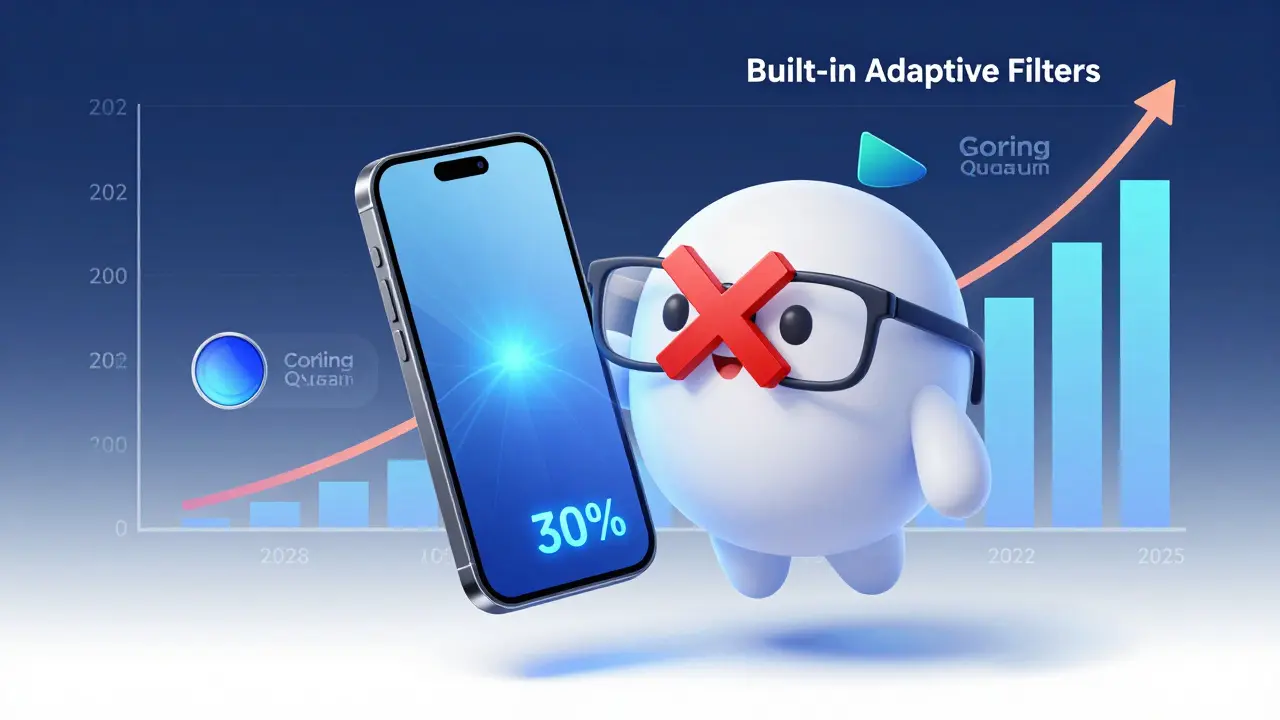
The blue light glasses market hit $3.12 billion in 2022. But here’s the shift: manufacturers are building better screens. OLED displays now reduce blue light emission by 30-40% at the hardware level-no filter needed. Corning’s prototype quantum dot lenses can block 45% of harmful blue light without color distortion. Samsung’s 2025 roadmap aims for 50% reduction with less than 2% color shift.
That means the future isn’t about buying glasses. It’s about buying better devices. And that’s why market analysts predict a 18% annual drop in non-prescription blue light glasses sales by 2028.
Bottom Line: You Don’t Need Fancy Gear
Blue light isn’t a monster. But it’s a real disruptor-especially at night. You don’t need amber glasses or a $50 screen filter to protect your eyes. You need better habits.
Use the 20-20-20 rule. Adjust your screen brightness. Keep your phone at arm’s length. Turn on night mode early. Get morning sunlight. That’s it. The science is clear: these simple changes cut eye strain, improve sleep, and reduce discomfort without costing a dime.
And if you’re still unsure? Try this: go one week without blue light glasses. Just use the 20-20-20 rule and night mode. If your eyes feel better, you’ve already won.
Does blue light from screens cause permanent eye damage?
There is no conclusive evidence that blue light from screens causes permanent damage like macular degeneration or cataracts. While lab studies show high-intensity blue light can stress eye cells, the levels from phones and computers are far below dangerous thresholds. The American Academy of Ophthalmology states that blue light glasses are not necessary for eye health. The real issues are eye strain and sleep disruption-both of which are temporary and reversible.
Are blue light glasses worth buying?
For most people, no. Clear lenses with minimal blue light filtering (10-25%) offer little benefit over software filters. Amber-tinted glasses block more light but distort colors and can interfere with tasks like photo editing or design work. If you have severe digital eye strain and other habits aren’t helping, they might offer relief-but they’re not a magic fix. The 20-20-20 rule and screen brightness adjustments are more effective and free.
How does blue light affect sleep?
Blue light suppresses melatonin, the hormone that signals sleep. Research from Harvard Medical School shows that 6.5 hours of blue light at night delays melatonin release by over 1.5 hours compared to green light. This makes it harder to fall asleep and reduces sleep quality. Turning on night mode two hours before bed can increase melatonin production by 58%, according to University of Toronto studies. Avoiding screens entirely in the hour before bed is even better.
What’s the best way to reduce eye strain from screens?
Use the 20-20-20 rule: every 20 minutes, look at something 20 feet away for 20 seconds. Adjust screen brightness to match room lighting. Keep screens at least 20 inches from your eyes. Blink consciously. Use artificial tears if your eyes feel dry. These steps reduce eye strain by over 50% and are backed by multiple clinical studies. No special glasses needed.
Do I need to use blue light filters on all my devices?
Yes-if you want consistent results. Most people turn on night mode on their phone but forget their laptop, tablet, or smart TV. A 2022 survey found 68% of users failed to apply settings across all devices, which negates the benefits. Set up night mode on every screen you use after sunset. Use automatic scheduling so it turns on without thinking.
Can children be more affected by blue light?
Yes. Children’s lenses are clearer, letting more blue light reach the retina. The French health agency ANSES warns that children under 3 exposed to more than 100 lux of blue light daily may face potential long-term retinal risks. Limit screen time before bed for kids. Use night mode and encourage outdoor play during the day. Natural light helps their developing circadian rhythm.
12 Comments
So blue light’s not evil… but also kinda is? 🤔 My phone’s glow is just my personal nightlight now. I’ve accepted it. Bring on the amber glow, I’m already half-asleep anyway.
This is the kind of post that makes me feel like I finally understand my own body. The 20-20-20 rule? I started doing it last week and my headaches? Gone. Like, poof. Magic? Nah. Just biology being awesome. 🙌
All this science. All these studies. But have you considered that screens are just a distraction from the real problem? The system. The algorithm. The capitalist machine that wants you awake, scrolling, buying, consuming. Blue light? Just the side effect.
I appreciate the data-driven approach here. The most compelling takeaway is not the filters-it’s behavioral change. Consistency matters more than gadgets. Implementing the 20-20-20 rule and ambient lighting adjustments has reduced my digital eye strain by over 60% in three weeks. No product required.
Thank you for presenting evidence without sensationalism. Too many articles paint blue light as a villain when the real issue is behavioral imbalance. The fact that melatonin suppression drops by 58% with night mode two hours before bed is a powerful, actionable insight. I’ve set mine to auto-enable at 8 p.m. - game changer.
You guys are forgetting one thing: the 20-20-20 rule only works if you actually LOOK away. Most people just glance at the wall while still scrolling. I’ve seen it. It’s not a rule, it’s a ritual with no action. Also, blue light glasses? If you’re wearing them and still bingeing TikTok at midnight, you’re not fixing anything.
Loved this. 🌞 Morning sun is my new religion. I go outside for 15 mins before coffee now. My sleep? Deeper. My focus? Sharper. And no, I don’t wear blue light glasses. My eyes don’t need a filter - they need sunlight. Simple. Free. Perfect.
I used to think I needed glasses until I just… started using night mode and keeping my phone farther away. No joke. My eyes stopped burning after like 3 days. I didn’t even know I was squinting. Also, blink more. Seriously. You’re not a robot.
I’m from India and we have a different problem: 80% of kids here use phones in bed after midnight. No night mode. No limits. Their eyes are dry, their sleep is shattered, and parents think it’s normal. This article should be mandatory in schools. We need policy, not just personal habits.
All this ‘science’ and nobody mentions that the real issue is that we’re addicted to our devices. Blue light? Just the excuse. If you can’t put your phone down, no filter in the world will help. Stop blaming the light. Start blaming yourself.
The human eye evolved under the sun not under LEDs and OLEDs and quantum dots and adaptive color temperatures and melatonin suppression metrics and 415 to 455 nanometers and oxidative stress thresholds and clinical studies and peer reviewed journals and behavioral interventions and circadian entrainment and ambient lighting matching and diopter adjustments and blink rate analytics and screen brightness calibration and sleep hygiene protocols and lutein supplementation and macular pigment density and all of this is just a distraction from the truth that we are creatures of rhythm and we have forgotten how to be still and that the real solution is silence and darkness and the absence of glowing rectangles and the return to the primal night where we once dreamed without metrics and without filters and without the need to prove we are doing it right
In India, we don’t need blue light filters. We need better electricity. My phone auto-dims at night because the power cuts out every 3 hours. My eyes are fine. The real problem? Not the screen. It’s the 12-hour workdays and 4-hour commutes and 3 kids screaming and no quiet time. Fix society first.