
Calcium Supplements and Bisphosphonates: How to Avoid Absorption Problems

Bisphosphonate & Calcium Timing Calculator
Calcium supplements can reduce bisphosphonate absorption by up to 94%. Proper timing is essential for your medication to work.
If you're taking bisphosphonates for osteoporosis, and you're also taking calcium supplements, you might be unknowingly reducing the effectiveness of your medication. It’s not that these two things are dangerous together - it’s that calcium literally blocks your body from absorbing the bisphosphonate. And if the drug doesn’t get absorbed, it can’t do its job. That means your bones stay weak, and your fracture risk stays high.
Why Calcium Ruins Bisphosphonate Absorption
Bisphosphonates - drugs like alendronate (Fosamax), risedronate (Actonel), and ibandronate (Boniva) - are designed to slow down bone loss. They work by sticking to bone surfaces and stopping cells that break down bone. But here’s the catch: these drugs are poorly absorbed to begin with. Only about 1% of the pill you swallow actually makes it into your bloodstream. And calcium? It binds to bisphosphonates in your gut like glue. The result? A chemical compound that your body can’t absorb at all. Studies show that taking calcium carbonate (the most common form in supplements) at the same time as alendronate cuts absorption by 94%. Even calcium citrate, which is easier on the stomach, still reduces absorption by 88%. That’s not a small drop - that’s almost total failure. And it doesn’t matter if you take your calcium a few minutes later. If it’s in your system while the bisphosphonate is trying to get absorbed, it interferes.When to Take Your Bisphosphonate
The FDA and major bone health organizations agree on one thing: bisphosphonates must be taken on a completely empty stomach. That means:- No food - not even a cracker
- No coffee, tea, juice, or milk
- No other medications - including vitamins, antacids, or iron pills
- Only plain water
When to Take Calcium Supplements
Now that you know when not to take calcium, here’s when you should: at least two hours after your bisphosphonate. The best time is with dinner. Why dinner? Because your body absorbs calcium better when it’s taken with food, and vitamin D (which helps calcium work) is often taken with meals anyway. Taking calcium at night also helps maintain steady blood levels while you sleep, when bone remodeling naturally occurs. If you take multiple supplements - magnesium, vitamin D, zinc - space them out too. Don’t dump them all into your morning routine. Save them for lunch or dinner. A simple trick: use two pill organizers. Label one “Bisphosphonate - AM Only” and the other “Calcium + Vitamins - PM Only.” Many patients who’ve done this report better adherence and improved bone density.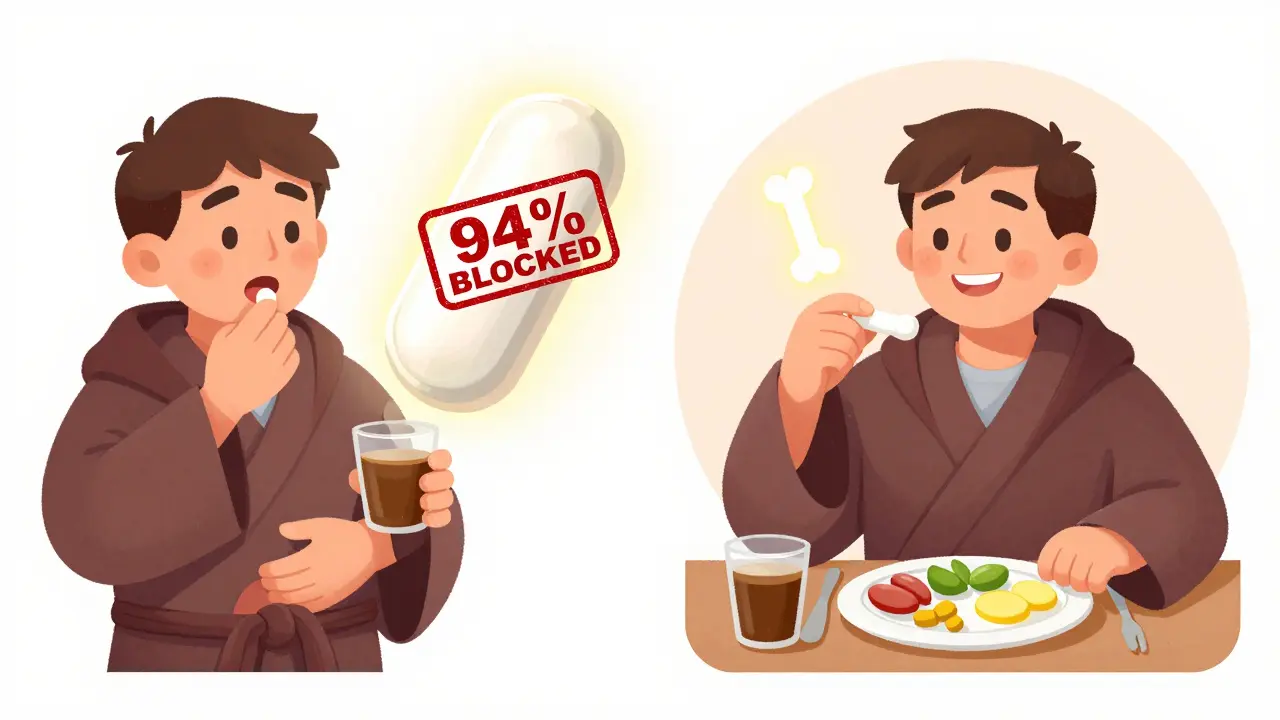
What About IV Bisphosphonates?
If the daily pill routine feels overwhelming, you’re not alone. That’s why many people switch to intravenous (IV) bisphosphonates like zoledronic acid (Reclast). This version is given once a year in a doctor’s office. Since it goes straight into your bloodstream, calcium doesn’t interfere. No fasting. No waiting. No lying down. But there’s a trade-off. About 15-30% of people get flu-like symptoms after the infusion - fever, muscle aches, fatigue - usually lasting 24-48 hours. It’s not dangerous, but it’s uncomfortable. Still, for people who forget pills, have trouble swallowing, or have GERD, IV treatment is often the better choice. In fact, 42% of patients over 75 now get IV bisphosphonates, compared to 28% of younger adults.What If You Messed Up?
You took your bisphosphonate with coffee. You took your calcium 15 minutes later. You forgot to sit up. What now? Don’t panic. Don’t double-dose tomorrow. Just skip today. Wait until tomorrow morning, fast again, and start over. Taking an extra pill won’t fix yesterday’s mistake - it’ll just increase your risk of stomach irritation or ulcers. The goal isn’t perfection every single day. It’s consistency over months and years. A Johns Hopkins case study followed a 79-year-old woman who took her bisphosphonate with her morning calcium pill for 18 months. She thought she was doing everything right - until she broke two vertebrae. Her bone density scans showed no improvement. The medication never got absorbed.Testing and Monitoring
Before starting bisphosphonates, your doctor should check your blood levels for:- 25-hydroxyvitamin D (aim for >30 ng/mL)
- Calcium (should be above 8.5 mg/dL)
- Parathyroid hormone (to rule out overactive glands)
- Phosphorus

Why So Many People Fail
You’d think this would be simple. But here’s the reality: only 42% of patients follow the rules after six months. Why?- 68% of patients say they forget the timing rules
- 52% say their morning coffee routine is too hard to break
- 28% stop because lying upright after taking the pill hurts their esophagus
- 45% get stomach upset when they accidentally take calcium too close
What Actually Works
The good news? Simple fixes make a huge difference.- Patients who got personalized instructions + a follow-up phone call had a 73% adherence rate after a year. Those who didn’t? Only 38%.
- Using a pill organizer labeled “AM” and “PM” boosted adherence by 65% in one study.
- The National Osteoporosis Foundation’s free app sends reminders with exact timing instructions - used by over 28,000 people.
What’s Next?
Drugmakers know the timing problem is a big barrier. New formulations are being tested - like enteric-coated alendronate that can be taken with food. Early results show 38% better absorption. If approved, this could change everything. Until then, the best advice is simple: take your bisphosphonate on an empty stomach with water, wait 30-60 minutes, then eat. Take calcium at night. It’s not glamorous. It’s not exciting. But it’s the only way to make sure the medicine you’re paying for actually works.And if the routine feels impossible? Talk to your doctor about IV options. Your bones don’t care how you get the drug - they just care that you get it.
Can I take calcium and bisphosphonates at the same time?
No. Taking calcium and bisphosphonates together reduces bisphosphonate absorption by up to 94%. Calcium binds to the drug in your gut, forming a compound your body can’t absorb. Always wait at least two hours after taking your bisphosphonate before taking calcium.
What if I take my bisphosphonate with coffee or juice?
Coffee, tea, juice, and even mineral water can reduce bisphosphonate absorption by 50-60%. Only plain water is safe. If you accidentally take it with coffee, skip that dose and wait until tomorrow morning to try again. Don’t double up - it increases your risk of stomach damage.
Do I need to stay upright after taking a bisphosphonate?
Yes. Stay sitting or standing for at least 30 minutes after taking alendronate, or 60 minutes for risedronate and ibandronate. Lying down increases the risk of the pill sticking to your esophagus, which can cause ulcers or inflammation. About 62% of GI side effects happen because patients lie down too soon.
Is it better to take bisphosphonates orally or intravenously?
Oral bisphosphonates are cheaper and effective - but only if taken perfectly. IV versions like zoledronic acid eliminate absorption issues because they go straight into your bloodstream. However, they can cause temporary flu-like symptoms in 15-30% of people. IV is often better for older adults or those who struggle with daily pills.
How long should I fast before taking a bisphosphonate?
You need to fast for at least 8 hours before taking your bisphosphonate. That means no food, no drinks (except water), and no other medications since your last meal. Most people take it right after waking up, before breakfast, to ensure their stomach is truly empty.
What vitamins should I take with bisphosphonates?
Vitamin D is essential - your body needs it to absorb calcium. Take vitamin D with your evening meal, not in the morning. Avoid taking other supplements like magnesium or iron in the morning - wait until after your bisphosphonate waiting period. Only plain water is safe with the drug.
Can I take calcium supplements if I’m on IV bisphosphonates?
Yes. Since IV bisphosphonates enter your bloodstream directly, calcium doesn’t interfere with absorption. However, your doctor will still check your calcium levels before each infusion. Low calcium can cause side effects like muscle cramps or irregular heartbeat after the infusion.
How do I know if my bisphosphonate is working?
Bone density scans (DEXA) are the best way. Most people see improvement after one year of consistent use. If your bone density stays the same or drops, it could mean the drug isn’t being absorbed - possibly because of timing errors. Talk to your doctor if you’re unsure.
If you’ve been taking your bisphosphonate with food or calcium and haven’t seen results, you’re not alone. But fixing the timing can make all the difference. Your bones don’t need magic - they need consistency.
11 Comments
bro just took my fosamax with coffee like a chad and now my esophagus feels like sandpaper lmao
From a clinical pharmacology standpoint, the chelation kinetics between divalent calcium cations and the phosphonate backbone of bisphosphonates are well-documented in the Journal of Bone and Mineral Research. The formation of insoluble Ca-bisphosphonate complexes in the duodenum reduces oral bioavailability by >90%, which is why fasting protocols are non-negotiable. The 30-60 minute window isn't arbitrary-it's the pharmacokinetic sweet spot for gastric emptying before luminal calcium concentrations spike.
What's rarely discussed is the circadian influence on bone remodeling: nocturnal osteoclast activity peaks between 2-4 AM, which is why nighttime calcium dosing enhances mineral incorporation. Also, vitamin D metabolism is PTH-dependent, so timing it with food optimizes intestinal TRPV6 channel upregulation.
And yes, IV zoledronate bypasses all this, but the acute phase reaction? That's IL-6 and TNF-alpha mediated. Don't confuse side effects with inefficacy.
How is it that 58% of patients still can't follow a 30-minute rule? This isn't rocket science-it's basic physiology. The fact that people treat their osteoporosis like a Netflix binge-'I'll do it later'-is why we have a public health crisis in bone fragility. If you can't manage one pill a day with water and a chair, maybe you shouldn't be taking it at all.
in india we just take calcium with dinner and fosamax on empty stomach before chai-works fine. no need to overcomplicate. also, if you're old and can't sit up, just prop yourself with pillows. no one's gonna arrest you for lying down after 45 mins. common sense > guidelines.
I’ve been on alendronate for 4 years and I used to take it with my morning smoothie because I thought ‘it’s just a little fruit’-turns out, the magnesium in spinach and the calcium in almond milk were completely neutralizing the drug. My DEXA scan showed a 3% drop in hip density. I switched to the two-box system-AM for bisphosphonate, PM for everything else-and after 18 months, my spine density went up 5.8%. It’s not sexy, but it works. I also started taking my vitamin D with dinner and noticed fewer night leg cramps. The real issue isn’t the science-it’s the lack of systems. People need visual cues, not lectures. A pill organizer with red and green labels? That’s the real MVP here.
And for the IV crowd-yes, the flu-like symptoms suck, but after the first dose, I just took ibuprofen before the infusion and slept through it. No more worrying about coffee, lying down, or forgetting. If you’re 70+ and juggling 8 meds, IV is the smart play. Your bones don’t care how you get the drug. They just want it.
Also, vitamin D levels matter more than people think. I had mine checked and it was at 21 ng/mL. Once I started 2000 IU nightly, my calcium absorption improved even without changing my bisphosphonate routine. It’s not just timing-it’s the whole ecosystem.
you people are so obsessed with 'timing' and 'protocols' like your bones are some kind of sacred temple... but what if you just... ate real food? like bone broth, leafy greens, sardines? maybe you don't need pills at all. maybe your body just needs to be fed, not dosed. capitalism sold you a pill and now you're addicted to rules.
i took no supplements for 2 years and broke my wrist falling off a bike. guess what? it healed. faster than my aunt's 'perfectly timed' bisphosphonate regimen. maybe the real problem is fear. not osteoporosis.
also i took my calcium with coffee once. and nothing happened. so maybe the science is wrong? or maybe you're just scared to live without a schedule?
Look, I get it. Taking a pill before breakfast, waiting an hour, staying upright-it’s a lot. I used to forget. I used to lie down. I used to think, ‘It’s just one time.’ But here’s the truth: your bones don’t care how hard you try. They only care if you showed up, consistently, over years. I started using a little alarm on my phone: ‘Fosamax-water only-no coffee-sit up.’ I put my PM box on my nightstand next to my toothbrush. Now, every night, I take my calcium and vitamin D like a ritual. And guess what? I haven’t had a fall in 3 years. I’m not ‘cured.’ But I’m not scared anymore. You don’t need to be perfect. You just need to show up. Again. And again. And again. That’s how you win.
so the article says calcium blocks absorption but then says iv bisphosphonates are better... but iv ones cause flu symptoms... so we're just swapping one problem for another? sounds like pharma made a pill that's too hard to use so they made an iv that makes you sick. genius.
so the real villain here isn't calcium... it's the american breakfast. coffee, toast, orange juice, yogurt-this whole morning ritual is a conspiracy to make bisphosphonates useless. next they'll tell us not to breathe oxygen while taking insulin.
also why does everyone assume old people can sit upright for 60 minutes? my grandma has a herniated disc and a cane. she's not doing yoga after her pill. maybe the real solution is not more rules... but better drugs.
took my alendronate with water, waited an hour, had oatmeal. did this for 2 years. bone density stayed the same. switched to IV. got the flu for 2 days. bone density up 7%. worth it. no more stress. no more counting minutes. just go to the clinic once a year. chill.
My mother took hers with milk for 14 years. Broke her hip at 82. They say it was a fall. I say it was a pill.