
CBD Oil and Prescription Medications: Understanding CYP450 Inhibition and Sedation Risks

CBD Interaction Risk Estimator
Select the options that best describe your situation to estimate potential interaction severity.
Check Your Compatibility
Enter your details to see how CBD might interact with your current regimen.
Risk Assessment
Recommended Actions:
You pour your morning coffee, grab your prescription pills, and then reach for that bottle of CBD oil is a popular supplement derived from Cannabis sativa plants, often used for anxiety, pain, or sleep support. It feels like a harmless routine. But inside your liver, a silent chemical traffic jam might be forming. This isn't just theoretical fear-mongering; it’s biochemistry in action. When you combine CBD with certain prescription drugs, you risk dangerous side effects, primarily due to how CBD interferes with the enzymes responsible for breaking down medications.
The core issue lies in a group of liver enzymes known as the cytochrome P450 system. Specifically, CBD acts as an inhibitor of several key isoforms within this system. To understand why this matters, you need to look at what these enzymes actually do. They are the body's primary cleanup crew, metabolizing roughly 70-80% of all clinically used medications. When CBD steps in and blocks their work, drugs stay in your bloodstream longer and at higher concentrations than intended. This can turn a standard dose into an overdose without you even realizing it.
How CBD Blocks Liver Enzymes (CYP450)
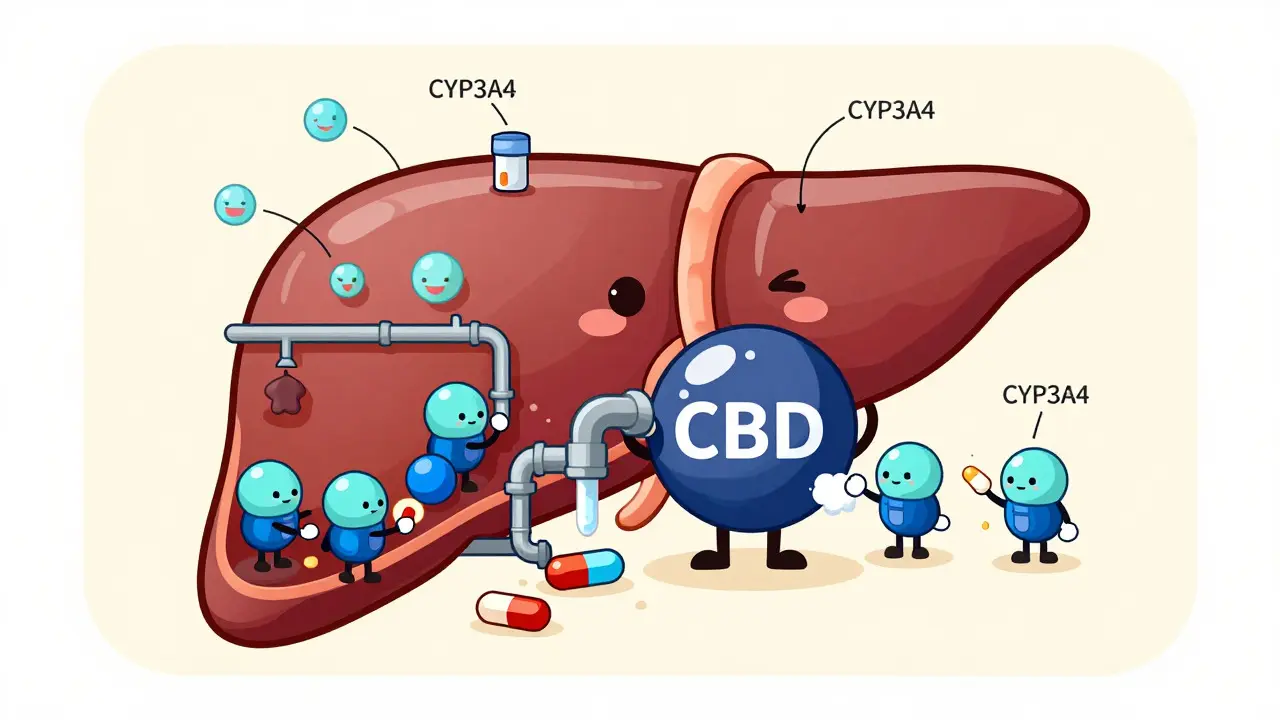
The cytochrome P450 enzyme system is not a single entity but a family of proteins. The most relevant ones for drug interactions are CYP3A4, CYP2C19, CYP2C9, and CYP2D6. Research published in medical journals has established that cannabidiol (CBD) demonstrates broad inhibitory effects on these specific enzymes. Think of it like putting a cork in a drain. If the drain is clogged, the water (your medication) backs up instead of flowing away.
Studies by researchers such as Yamaori et al. have shown that CBD is particularly potent at inhibiting CYP2E1 and CYP2C19. For example, CBD’s inhibition potency against CYP2C19 is significant enough that it affects drugs metabolized by this pathway. This includes many common antidepressants, anti-seizure medications, and blood thinners. The mechanism is competitive inhibition, meaning CBD competes with your medication for the same binding sites on the enzyme. Once CBD occupies those spots, your medication cannot be processed efficiently.
| Enzyme Isoform | Inhibition Potency by CBD | Common Medications Affected |
|---|---|---|
| CYP3A4 | Moderate to High | Statins, calcium channel blockers, some benzodiazepines |
| CYP2C19 | High | Clobazam (Onfi), proton pump inhibitors, some SSRIs |
| CYP2C9 | Moderate | Warfarin (Coumadin), phenytoin, diclofenac |
| CYP2D6 | Moderate | Codeine, tramadol, many beta-blockers |
This table highlights why checking your medication list is crucial. If you take any drug listed under these columns, adding CBD requires caution. The FDA-approved epilepsy drug Epidiolex carries explicit warnings about these interactions because the data is so robust. For instance, co-administration of CBD with clobazam resulted in a 60% increase in plasma concentrations of its active metabolite. That is a massive jump that can lead to severe drowsiness or toxicity.
The Sedation Risk: More Than Just Drowsiness
One of the most immediate and noticeable side effects of CBD-drug interactions is sedation. You might expect this if you take CBD for sleep, but it becomes problematic when combined with other central nervous system depressants. Benzodiazepines like diazepam (Valium) or lorazepam (Ativan), along with opioids and certain antihistamines, rely on efficient metabolism to maintain safe levels in the blood.
When CBD inhibits the enzymes breaking down these drugs, their effects intensify. Patients have reported extreme fatigue, confusion, and difficulty concentrating. A review of adverse events found that a significant portion of sedation-related reports linked to CBD involved patients taking antiepileptic drugs or benzodiazepines. This isn't just about feeling tired; it's about impaired motor function and cognitive slowing, which can be dangerous if you drive or operate machinery.
Consider the case of a patient taking warfarin, a blood thinner metabolized by CYP2C9. While warfarin doesn't cause sedation directly, the interaction here is life-threatening. By inhibiting CYP2C9, CBD causes warfarin levels to spike, increasing the International Normalized Ratio (INR). An INR that gets too high means your blood takes too long to clot, raising the risk of internal bleeding. Real-world patient reports describe INR levels jumping from a therapeutic range of 2.5 to dangerous levels above 5.0 within days of starting CBD. This requires emergency intervention with vitamin K to reverse the effect.
Who Is Most at Risk?
Not everyone who uses CBD will experience a severe interaction, but certain groups face much higher risks. The likelihood of trouble depends on three main factors: the type of medication, the dose of CBD, and individual genetic variations in liver enzyme activity.
- Patients on Narrow Therapeutic Index Drugs: These are medications where the difference between a helpful dose and a toxic dose is very small. Warfarin, phenytoin, and digoxin fall into this category. Even a slight change in metabolism can push you out of the safe zone.
- High-Dose CBD Users: Clinical significance typically emerges at doses above 25 mg per day. Many over-the-counter supplements contain varying amounts, sometimes far more than labeled. Studies show that product purity varies wildly, with actual CBD content ranging from 42% to 121% of what the label claims. This unpredictability makes dosing tricky.
- Polymedicated Individuals: If you take multiple prescriptions, especially those processed by CYP3A4 or CYP2C19, the cumulative load on your liver increases. Adding CBD is like adding another layer of complexity to an already busy system.
It is also worth noting that minor cannabinoids found in full-spectrum oils, such as THC and CBN, also inhibit these enzymes, though generally less potently than pure CBD. However, their presence adds to the overall inhibitory burden. THC, for example, shows strong inhibition of CYP2C19, compounding the effects if you are using full-spectrum products rather than isolates.

Practical Steps for Safe Use
If you want to use CBD while managing prescription medications, you don’t necessarily have to choose one or the other. You just need a strategy. The goal is to mitigate risk through monitoring and communication.
- Consult Your Pharmacist or Doctor: Before buying that bottle, ask a professional. Pharmacists have access to interaction checkers that can flag potential conflicts based on your specific regimen. Don't assume natural means safe.
- Start Low and Go Slow: Begin with the lowest possible dose of CBD. Monitor how you feel and watch for signs of increased side effects from your regular meds, such as unusual bruising, excessive drowsiness, or changes in mood.
- Request Therapeutic Drug Monitoring: For drugs like warfarin or anti-seizure medications, ask your doctor to check blood levels more frequently after starting CBD. Measuring trough levels within 3-5 days of initiation can catch dangerous spikes early.
- Stagger Timing: While this doesn't eliminate metabolic inhibition, separating the administration of CBD and your medication by 2-4 hours may help manage peak concentration overlaps, though clinical evidence for this is limited compared to dose adjustment.
- Choose Reputable Brands: Look for products with third-party lab testing (Certificates of Analysis). Knowing the exact amount of CBD you are consuming helps you and your provider calculate risks more accurately.
Healthcare providers are increasingly recognizing these issues. Organizations like the American Society of Health-System Pharmacists now recommend avoiding concurrent use of CBD with narrow therapeutic index drugs unless closely monitored. Some clinicians suggest alternative cannabinoids like CBG (cannabigerol), which appears to have less impact on CYP enzymes, though research on this is still emerging.
Future Outlook and Regulatory Changes
The landscape is shifting. As the global CBD market expands, regulatory bodies are catching up. The FDA has issued warning letters to companies failing to disclose drug interaction risks. In Europe, guidelines now require cannabinoid medicines to include CYP450 interaction data on labels. We are likely to see more standardized testing and clearer labeling in the coming years.
Research is also exploring ways to reduce these interactions. Scientists are developing nanoparticle delivery systems that might bypass some of the hepatic metabolism, potentially lowering the risk of enzyme inhibition. Until then, vigilance is your best defense. Understanding that CBD is pharmacologically active-not just a benign wellness trend-is the first step toward using it safely alongside your health care plan.
Does CBD interact with blood pressure medication?
Yes, CBD can interact with many blood pressure medications, particularly calcium channel blockers and some ACE inhibitors, because they are metabolized by CYP3A4. This interaction can cause blood pressure to drop too low (hypotension), leading to dizziness or fainting. Always monitor your blood pressure closely when starting CBD.
Is isolate safer than full-spectrum CBD regarding drug interactions?
Potentially. Full-spectrum CBD contains other cannabinoids like THC and CBN, which also inhibit liver enzymes. CBD isolate contains only cannabidiol, removing the additive inhibitory effects of other compounds. However, CBD itself is a potent inhibitor, so interactions are still possible with isolate, just potentially less complex.
How quickly do CBD drug interactions occur?
Interactions can begin within days of starting CBD. Because CBD accumulates in the body and steadily inhibits enzymes, you may notice increased side effects from your prescription drugs within the first week. Blood tests for drugs like warfarin should be done within 3-5 days of initiation to detect changes.
Can CBD stop working if I take other medications?
While CBD is primarily an inhibitor, some medications can induce liver enzymes, speeding up CBD's breakdown. This could theoretically reduce CBD's effectiveness. However, the more common and dangerous scenario is CBD inhibiting the breakdown of your prescription drugs, leading to toxicity.
What symptoms indicate a serious CBD-medication interaction?
Watch for unusual bleeding or bruising (with blood thinners), extreme drowsiness or confusion (with sedatives), rapid heartbeat or irregular pulse (with heart meds), and severe nausea or vomiting. If you experience these, seek medical attention immediately and inform your provider about your CBD use.