
Constipation from Medications: A Complete Management Guide

Medication Constipation Risk Analyzer
Select Your Medications
Check all medications you are currently takingPain & Nerve Medications
Allergy & Sleep Aids
Heart & Blood Pressure
Other Common Medications
How This Works
This tool analyzes the combined effect of your medications on gut motility based on their known mechanisms of action. It considers receptor binding, neurotransmitter blocking, and smooth muscle relaxation effects documented in clinical studies.
Risk Categories
Your Constipation Risk Profile
Risk Assessment
Key Statistics
Recommended Treatment Strategy
Imagine taking a pill to fix one problem, only to create another that makes you miserable. You take an opioid for pain, an antihistamine for allergies, or a calcium channel blocker for blood pressure, and suddenly your digestive system grinds to a halt. This is medication-induced constipation, defined as infrequent bowel movements with hard stools caused by pharmaceutical interventions altering gastrointestinal motility. It’s not just an annoyance; it’s a physiological blockade that affects millions of patients daily. If you’re struggling with this, you aren’t alone, and more importantly, you don’t have to accept it as an inevitable side effect.
Why Your Gut Slows Down on Medication
To manage the problem, you first need to understand the mechanism. Your gut doesn't just sit there; it moves food along using complex nerve signals and muscle contractions. Many medications interfere with these signals directly. When Dr. John C. McDonald published his seminal work in the Journal of Clinical Investigation in 1974, he highlighted how drugs could systematically alter these processes. Today, we know that different drug classes attack the digestive system in specific ways.
Opioids are perhaps the most notorious offenders. They bind to μ-opioid receptors in the gut, essentially putting the nerves to sleep. As Dr. Braden Kuo from Massachusetts General Hospital explains, "the narcotic effect can cause nerves in the gut to 'sleep,' inhibiting movement." This reduces gastric emptying and peristalsis, leading to increased fluid absorption and rock-hard stools. According to StatPearls (NCBI Bookshelf, 2023), medication-induced constipation affects approximately 40-60% of patients receiving opioids for non-cancer pain.
Anticholinergics, including first-generation antihistamines like diphenhydramine (Benadryl), block acetylcholine, a neurotransmitter essential for muscle contraction. Studies in the journal Gastroenterology (2020) show this can decrease peristalsis and secretions by 30-40%. Similarly, antipsychotics like clozapine impair motility through a combination of anticholinergic and dopaminergic activity, slowing transit by 25-35% (Psychopharmacology Bulletin, 2022). Even common heart medications like calcium channel blockers (e.g., diltiazem) relax smooth muscle in the GI tract, slowing transit time by 20-25% (American Journal of Gastroenterology, 2021).
| Drug Class | Mechanism of Action | Impact on Gut Motility | Prevalence of Constipation |
|---|---|---|---|
| Opioids | Binds to μ-opioid receptors, inhibiting nerve signals | Reduces peristalsis, increases fluid absorption | 40-60% of users |
| Anticholinergics | Blocks acetylcholine | Decreases peristalsis and secretions by 30-40% | 25-30% of users |
| Calcium Channel Blockers | Relaxes smooth muscle | Slows transit time by 20-25% | Varies by drug (5-15%) |
| Iron Supplements | Causes oxidative stress and inflammation | Disrupts microbiota, slows transit by 25-30% | Common side effect |
The Fiber Myth: Why More Isn't Always Better
If you’ve been told to eat more fiber when you’re constipated, you might be doing things backward. For medication-induced constipation, bulk-forming laxatives like psyllium (Metamucil) are often ineffective. In fact, they can make things worse. Because your gut isn't moving properly, adding more bulk without stimulating movement can lead to bloating and impaction. GoodRx clinical analysis (2023) suggests that bulk-forming agents may worsen symptoms by 10-15% in these cases.
Dietary interventions alone-such as aiming for 25-30g of fiber daily plus 2-3 liters of fluids-provide only 20-30% efficacy for medication-induced constipation. However, when combined with appropriate laxatives, efficacy jumps to 60-70% (MedCentral, 2023). The key is matching the treatment to the mechanism. If your gut is "asleep" due to opioids, fiber won't wake it up. You need a stimulant or a targeted receptor antagonist.

Targeted Treatments: Matching Laxatives to Drugs
Effective management requires a strategic approach based on what medication is causing the issue. One size does not fit all here.
Opioid-Induced Constipation (OIC)
For opioids, standard laxatives often fail because they don't address the receptor-mediated blockade. The American Gastroenterological Association (2021) recommends Peripheral μ-Opioid Receptor Antagonists (PAMORAs) like methylnaltrexone bromide (Relistor) for patients who fail conventional treatments. These drugs block opioid receptors in the gut without affecting pain relief in the brain. Clinical trials involving 713 patients showed that Relistor increases spontaneous bowel movements by 30-40% within 4 hours (Relistor.com, 2023). For those who cannot access PAMORAs, a combination of osmotic laxatives (polyethylene glycol/PEG) and stimulant laxatives (sennosides) shows 50-60% efficacy (Journal of Neurogastroenterology and Motility, 2022).
Anticholinergic and Antipsychotic Induced Constipation
When anticholinergics are the culprit, switching to alternative therapies is often the best move. For example, loratadine (Claritin) causes constipation in only 2-3% of users, compared to 15-20% for diphenhydramine (GoodRx, 2023). For antipsychotics like clozapine, which carry a risk of severe ileus, proactive laxative use is critical. CancerCare community forums indicate that 65% of patients using clozapine require daily laxatives, yet 40% report inadequate relief with standard over-the-counter options.
Calcium Channel Blockers and Diuretics
With calcium channel blockers, the choice of drug matters. Amlodipine causes constipation in 5-7% of patients, whereas verapamil affects 10-15% (MedCentral, 2023). Switching to a less impactful agent within the same class can sometimes resolve the issue. For diuretics, dehydration is the main driver. Loop and thiazide diuretics reduce available water by 15-20%, creating dry stools. Ensuring adequate hydration and monitoring potassium levels (hypokalemia reduces peristalsis by 10-15%) is essential (Mayo Clinic, 2023).
Proactive Management: Prevention Over Cure
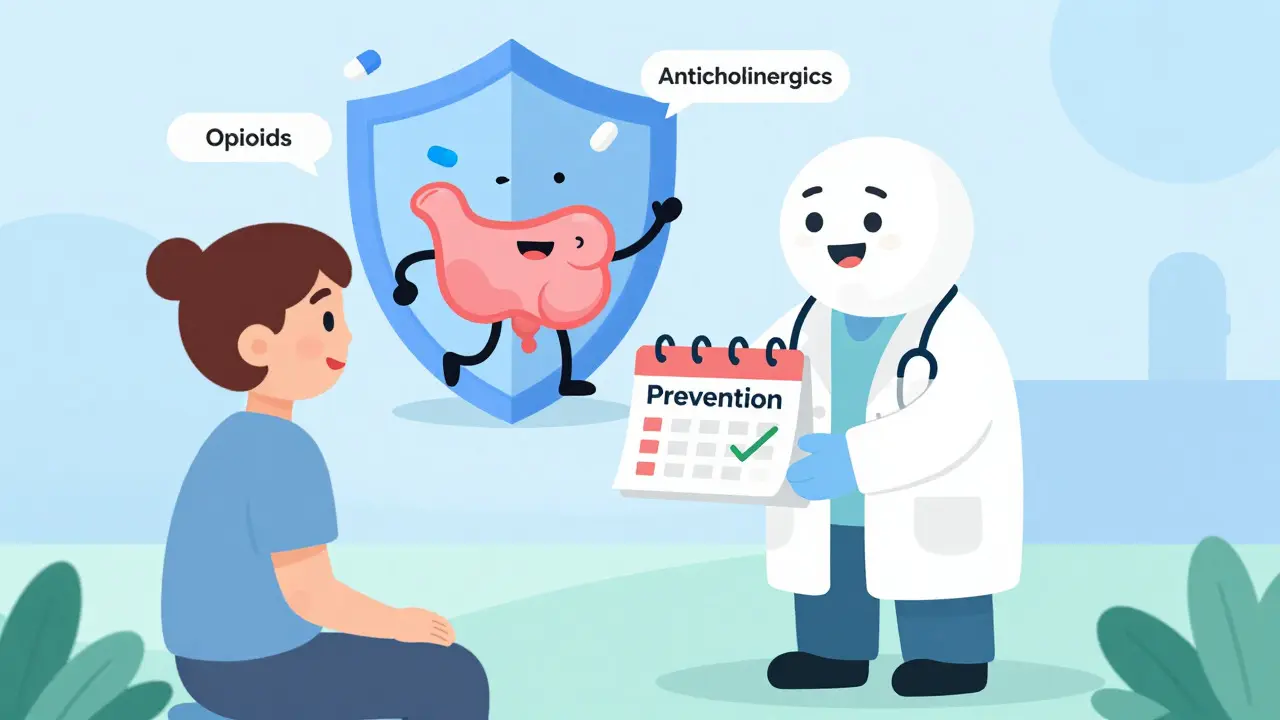
Waiting until you are constipated to start treatment is a common mistake. Mayo Clinic surveys (2023) found that 60% of patients wait for symptoms to develop before acting. Instead, prophylactic laxatives should begin simultaneously with high-risk medications. BC Cancer clinical guidelines (2022) recommend starting sennosides (17-34mg daily) immediately upon initiating opioid therapy. This proactive approach prevents the buildup of hardened stool and maintains regularity.
Electronic health record systems are beginning to reflect this shift. Mayo Clinic’s automated risk assessment system reduced medication-induced constipation incidence by 30% by triggering alerts for high-risk combinations (Mayo Clinic Proceedings, 2023). Until your doctor implements such systems, you must advocate for yourself. Ask about constipation prevention when starting new medications.
Navigating Costs and Access
While PAMORAs are highly effective, they come with significant cost barriers. Relistor averages $1,200/month without insurance (GoodRx price checks, October 2023). This financial burden leads many patients to suffer unnecessarily or discontinue necessary pain medication. On Reddit's r/ChronicPain, 78% of surveyed users reported discontinuing opioids due to constipation before trying PAMORAs (2023 data). If cost is an issue, discuss generic alternatives or combination therapies with your pharmacist. Sennosides and PEG are inexpensive and widely available, offering a viable backup plan.
Future Directions in Gut Health
The field is evolving rapidly. Newer PAMORAs like naloxegol (Movantik) and naldemedine (Symproic) have expanded options for chronic non-cancer pain. Looking ahead, microbiome-targeted therapies show promise. Seres Therapeutics' SER-287, currently in Phase 2 trials, has demonstrated a 40-50% improvement in medication-induced constipation symptoms (ClinicalTrials.gov NCT04822995). Personalized algorithms that assess individual risk factors are also emerging, promising more tailored and effective care in the near future.
What is the fastest way to relieve medication-induced constipation?
For opioid-induced constipation, Peripheral μ-Opioid Receptor Antagonists (PAMORAs) like methylnaltrexone (Relistor) provide the fastest relief, often within 4 hours. For other types, a combination of osmotic laxatives (like polyethylene glycol) and stimulant laxatives (like sennosides) typically works within 24-48 hours.
Does fiber help with medication-induced constipation?
Not always. Bulk-forming fibers like psyllium can worsen symptoms if gut motility is severely impaired, as they add volume without stimulating movement. Fiber is most effective when combined with adequate fluids and appropriate laxatives, but it should not be relied upon as a standalone solution for medication-related issues.
Which medications are most likely to cause constipation?
Opioids, anticholinergics (including some antihistamines and antidepressants), calcium channel blockers, iron supplements, and certain antipsychotics are among the most common culprits. Opioids affect 40-60% of users, while anticholinergics affect 25-30%.
Should I stop taking my medication if it causes constipation?
Never stop prescribed medication without consulting your doctor. Instead, ask for a management plan. Your provider may adjust the dosage, switch to a different drug within the same class, or prescribe a preventive laxative regimen to mitigate the side effect.
How long does it take for laxatives to work for medication-induced constipation?
Stimulant laxatives like senna usually work within 6-12 hours. Osmotic laxatives like polyethylene glycol may take 1-3 days. PAMORAs specifically designed for opioid-induced constipation can work within 4 hours. Consistency is key; these are often needed daily while on the offending medication.