
Counterfeit Drugs in Developing Nations: How Fake Medicines Are Killing People and What Can Be Done
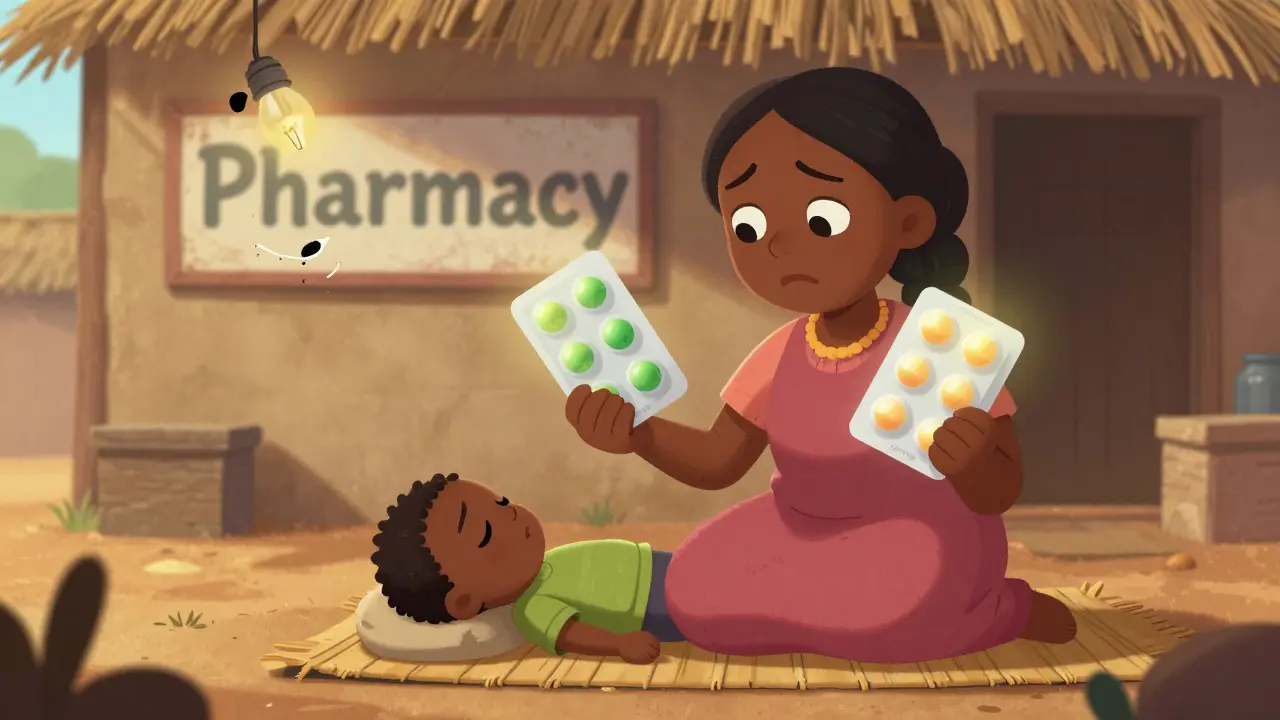
Every year, tens of thousands of people in developing nations die because they took a pill that looked real but contained nothing but flour, chalk, or worse - toxic chemicals. These aren’t rumors. They’re facts backed by the World Health Organization, Interpol, and peer-reviewed studies. In some parts of Africa and Southeast Asia, counterfeit drugs make up more than half the supply of life-saving medicines like malaria treatments and antibiotics. And the people buying them? They’re not criminals. They’re mothers, farmers, students - people who can’t afford real medicine and trust the packaging because it looks identical to the real thing.
What Exactly Are Counterfeit Drugs?
The WHO draws a clear line between two types of dangerous medicines: substandard and falsified. Substandard drugs are real products that failed quality checks - maybe they were stored in heat, expired, or were made with poor ingredients. Falsified drugs are outright frauds. They’re made to look like the real thing, but they’re not. They might have no active ingredient at all. Or they might have too little. Or they might have something deadly mixed in - like industrial solvents or rat poison.
Here’s what you’re actually getting when you buy a fake:
- 30% have zero active ingredient - meaning they do absolutely nothing.
- 45% have the wrong dose - too little to work, or too much to be safe.
- 25% contain toxic substances - chemicals that cause organ failure, seizures, or long-term damage.
And the packaging? It’s terrifyingly accurate. Interpol found that 90% of counterfeit pills mimic the real brand’s color, logo, foil seals, and even batch numbers. Some are now printed with 3D technology so precise that even pharmacists can’t tell the difference without lab equipment.
Why Is This Happening in Developing Nations?
This isn’t random. It’s a perfect storm of poverty, weak regulation, and global supply chain gaps.
In many low-income countries, a single course of real antimalarial drugs can cost $10-$15. The same fake version? $1-$2. For families living on $2 a day, the choice isn’t between safe and unsafe - it’s between life and death, and the fake drug looks like the only option.
At the same time, regulatory agencies in places like Nigeria, Pakistan, or Cambodia are underfunded, understaffed, and often lack the tools to test medicines. Some rural clinics don’t even have electricity, let alone spectrometers to analyze pills. Meanwhile, the global supply chain for medicines passes through five or more middlemen before reaching a village pharmacy. Each handoff is a chance for substitution.
And the criminals? They’re smart. They target high-demand drugs - antibiotics, heart meds, cancer treatments - because they’re expensive and people will pay anything for them. In 2024, the Pharmaceutical Security Institute recorded over 6,400 incidents of counterfeit drug operations across 136 countries. The profit margin? Up to 9,000%. Compare that to bank robbery: lower risk, higher reward.
The Human Cost: More Than Just a Number
Numbers like “72,000 child deaths from pneumonia” or “116,000 malaria deaths” sound abstract. But behind each one is a story.
In 2012, over 200 people in Lahore, Pakistan died after being given heart medication that contained a toxic chemical used in industrial cleaners. The pills came from a hospital supply chain - not a street vendor. People trusted the system.
In Nigeria, a mother posted on Reddit in March 2025: “My brother died of malaria last year after taking counterfeit Coartem. The pharmacy had no way to verify authenticity.”
In Kenya, a nurse reported that 50% of the malaria test kits in her rural clinic were fake - meaning patients were being misdiagnosed and given the wrong treatment. Some were sent home with nothing, while others got antibiotics they didn’t need, fueling drug resistance.
And it’s not just deaths. It’s long-term damage. When people take fake antibiotics that don’t kill all the bacteria, they create superbugs. The WHO says drug resistance from counterfeit medicines is now a top global health threat - worse than many epidemics because it makes real treatments useless.

Who’s Making These Drugs?
China produces 78% of the high-quality counterfeit medicines found globally. These aren’t backyard operations. They’re organized crime networks with factories, logistics teams, and even marketing departments. They copy the exact fonts, packaging materials, and even the smell of the blister packs.
But the distribution is local. Bangladesh, Lebanon, Syria, and Türkiye act as regional hubs, shipping fake drugs into neighboring countries where regulation is weakest. Once they cross borders, they move through informal markets, street vendors, and even licensed pharmacies that don’t know they’re selling fakes.
And now, criminals are using AI. In 2024, 15% of counterfeit packages were generated using AI tools that mimic real labels, batch codes, and even QR codes. These can fool basic verification apps unless they’re linked to a secure database - which most developing countries don’t have.
What’s Being Done? The Good, the Bad, and the Ugly
There are solutions - but they’re not reaching the people who need them most.
Blockchain tracking is one of the most promising tools. Pfizer has used it since 2004 to track 302 million doses and stop them from entering illegal markets. In 2025, the WHO launched the Global Digital Health Verification Platform, using blockchain to trace medicines from factory to patient. It’s working - in 27 countries, the system has cut counterfeit sales by 40%.
Mobile verification is another win. In Ghana, the mPedigree system lets people text a code from the pill package to a free number and get an instant reply: “Real” or “Fake.” It’s simple, cheap, and works on any phone. Over 15,000 people have used it. One user wrote: “The SMS verification saved my child’s life.”
But here’s the catch: only 28% of people in low-literacy areas can use these systems without help. And in rural clinics without electricity, mobile phones often don’t charge. Solar-powered verification devices are being rolled out in 12 African countries - and they work 85% of the time. But they’re still rare.
Meanwhile, most countries don’t have any system at all. Only 22% of pharmacies in low-income nations use any kind of verification tool. In the U.S. and Europe? It’s 98%.
Why Don’t Governments Do More?
The Medicrime Convention, an international treaty to fight fake medicines, has been signed by 76 countries. But only 45 have turned it into law. Why? Because enforcing it costs money - and most governments are too broke to fix their own health systems, let alone police medicine imports.
Plus, corruption plays a role. In some places, customs officials are paid to look the other way. Pharmacists who report fake drugs risk losing their licenses or worse. And when a country’s own drug manufacturers are involved - as happened in Pakistan in 2012 - the system protects itself.
The WHO says countries spend $30.5 billion a year on fake or substandard medicines. That’s money that could build clinics, hire nurses, or train doctors. Instead, it’s vanishing into criminal pockets.

What Can Be Done - Right Now?
There’s no single fix. But here’s what works:
- Train community health workers to spot fake packaging - even without tools. Simple things like checking for misspellings, uneven printing, or mismatched batch numbers can catch 30% of fakes.
- Expand free mobile verification like mPedigree. It costs less than $0.01 per check. If scaled across Africa and South Asia, it could save millions.
- Make real medicines cheaper. Governments and NGOs need to negotiate bulk pricing for essential drugs. If a malaria treatment costs $1 instead of $10, people won’t risk the fake.
- Use solar-powered verification kits in clinics. These cost under $200 and can test 100 pills a day. They’re already working in remote areas of Uganda and Malawi.
- Pressure global regulators. The EU’s new 2026 initiative will send $250 million to strengthen supply chains in 30 developing nations. That’s a start - but it needs to be faster and broader.
The most important thing? Don’t assume the problem is “over there.” Fake drugs are in global supply chains. A pill made in China can end up in a pharmacy in Texas, London, or Nairobi. The only way to stop this is global cooperation - not just in labs and borders, but in public awareness.
What You Can Do
If you’re buying medicine online - even from a “trusted” site - check the pharmacy’s license. If it doesn’t have a verifiable physical address and a licensed pharmacist on staff, walk away. The FDA says 96% of online pharmacies selling to Americans are illegal.
If you’re in a developing country and you suspect a medicine is fake - report it. Even if you don’t know how. Talk to a clinic. Call a health hotline. Share your story. Social media is already doing this: over 12,000 posts with #FakeMedicine were made in early 2025 - and they’re starting to get attention.
This isn’t about blame. It’s about survival. Every fake pill is a missed chance to heal someone. And every time we ignore it, we let the criminals win.
How common are counterfeit drugs in developing countries?
According to the World Health Organization, about 1 in 10 medicines in low- and middle-income countries are substandard or falsified. In some regions - like parts of West Africa and Southeast Asia - the rate jumps to 30% or higher for critical drugs like antimalarials and antibiotics.
Are fake medicines only sold on the black market?
No. Many counterfeit drugs enter正规 pharmacies and even public hospitals through corrupt supply chains. In Pakistan in 2012, over 200 people died from fake heart medicine distributed through a government hospital. The packaging was perfect - no one knew it was fake until it was too late.
Can I tell if a medicine is fake just by looking at it?
Sometimes - but not reliably. While some fakes have blurry text or wrong colors, 90% of modern counterfeits look identical to the real thing. Even trained pharmacists can’t spot them without lab equipment. Don’t rely on visual checks alone.
Why don’t governments just ban fake drugs?
Many governments lack the funding, staff, or technology to test medicines at scale. In rural areas, clinics may not have electricity or internet. Corruption also plays a role - some officials are paid to ignore fake drugs. And without strong laws and penalties, criminals keep operating.
Are there any safe ways to verify medicine online?
Yes. Systems like mPedigree and the WHO’s new Global Digital Health Verification Platform let you text a code from the medicine package to check its authenticity. These are free, work on basic phones, and have saved lives in Ghana, Nigeria, and Kenya. Look for these services in your country’s health ministry website.
How do counterfeit drugs cause drug resistance?
When fake antibiotics contain too little active ingredient, they don’t kill all the bacteria. The survivors become stronger and multiply. This creates superbugs that don’t respond to real drugs. The WHO says this is now a major reason why diseases like malaria and tuberculosis are getting harder to treat.
What’s the difference between a substandard and a falsified drug?
A substandard drug is made by a legitimate manufacturer but failed quality control - maybe it expired or was stored wrong. A falsified drug is a fake - made intentionally to deceive. It’s not just bad; it’s criminal.
Is it safe to buy medicines from online pharmacies?
Only if the pharmacy is licensed and has a physical address you can verify. The FDA says 96% of online pharmacies selling to Americans are illegal and likely sell fake or dangerous drugs. Always check for a verified pharmacy seal and a licensed pharmacist on staff.
What’s Next?
The World Health Organization aims to cut counterfeit drug rates to below 5% by 2027. That’s possible - but only if countries invest in verification tech, train frontline workers, and make real medicines affordable. The technology exists. The will doesn’t always.
Every time someone buys a fake drug, they’re not just risking their life - they’re helping a criminal network grow. And every time someone uses a verification code, reports a fake, or pushes for change, they’re saving lives.
This isn’t a problem for someone else to fix. It’s a global emergency - and it needs everyone’s attention.
10 Comments
I’ve seen this firsthand in rural Kenya last year. A neighbor’s child died after taking what looked like real Coartem. The pharmacy had a sign that said ‘WHO Approved’ - but the packaging had a tiny typo in the logo. No one noticed until it was too late.
It’s heartbreaking how the same people who can’t afford real medicine are the ones most likely to trust the fake ones because they look so good.
Let’s be brutally honest: this isn’t about ‘poverty’ or ‘regulation.’ It’s about human stupidity. People buy counterfeit drugs because they’re lazy, ignorant, and refuse to educate themselves. You don’t need a spectrometer to check if a pill’s packaging has a glossy sheen that’s slightly off - but apparently, you do need one to understand that.
The real tragedy isn’t the criminals - it’s the fact that millions would rather gamble with their lives than spend five minutes Googling how to verify a drug. This is a self-inflicted pandemic of ignorance.
YOU KNOW WHAT THIS IS? IT’S COLONIALISM 2.0. Big Pharma and Western governments sit in their ivory towers, charging $10 for malaria pills while ignoring the fact that people in Africa and South Asia are literally dying because they can’t afford the price tag - then they act shocked when someone buys a $1 fake?
And now they want us to trust blockchain apps? On phones that don’t charge? In villages without electricity? This isn’t innovation - it’s performative virtue signaling with a side of white savior complex.
Stop pretending tech is the answer. Fix the pricing. Make real drugs affordable. Or stop pretending you care.
Look, I am from India and I have seen this problem for many years. In small towns, people buy medicine from roadside shops because the hospital is 50 kilometers away and the bus fare costs more than the medicine. The fake pills are made by local people who are poor too, not big Chinese factories. The real issue is that no one gives them a better option.
When the government gives free medicine, people take it. When it is expensive, they take the fake. It is not about trust, it is about survival. You can talk about blockchain all day, but if someone is hungry and their child is feverish, they will take the pill that costs one rupee, even if it is made of sugar and chalk. The system is broken, not the people.
China is running the whole show here. 78% of counterfeits come from them. Why are we letting them get away with this? We should sanction every Chinese pharmaceutical company involved. Ban their exports. Cut off trade. This isn’t a ‘global supply chain issue’ - it’s a national security threat. Fake medicine is chemical warfare against the developing world, and our government is doing nothing.
And don’t give me that ‘affordability’ crap. If you can’t afford real medicine, you shouldn’t be buying it at all. That’s not a reason to enable criminals - that’s a reason to get on welfare or move to a country that actually works.
Thank you for writing this. I work with a nonprofit in Ghana that distributes solar-powered verification kits. We’ve seen families cry when they find out a medicine is fake - not because they’re angry, but because they’re relieved they didn’t give it to their child.
The real heroes aren’t the tech or the laws - they’re the community health workers who walk miles to teach people how to check batch numbers. We need to fund them, not just the shiny apps.
It’s ironic. We live in an age where you can verify the origin of a diamond or a coffee bean with your phone - but you can’t verify a lifesaving pill unless you’re in a lab.
The problem isn’t the fake drugs. It’s that we treat medicine like a commodity instead of a human right. If insulin were treated like water, no one would be dying from counterfeit versions. We’ve normalized suffering because we’ve normalized profit.
One sentence: mPedigree saved my cousin’s life in Nigeria - she texted the code, got ‘Fake,’ and went to the clinic. She’s alive today because someone made it simple.
Thank you for the detailed breakdown. I’ve been researching this for a university project and was struck by how many of the proposed solutions - like solar verification kits - are already working but remain underfunded and underpublicized.
What’s missing isn’t technology, but coordination. If NGOs, governments, and even pharmaceutical companies could share data on counterfeit hotspots in real time, we could deploy resources before outbreaks happen. Right now, it’s all reactive - and people keep dying while systems wait for permission to act.
Also, I’d love to see more stories like the one from the Kenyan nurse. Personal testimony drives change more than statistics ever could.
One thing I’ve learned from working with rural clinics in Peru: people aren’t dumb for buying fake drugs - they’re rational. When your income is $1.50 a day and the real drug costs $12, choosing the $1 version isn’t ignorance - it’s economic calculus.
What if instead of blaming them, we built a system where the real drug costs $1.50? That’s what happened in Rwanda with HIV meds - bulk purchasing, local production, government subsidies. Deaths dropped by 70% in three years.
It’s not about tech. It’s about will. And if we have the will to send rockets to Mars, we have the will to save lives here.