
Dextromethorphan and MAOIs: What You Need to Know About the Dangerous Cough Syrup Interaction
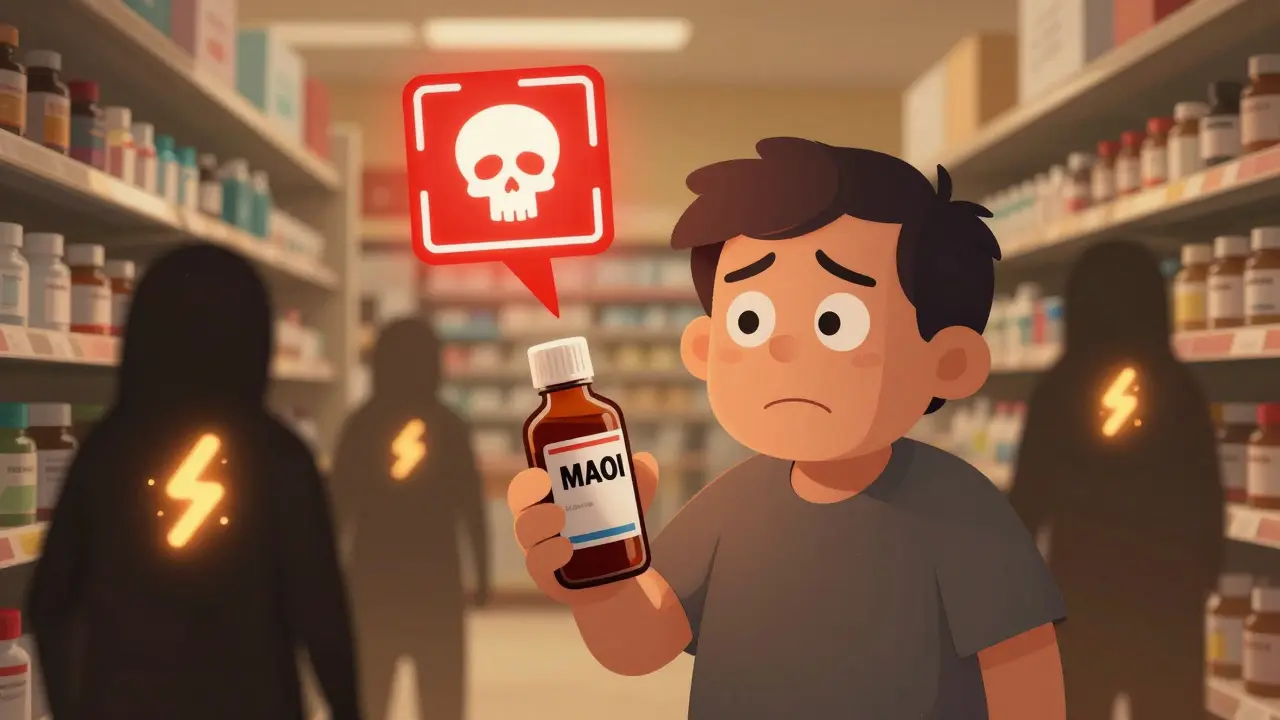
It’s easy to grab a bottle of cough syrup when you’re sick. You’re congested, your throat hurts, and you just want to sleep. But if you’re taking an MAOI antidepressant - even if you’ve been on it for years - that little bottle could be hiding a silent killer. The combination of dextromethorphan and MAOIs isn’t just risky. It’s life-threatening. And most people have no idea.
What’s in Your Cough Syrup?
Dextromethorphan is the most common cough suppressant in over-the-counter medicines. You’ll find it in Robitussin, Delsym, NyQuil, TheraFlu, and dozens of other brands. It’s been used since 1958, and for decades, it was considered harmless. But here’s the catch: dextromethorphan doesn’t just calm your cough. It also blocks serotonin reuptake in your brain. That means it makes more serotonin available where it shouldn’t be.Now imagine you’re on an MAOI - a medication like phenelzine (Nardil), tranylcypromine (Parnate), rasagiline (Azilect), or selegiline (Zelapar). These drugs were developed in the 1950s to treat depression, and they work by stopping your body from breaking down serotonin, norepinephrine, and dopamine. They’re powerful. And they’re not going away. About 1.2 million Americans still take them today.
Put them together? Your brain gets flooded with serotonin. Not a little extra. Not a slight bump. A dangerous, uncontrolled surge. That’s called serotonin syndrome. And it doesn’t wait around.
What Is Serotonin Syndrome?
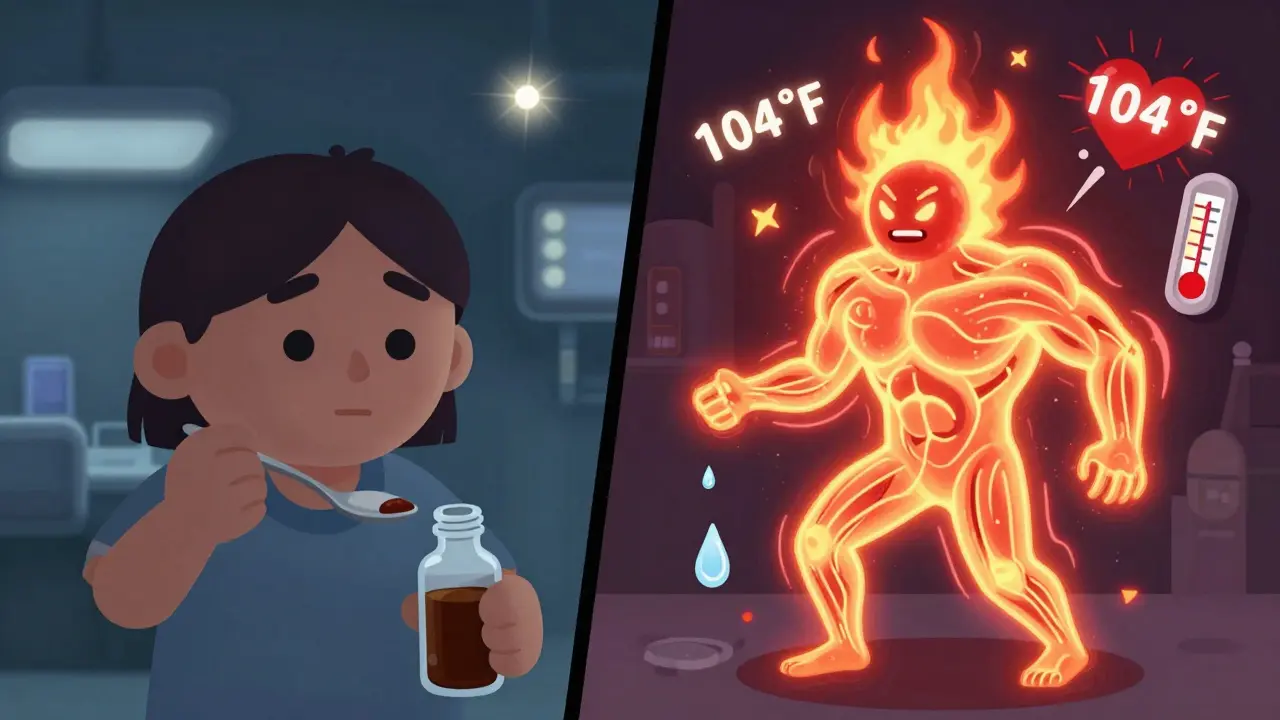
Serotonin syndrome isn’t just a bad headache or a weird feeling. It’s a medical emergency. Symptoms can show up in as little as 6 hours after taking dextromethorphan while on an MAOI. They include:- High fever (104°F or higher)
- Severe muscle stiffness or twitching
- Fast heart rate, high blood pressure
- Confusion, agitation, hallucinations
- Shivering, sweating, tremors
- Nausea, vomiting, diarrhea
- In severe cases: seizures, loss of consciousness, death
According to a 2022 review in the PMC journal, between 2% and 12% of people who develop severe serotonin syndrome die from it. That’s not a small risk. That’s a real, measurable danger. And it’s not rare. Between 2010 and 2022, the FDA’s own database recorded 237 cases linked to dextromethorphan and MAOIs. Over 40% of those patients ended up in the hospital.
One Reddit user on r/MAOI described taking a cold medicine while on selegiline. Within hours: confusion, muscle rigidity, fever over 104°F. They barely made it to the ER. Another patient on PatientsLikeMe said they couldn’t speak clearly after taking Parnate and a cough syrup. ER doctors told them they were lucky to survive.
Why This Interaction Is So Dangerous
It’s not just about serotonin. The body’s metabolism plays a role too. Dextromethorphan is broken down by an enzyme called CYP2D6. MAOIs can slow this process down. That means more of the cough suppressant stays in your system - up to 400% more, according to clinical studies. You don’t even need to take a full dose. A single teaspoon of liquid cough syrup can be enough to trigger a reaction.And it’s not just MAOIs. If you’re also taking fluoxetine, paroxetine, or even some heart medications like quinidine, your risk goes up again. These drugs also block CYP2D6. So even if you’re careful about MAOIs, another pill in your medicine cabinet could make things worse.
Doctors and pharmacists have known about this since 1976. That’s when the FDA’s nonprescription cough and cold panel first warned the public. But here’s the problem: most people don’t know.
How Many People Are at Risk?
A 2019 survey found that 78% of patients on MAOIs didn’t realize common cough medicines contained dextromethorphan. That’s nearly four out of five people. And it’s not because they’re careless. It’s because the warnings on the bottles are often hidden.A 2021 analysis by the Institute for Safe Medication Practices found that only 38% of dextromethorphan product labels clearly show the MAOI warning. Some use tiny print. Others bury it in a list of “other ingredients.” The FDA tried to fix this in 2010 after 27 deaths between 2000 and 2009. But enforcement is still weak.
Pharmacists are the last line of defense. A 2021 study showed that when pharmacists took the time to counsel MAOI patients about OTC meds, accidental interactions dropped by 67%. That’s huge. But most pharmacies don’t have time for that. A busy prescription line, a rushed patient, a quick “take this with food” - and the warning gets lost.
What Should You Do?
If you’re on an MAOI, here’s what you need to do right now:- Check every cough, cold, and flu medicine you own. Look for “dextromethorphan” on the label. It’s not always obvious. It might be listed as “DM” or “DXM.”
- Don’t take any dextromethorphan product - ever. Not even once. Not even if you feel fine. The risk doesn’t go away after a few days. The FDA and other agencies say you must wait at least 14 days after your last MAOI dose before taking it. Some experts recommend 2 weeks after stopping the MAOI, and 2 weeks before starting it again.
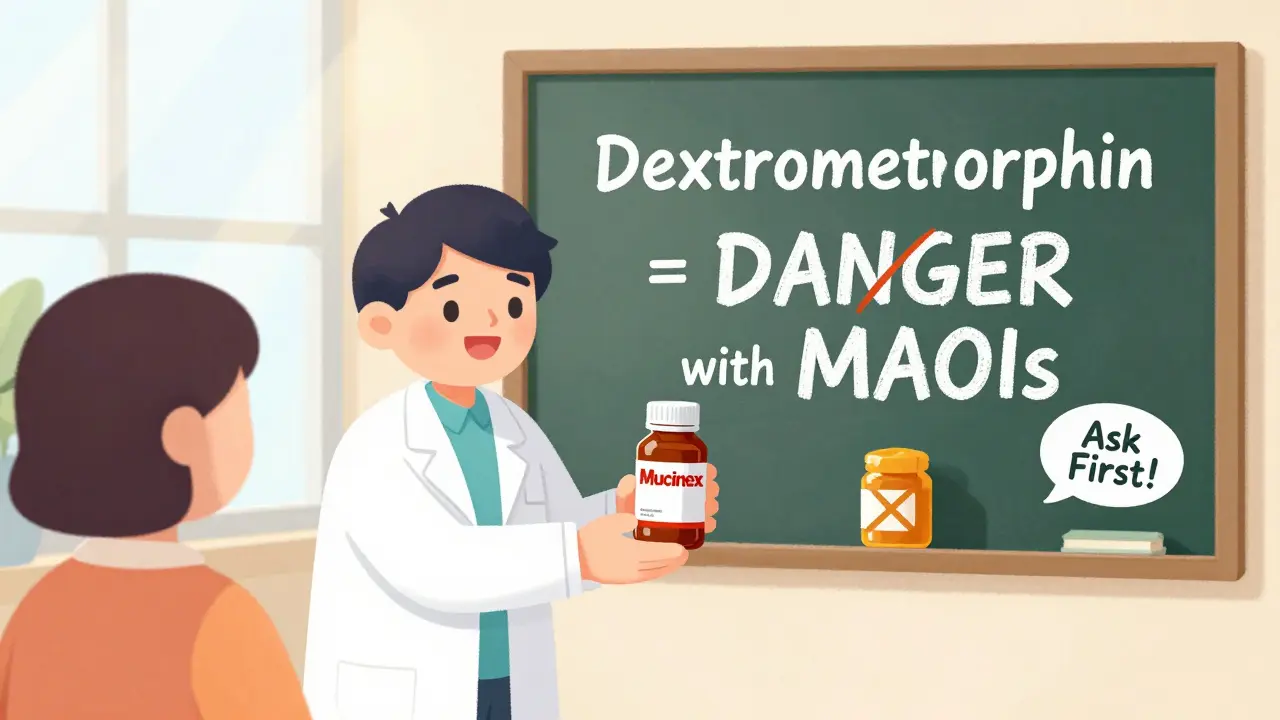
- Ask your pharmacist. Bring your medication list. Say: “I’m on an MAOI. What cough and cold medicines are safe?” They’ll know. Most have access to drug interaction databases.
- Use alternatives. Guaifenesin (Mucinex) is safe - it’s an expectorant, not a suppressant. Honey (one or two teaspoons) works better than dextromethorphan for coughs, according to the Cochrane Review. But avoid honey products that claim to have “natural ingredients” - some contain tyramine, which can also interact with MAOIs.
What If You Accidentally Took Both?
If you took dextromethorphan while on an MAOI and feel off - even slightly - go to the ER. Don’t wait. Don’t call your doctor tomorrow. Don’t try to sleep it off. Serotonin syndrome can kill you before the drug leaves your system. Emergency treatment includes:- Stopping both drugs immediately
- IV fluids and cooling measures for high fever
- Medications like cyproheptadine (a serotonin blocker) to reverse the effects
- Intensive care if breathing or heart function is affected
There’s no home remedy. No “just wait it out.” If you’re having tremors, confusion, or a fever over 102°F - call 911.
What’s Changing?
The good news? Awareness is growing. In 2022, the FDA proposed new rules to require larger, bolder warnings on all dextromethorphan products. Implementation is expected by late 2024. The European Medicines Agency now requires printed patient guides listing every brand name that contains dextromethorphan. And researchers are finding that newer MAOIs like moclobemide - a reversible type - have far fewer interactions. Only one case has been reported in combination with dextromethorphan, compared to over 180 with older MAOIs.But until those changes fully roll out, the risk is real. And it’s not going away. With MAOI use up 22% since 2020 for treatment-resistant depression, more people are being prescribed these drugs. And more people are reaching for cough syrup.
Final Warning
This isn’t a “maybe” or a “probably.” This is a clear, documented, deadly interaction. The science is solid. The data is public. The deaths have been recorded. You don’t need to be an expert to understand this: if you’re on an MAOI, dextromethorphan is off-limits. No exceptions. No exceptions for “just one dose.” No exceptions for “I didn’t know.”Read your labels. Talk to your pharmacist. Keep your medicine cabinet clean. Your life might depend on it.
12 Comments
For years I thought OTC meds were harmless. Then my mom ended up in the ER after taking NyQuil with her MAOI. She didn’t even know dextromethorphan was in it. The label said 'cough suppressant' like it was sugar water. No bold warnings. No red flags. Just tiny print buried under 'active ingredients.' This isn’t negligence-it’s systemic failure. We need mandatory, visible labeling. Not just for MAOIs, but for every high-risk combo. Lives depend on clarity, not fine print.
Oh please. Another fearmongering post. People have been taking cough syrup with MAOIs for decades and nobody died. It’s not a chemical bomb. It’s a myth amplified by overzealous doctors and Reddit panic. My cousin took Delsym for a week while on Parnate and she’s fine. Maybe your body’s just weak? Or you’re allergic to common sense?
I’m so grateful this was posted 💙 I’ve been on selegiline for 3 years and never knew about this. I used to grab Robitussin every winter like clockwork. Now I keep Mucinex and honey on hand. Also-honey works better than DM anyway. Who knew? 🤯 Thank you for the clarity. This saved me from a nightmare.
so i just checked my cabinet and yeah i had 3 bottles with dextromethorphan in them i threw them all out today. no regrets. also i asked my pharmacist and she gave me a printed list of safe meds. she even wrote it in marker on a sticky note. i cried. thank u pharmacist. thank u internet. thank u life.
Here’s the truth: MAOIs are powerful. Dextromethorphan is sneaky. The combo? Deadly. No drama. No 'maybe.' Just math: serotonin overload + inhibited metabolism = ICU. Stop being casual. Read labels. Talk to your pharmacist. If you don’t, you’re not just risking your life-you’re risking a slow, terrifying death. And you won’t get a second chance.
Oh wow. Another ‘you’re all going to die’ post. I’m shocked. Shocked I tell you. 🤡 Next up: ‘Don’t breathe near a toaster if you’re on Zoloft.’ This isn’t medicine-it’s performance art. Someone get this guy a TED Talk. And maybe a therapist.
Interesting. In India, dextromethorphan is often sold without prescription. But MAOI use is rare here. Still, I’ve seen patients take cough syrups with antidepressants and no one warns them. This issue is global. Education matters more than labels. We need community health talks. Not just warnings on bottles.
As a clinical pharmacist with over 20 years in practice, I can confirm: this interaction is among the most under-recognized and lethal in outpatient care. We routinely counsel MAOI patients, but many clinics lack protocols. I’ve seen three cases in my career. Two were fatal. The third, a 72-year-old woman, survived only because her daughter noticed the tremors and called 911 within 90 minutes. This is not hypothetical. It is happening now.
thank you thank you thank you!!! i’ve been on nardil for 5 years and i thought i was being careful… but i didn’t know about the cyp2d6 thing!! now i’m checking every single thing i take!! i’m gonna print this out and tape it to my fridge!!
Imagine. Imagine, if you will, the quiet horror of a body slowly betraying itself-muscles locking like steel, temperature climbing beyond human tolerance, consciousness slipping like sand through fingers. No scream. No warning. Just a cough syrup. One teaspoon. One moment of ignorance. One life, erased. This isn’t a medical footnote. It’s a tragedy waiting in every pharmacy aisle. And we’re still letting it happen.
Here in Tamil Nadu, we use herbal cough remedies more than OTC. But when people do use syrups, they don’t read labels. They trust the brand. This is a global blind spot. Maybe we need community pharmacists to visit homes in rural areas. Or maybe radio announcements in local languages. Education can’t wait for FDA rules.
While the dangers of dextromethorphan in combination with MAOIs are well-documented, it is also critical to acknowledge that not all MAOIs are created equal. Reversible inhibitors like moclobemide demonstrate significantly reduced interaction potential. Furthermore, newer formulations of cough suppressants are emerging that exclude dextromethorphan entirely. Advocacy for regulatory reform must be paired with innovation. We must not only warn-we must also provide safe alternatives.