
Dual Antiplatelet Therapy: Managing Bleeding Side Effects

When you’ve had a heart attack or a stent placed in your artery, doctors often prescribe dual antiplatelet therapy - or DAPT - to keep your blood from clotting and causing another crisis. It’s a powerful combo: aspirin plus a P2Y12 inhibitor like clopidogrel, prasugrel, or ticagrelor. Together, they cut your risk of another heart attack or stent clot by up to 30%. But there’s a catch. Every time you take these drugs, you’re also increasing your chance of bleeding - sometimes seriously. And that’s where things get tricky.
Why DAPT Works (and Why It Bleeds)
DAPT stops platelets from sticking together. Platelets are tiny blood cells that rush to seal cuts. But in narrowed arteries, they can also form dangerous clots. Aspirin blocks one pathway; the P2Y12 drug blocks another. Double protection = fewer heart attacks. But your body doesn’t know the difference between a clot in your artery and a cut on your finger. So when you bump your arm, or brush your teeth too hard, or even get a nosebleed, your blood doesn’t clot the way it used to.
The numbers are real. In the PLATO trial, patients on DAPT had a 1-2% higher chance of major bleeding than those on aspirin alone. That might sound small, but major bleeding means hospitalization, blood transfusions, or even death. And it’s not just big bleeds. Minor ones - like bruising easily, bleeding gums, or frequent nosebleeds - are common. In fact, the TALOS-AMI trial found that over 15% of patients on ticagrelor-based DAPT had what’s called “nuisance bleeding”: not dangerous, but annoying enough to make people stop taking their meds.
Who’s at Highest Risk?
Not everyone on DAPT bleeds. But some people are far more likely to. The guidelines now use a tool called the PRECISE-DAPT score to measure your bleeding risk. If your score is 25 or higher, you’re in the high-risk group. What pushes you there?
- Age 75 or older
- History of bleeding (even a GI bleed from years ago)
- Low hemoglobin (anemia)
- Chronic kidney disease (creatinine clearance under 60)
- Taking blood thinners like warfarin or apixaban
- Platelet count below 100,000
One study found that patients with two or more of these factors had a 4% or higher chance of life-threatening bleeding within a year. That’s why doctors now check your score within 24 hours of getting a stent. If you’re high risk, your treatment plan changes.
Which DAPT Drug Is Right for You?
Not all P2Y12 inhibitors are equal. They differ in strength, speed, and bleeding risk.
| Drug | Dose | Strength | Major Bleeding Risk vs. Clopidogrel | Ischemic Event Reduction |
|---|---|---|---|---|
| Clopidogrel | 75 mg daily | Moderate | Baseline | 10-15% lower than newer agents |
| Ticagrelor | 90 mg twice daily | High | +27% | Higher than clopidogrel |
| Prasugrel | 10 mg daily (5 mg if ≥75 or <60 kg) | High | +20% | Similar to ticagrelor |
Here’s the trade-off: ticagrelor and prasugrel work faster and stronger. That means better protection against heart attacks - but more bleeding. Clopidogrel is gentler on your body, but less effective at preventing clots. If you’re young and healthy, the stronger drugs often win. If you’re older, have kidney issues, or have bled before, clopidogrel might be safer.
Shortening DAPT: The New Standard for High-Risk Patients
For years, everyone got 12 months of DAPT after a stent. But research changed that. The MASTER DAPT trial (2022) showed that for high-risk patients, just one month of DAPT - then switching to aspirin alone - cut major bleeding by nearly 7% over two years. And guess what? Heart attacks didn’t go up. Same with the Onyx ONE trial: 1-month DAPT was as safe as 12 months for bleeding, but much safer.
Now, the ACC/AHA guidelines say: if you’re high risk, you don’t need a full year. In fact, you might be better off with less. Some patients even get just 14 days of DAPT before switching to single therapy. This isn’t cutting corners - it’s precision medicine.
De-escalation: Switching to a Safer Drug
What if you started on ticagrelor because you had a big heart attack, but now you’re stable? You might not need the strongest drug anymore. The TALOS-AMI trial showed that switching from ticagrelor to clopidogrel after one month cut major bleeding by 2.1% - without raising the risk of another heart attack. That’s a win. Many doctors now do this: start strong, then switch down. It’s like using a sledgehammer to break a rock, then switching to a chisel to shape it.
And it works. Patients who de-escalated reported better quality of life. One survey found a 15-point jump on the Seattle Angina Questionnaire - meaning less chest pain, more energy, less fear.

What to Do If You Bleed
Minor bleeding? Nosebleed that lasts 10 minutes? Bruise the size of a palm? Don’t panic. But do call your doctor. Don’t stop your meds on your own. Stopping DAPT too early - especially before six months - can triple your risk of stent clotting. That’s deadly.
For major bleeding - vomiting blood, black tarry stools, sudden dizziness, swelling from a bruise - go to the ER. Hospitals have protocols. For patients who had a stent within the last three months, they’ll restart DAPT as soon as you’re stable. If it’s been 3-6 months and you’re high risk, they might switch you to aspirin alone.
Platelet transfusions? Only for life-threatening bleeding in people who took clopidogrel in the last five days. One unit can restore 30% of clotting ability in two hours. But for ticagrelor or prasugrel? There’s no antidote. That’s a big problem. Unlike warfarin (which has vitamin K and fresh plasma) or dabigatran (which has idarucizumab), we have no drug to reverse ticagrelor. It wears off on its own - in 1-3 days. So prevention is everything.
What You Can Do at Home
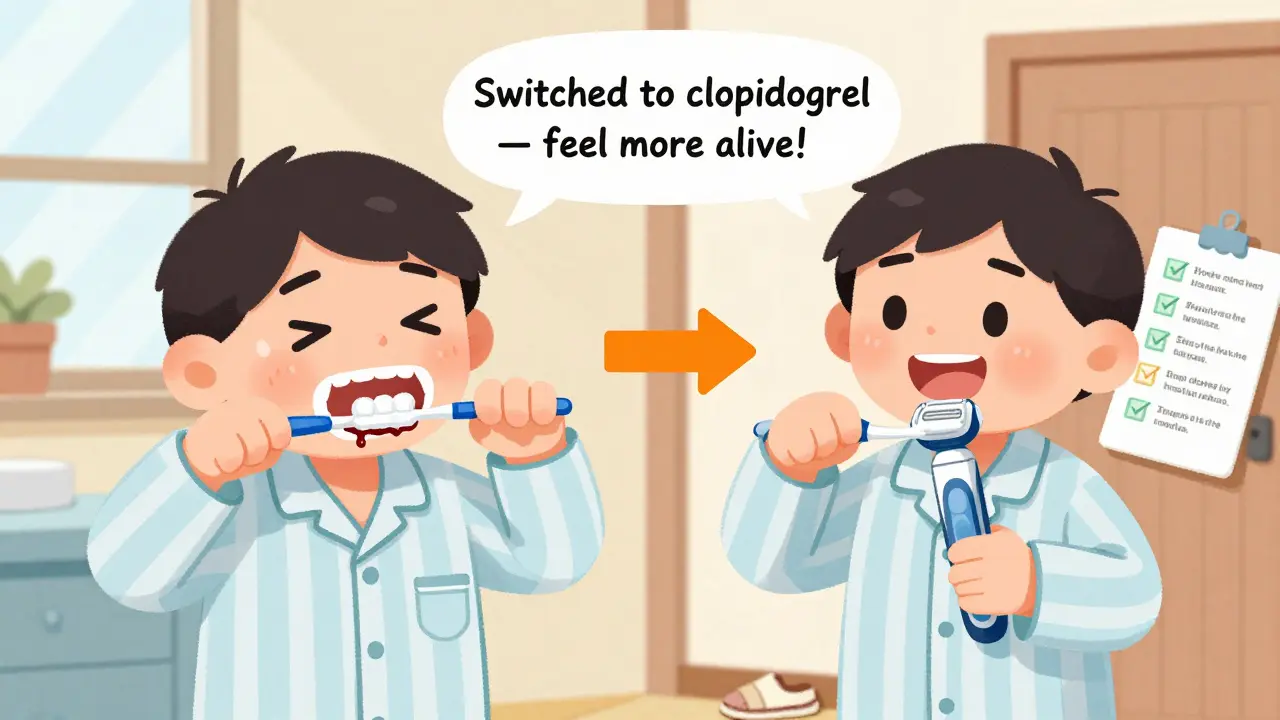
- Use a soft toothbrush. Avoid flossing too hard.
- Use an electric razor instead of a blade.
- Wear shoes indoors to avoid cuts.
- Don’t take NSAIDs like ibuprofen or naproxen. They worsen bleeding. Use acetaminophen instead.
- Tell every doctor, dentist, or surgeon you’re on DAPT - even for a simple procedure.
- Track your bleeding: keep a log of nosebleeds, bruising, or unusual fatigue.
And if you’re feeling anxious about bleeding? You’re not alone. A 2022 survey found 68% of DAPT patients with minor bleeding worried about daily life. Some avoided social events. Others stopped exercising. But patients who switched to clopidogrel or shortened their DAPT period reported feeling more confident - and more alive.
The Future: Personalized DAPT Is Coming
Right now, we’re still guessing a lot. But the future is data-driven. The DAPT-PLUS registry is tracking 15,000 patients with machine learning to predict who bleeds and who doesn’t. By 2028, doctors will use AI to decide your exact DAPT duration - not based on age or guesswork, but on your real-time risk profile.
And there’s hope for reversal agents. Two new drugs are in early trials - one uses a protein to block ticagrelor, another uses an aptamer (a synthetic molecule) to neutralize it. If they work, we’ll finally have a way to turn off DAPT in emergencies. That’s a game-changer.
For now, the message is clear: DAPT saves lives - but it’s not one-size-fits-all. Your doctor should be talking to you about your bleeding risk, your drug choice, and your plan to shorten or switch therapy. If they’re not, ask. You deserve a plan that protects your heart - without making you afraid to live.
Can I stop DAPT if I’m bleeding too much?
Never stop DAPT on your own. Stopping too early - especially before 6 months - raises your risk of stent clotting by 2 to 3 times. If you’re bleeding, contact your doctor immediately. They may switch you to a safer drug, shorten the duration, or switch to aspirin alone - but only under medical supervision.
Is clopidogrel safer than ticagrelor?
Yes, clopidogrel causes less bleeding than ticagrelor - about 30-40% less. But it’s also less effective at preventing heart attacks. For low-risk patients, clopidogrel is often preferred. For high-risk patients or those with severe blockages, the stronger drugs may be worth the extra bleeding risk - especially if you can de-escalate later.
How long should I stay on DAPT after a stent?
For standard-risk patients, 6 to 12 months is typical. For high bleeding risk patients (score ≥25), 1 to 3 months may be enough. The 2022 MASTER DAPT trial showed that 1-month DAPT followed by aspirin alone was just as safe for preventing heart attacks - and cut bleeding by nearly 7%. Your doctor should use your PRECISE-DAPT score to decide.
Can I take ibuprofen while on DAPT?
No. Ibuprofen, naproxen, and other NSAIDs increase bleeding risk and can interfere with aspirin’s effect. Use acetaminophen (Tylenol) for pain or fever instead. Always check with your doctor before taking any new medication - even over-the-counter ones.
Do I need to get my platelet levels tested?
No. Major guidelines, including those from the French Working Group and the ACC, say routine platelet testing doesn’t improve outcomes. It’s expensive, unreliable, and not proven to help manage bleeding. Doctors should rely on clinical risk scores - like PRECISE-DAPT - not lab tests.
Managing DAPT isn’t about avoiding risk - it’s about balancing it. Your heart needs protection. Your body needs to heal. The right plan does both. Talk to your doctor. Ask questions. Know your numbers. And don’t let fear stop you from living - just make sure you’re doing it safely.
10 Comments
DAPT is just another pharmaceutical racket. They make you take two drugs so you need three more to fix the side effects. Bleeding? That's just the body telling you you're being poisoned. I stopped mine after 3 weeks. No stent clot. No hospital. Just freedom. Trust your body, not the guidelines.
The PRECISE-DAPT score is statistically sound but clinically lazy. You're aggregating risk factors like they're independent variables when in reality, renal dysfunction + age + anemia creates a nonlinear bleeding trajectory. The MASTER DAPT trial? Underpowered for subgroups. We need dynamic risk modeling, not binary cutoffs. Also, ticagrelor's half-life is 7-12 hours? That's not 'reversible'-that's just delayed toxicity. We need pharmacokinetic monitoring, not patient self-reporting.
This is an incredibly thoughtful and comprehensive overview. I appreciate how you emphasized the balance between ischemic protection and bleeding risk. Many patients are terrified of bleeding, but equally afraid of stopping their meds. The de-escalation strategy is a game-changer, and the data supporting shorter durations for high-risk patients is reassuring. Thank you for highlighting that this isn't about fear-it's about informed, individualized care.
I had a stent in 2021 and was on ticagrelor. Within 3 weeks, I was bleeding from my gums every morning, had bruises on my thighs from sitting on the couch, and once woke up with blood in my snot. My doctor said 'it's normal.' Normal?! I started Googling and found out there's NO ANTIDOTE. I switched to clopidogrel. I'm alive. My wife says I'm not as pale anymore. I didn't have another heart attack. So yeah. Listen to your body. And if your doctor says 'it's normal,' ask for a second opinion. Or three.
I just want to say: thank you for writing this. So many patients feel abandoned when they start bleeding. We’re told ‘it’s just bruising,’ or ‘it’s just a nosebleed,’ but it’s not just a symptom-it’s a signal. The fact that you included practical tips-soft toothbrush, electric razor, acetaminophen-means so much. I’ve shared this with my support group. We’re not just patients. We’re people trying to live. And this? This helps us live better.
Okay, I need to vent for a second because I just had to explain to my 78-year-old dad why he can't take ibuprofen for his arthritis anymore. He said, 'But it worked for years!' And I said, 'Dad, you're on DAPT, and if you bleed out in the middle of the night, I'm not going to be able to find your blood type in the dark!' He stared at me like I was speaking Klingon. Then he asked if he could still drink whiskey. I said no. He said, 'Then what's the point?' I didn't answer. I just hugged him. And cried. Because this isn't a medical chart. It's a life. And we're all just trying to hold on.
I'm a nurse who works in cardiac care. I see this every day. The patients who thrive aren't the ones who followed the guidelines perfectly. They're the ones who asked questions. Who kept logs. Who told their dentist. Who switched to clopidogrel after a month and felt like they could breathe again. The system is broken, but we can still be human. If you're reading this and you're scared? You're not alone. Talk to your provider. Bring this article. Ask for the PRECISE-DAPT score. You've got this.
AMERICA NEEDS TO STOP BEING SO FRAGILE 🇺🇸💉 DAPT ISN'T A HUG. IT'S A SHIELD. IF YOU BLEED, YOU WERE WEAK. WEAKNESS ISN'T A MEDICAL CONDITION. WEAKNESS IS A CHOICE. SWITCH TO ASPIRIN? NO. SWITCH TO STRENGTH. NO MORE CRYING OVER BRUISES. NO MORE WHINING ABOUT GUMS. WE DON'T NEED ANTIDOTES. WE NEED DISCIPLINE. STAY ON THE DRUG. STAY STRONG. AMERICA STANDS TALL. STENT OR NOT. WE DON'T QUIT. 🇺🇸🔥
I used to be the guy who took everything at face value. Then I got a stent. Then I bled. Then I learned. The truth? There’s no perfect answer. Just better trade-offs. I started on ticagrelor. Got a nosebleed every Tuesday. Switched to clopidogrel after 4 weeks. No more bleeding. No more heart attack. Same outcome. Different path. My point? Your body isn't a lab rat. It's yours. Listen. Adapt. Don't let anyone tell you your fear is irrational. It's data.
The data is clear. PRECISE-DAPT >15. De-escalate. Clopidogrel. Aspirin monotherapy. No need for extended DAPT. Evidence-based. Simple. Done.