
FibroScan vs Serum Scores: A Practical Guide to Noninvasive Liver Fibrosis Tests
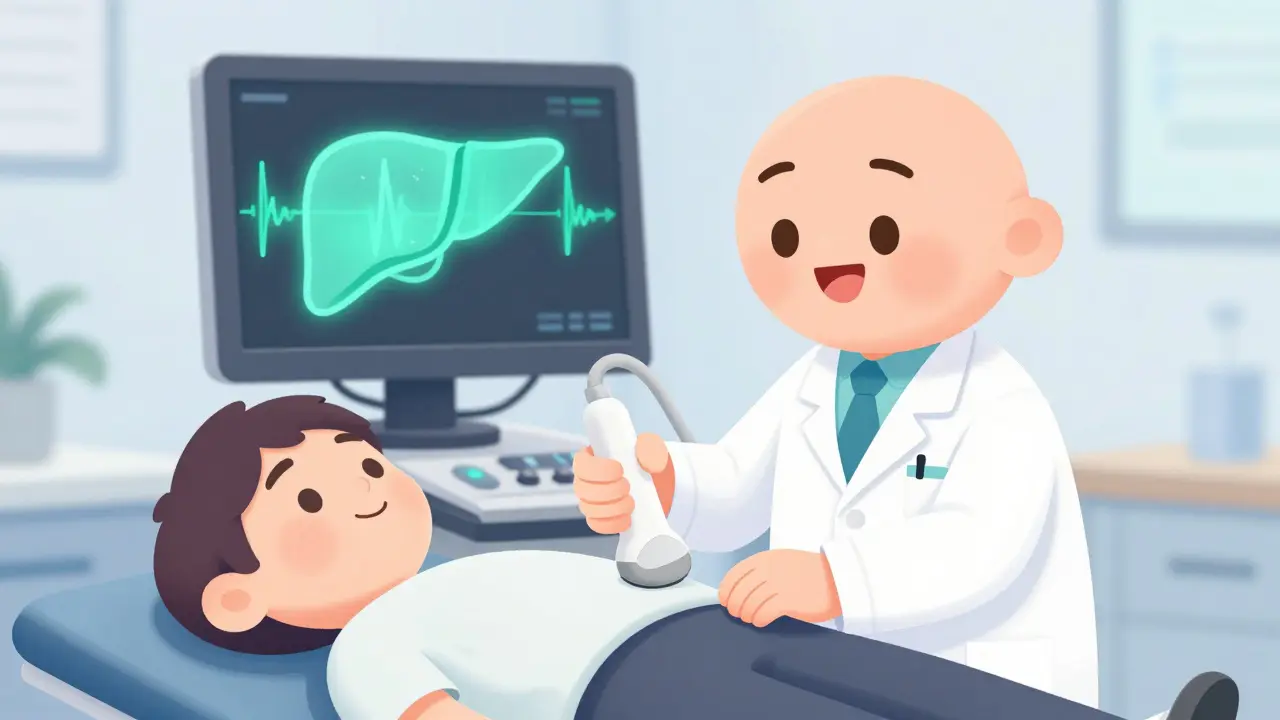
Your liver is the hardest working organ in your body. It filters toxins, processes nutrients, and fights infection without ever complaining. But when it gets damaged, the scarring-called liver fibrosis, which is the buildup of scar tissue that can lead to cirrhosis and liver failure-is silent. For decades, the only way to know how much damage had occurred was a liver biopsy. That meant sticking a needle into your abdomen, dealing with pain, and risking bleeding or infection. Today, you don’t have to go through that unless absolutely necessary. Modern medicine offers noninvasive alternatives that are faster, safer, and often just as accurate.
If you’ve been told your liver enzymes are high, or if you carry extra weight and worry about fatty liver disease, you’ve likely heard terms like FibroScan, which is a specialized ultrasound device that measures liver stiffness to detect fibrosis or serum scores, which are calculations based on routine blood test results to estimate liver scarring risk. These tools have changed how doctors diagnose liver disease. They allow for early detection, regular monitoring, and better treatment decisions without the trauma of surgery. Understanding the difference between these methods helps you take control of your health journey.
How FibroScan Measures Liver Health
FibroScan, developed by the French company Echosens, uses a technology called transient elastography. Think of it like tapping a watermelon to see if it’s ripe. A ripe melon feels firm but gives slightly; an overripe one is mushy. Similarly, a healthy liver is soft and pliable. As fibrosis develops, collagen deposits make the liver stiff. The FibroScan machine sends low-frequency shear waves (50Hz) through your skin and into your liver. It then measures how fast those waves travel. Faster waves mean a stiffer liver, which indicates more scarring.
The result is given in kilopascals (kPa). According to the UK's National Health Service (NHS), a normal liver usually registers between 2 and 7 kPa. Higher numbers suggest progressive fibrosis. For example, values above 12 kPa often indicate advanced fibrosis or cirrhosis. The procedure takes less than ten minutes. You lie on your back, lift your right arm, and the technician places a probe between your ribs. There is no pain, no needles, and no recovery time. You can drive home immediately after the test.
Modern devices like the FibroScan 630, released in 2020, also measure fat content using the Controlled Attenuation Parameter (CAP). This dual capability is crucial because many patients suffer from both fat accumulation and scarring. CAP scores range from 100 to 400 dB/m. A score between 238 and 260 dB/m suggests mild fat (11-33%), while scores above 290 dB/m indicate severe steatosis (over 67% fat). This comprehensive view helps doctors tailor treatments specifically for fatty liver disease, known medically as NAFLD or NASH.
Understanding Serum-Based Scores
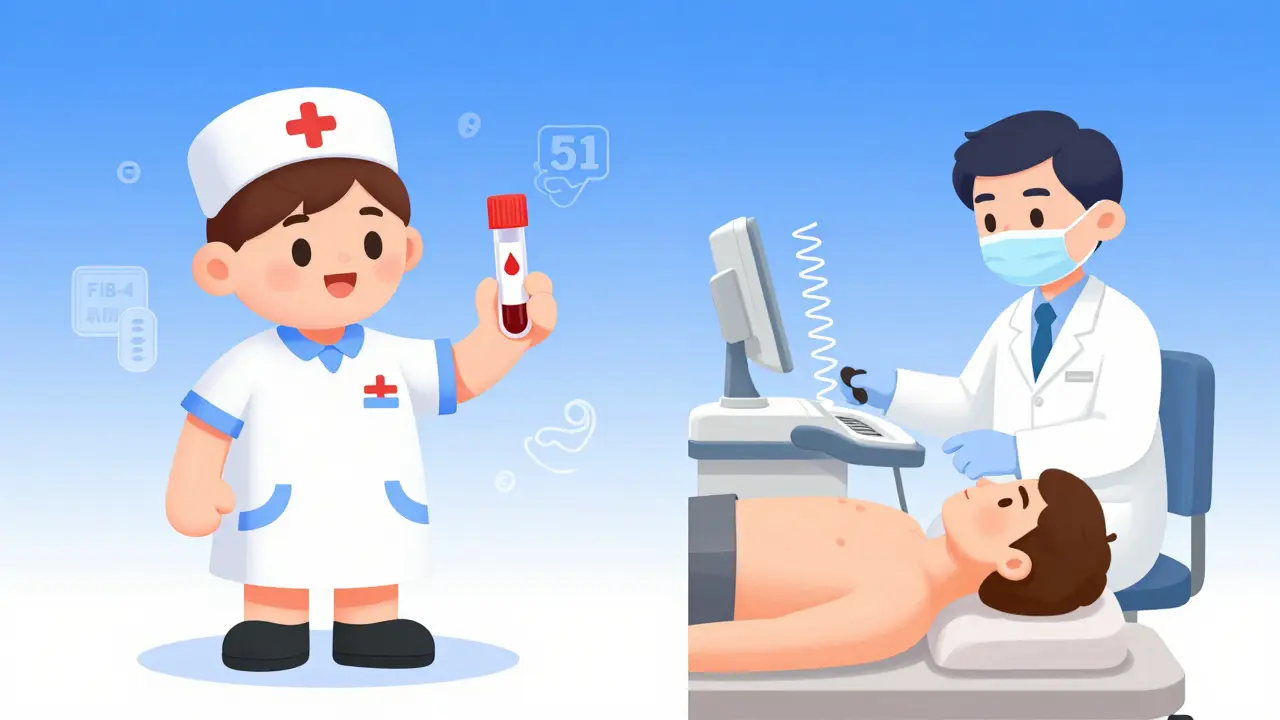
While FibroScan requires a specific machine and trained operator, serum scores rely on data you already have: your blood work. These formulas combine common lab markers to estimate the probability of fibrosis. The most widely used are FIB-4 (Fibrosis-4 Index) and APRI (Aspartate Aminotransferase-to-Platelet Ratio Index).
FIB-4 calculates risk using four variables: age, AST (aspartate aminotransferase), ALT (alanine aminotransferase), and platelet count. It is incredibly accessible because every primary care doctor runs these tests routinely. If your FIB-4 score is below 1.3, there is a 90% chance you do not have advanced fibrosis. This high negative predictive value makes it perfect for screening large populations. On the other hand, a score above 2.67 signals a high risk of advanced fibrosis, prompting further investigation. APRI works similarly but uses only AST and platelets. A score of 2.0 or higher typically suggests cirrhosis.
Another option is the Enhanced Liver Fibrosis (ELF) test. Unlike FIB-4 and APRI, which use standard blood counts, ELF measures three direct biomarkers of fibrosis: hyaluronic acid, PIINP, and TIMP-1. It is more expensive but often considered more specific for active fibrogenesis. Doctors might choose ELF when standard scores are inconclusive or when they need to monitor response to antifibrotic therapies.
Comparing Accuracy and Reliability
| Feature | FibroScan (Transient Elastography) | Serum Scores (FIB-4/APRI) |
|---|---|---|
| Cost per Test | $50 - $150 | $10 - $20 (uses existing labs) |
| Turnaround Time | Immediate results | 24-72 hours (lab processing) |
| Accuracy for Advanced Fibrosis | High (AUROC ~0.85-0.99) | Moderate (varies by cutoff) |
| Limitations | Obesity (BMI >28), acute inflammation | Age bias, less specific for mild fibrosis |
| Best Use Case | Confirming diagnosis, monitoring progression | Initial population screening |
No single test is perfect. Studies show conflicting results depending on the patient population. A 2023 study published in PMC found that FibroScan correctly identified only 45.9% of patients with biopsy-confirmed advanced fibrosis (F3/F4) when using a strict cutoff of ≥12 kPa. In contrast, FIB-4 missed even more cases, identifying only 16.8% of the same group. However, other research, such as a 2022 Elsevier study, reported much higher accuracy for FibroScan, with an Area Under the Receiver Operating Characteristic curve (AUROC) of 0.99 for detecting cirrhosis.
The discrepancy highlights a key point: context matters. FibroScan excels at quantifying stiffness in real-time but can be fooled by acute inflammation. If you have a flare-up of hepatitis, your AST levels spike, making the liver temporarily stiffer. This leads to false positives. Serum scores like FIB-4 struggle with age. Younger patients under 35 often have lower platelet counts naturally, which can artificially inflate their FIB-4 score, suggesting fibrosis where none exists. Conversely, older patients may have advanced fibrosis but low enzyme levels, leading to false negatives.
When Each Test Shines
Doctors rarely rely on just one method. The European Association for the Study of the Liver (EASL) recommends a sequential approach. Start with FIB-4 because it is cheap and easy. If the score is low (<1.3), you are likely safe, and no further testing is needed for now. If the score is intermediate (1.3-2.67), move to FibroScan. This step clarifies the picture. If FibroScan shows high stiffness, consider a biopsy or MRI elastography for confirmation. This protocol reduces the need for invasive biopsies by up to 70%, according to a 2020 study in the journal *Gut*.
FibroScan is particularly valuable for monitoring. If you are being treated for Hepatitis C or NASH, you need to know if the treatment is working. Repeating blood tests every month is impractical and costly. FibroScan provides immediate feedback during your visit. You can see trends over time. Did the stiffness drop from 14 kPa to 10 kPa? That’s a sign of healing. Serum scores change slowly and are influenced by daily fluctuations in diet and activity, making them poor tools for short-term monitoring.
However, accessibility wins for serum scores. Not every clinic has a FibroScan machine. In rural areas or resource-limited settings, FIB-4 is the lifeline. Primary care physicians can calculate it instantly using electronic health records (EHR). A 2024 report noted that integrating FIB-4 into EHR systems increased screening rates from 12% to 67% among at-risk patients. This democratization of diagnostics saves lives by catching disease early, even if the precision isn't as high as imaging.
Practical Challenges and Limitations
Real-world application brings hurdles. Obesity is the biggest enemy of FibroScan. The shear waves cannot penetrate deep enough in patients with a Body Mass Index (BMI) over 28 kg/m². Up to 15% of procedures fail technically. To combat this, newer models offer an XL probe designed for larger bodies. But this adds cost and complexity. Patients have reported paying extra for repeat attempts. One user on a medical forum shared that at BMI 38, their scan failed three times before the XL probe worked, adding $200 to the bill.
Inflammation skews results too. If you ate a heavy meal within three hours of the test, bile ducts dilate, increasing pressure and stiffness readings. Always fast for at least three hours before a FibroScan. Right heart failure also elevates liver pressure, mimicking fibrosis. Technicians must rule out these confounders before interpreting the kPa number.
Serum scores face confusion among patients. Because they are calculated indices, not direct measurements, people often misunderstand them. A high FIB-4 doesn’t mean you definitely have cirrhosis; it means you are at higher risk. This ambiguity leads to anxiety. Some patients demand biopsies despite reassuring clinical pictures. Education is key. Doctors must explain that these are probabilistic tools, not definitive diagnoses.
Future Directions in Liver Diagnostics
Technology keeps evolving. Echosens announced the FibroScan 730 in April 2024, featuring AI-powered reliability scoring. This smart system analyzes each measurement in real-time, flagging unreliable data points and reducing technical failures by 22%. It learns from thousands of scans to improve accuracy across diverse body types.
New serum markers are emerging too. The 2024 EASL guidelines introduced FIB-5, which incorporates glucose levels alongside traditional markers. Early studies show 89% accuracy for advanced fibrosis in diabetic NAFLD patients. Since diabetes is a major driver of liver disease, this tailored approach promises better outcomes for millions.
Magnetic Resonance Elastography (MRE) remains the gold standard for noninvasive imaging, boasting 95% accuracy for significant fibrosis. But it costs ten times more than FibroScan and requires scheduling an MRI slot. It’s reserved for complex cases where other tests disagree. As AI integrates deeper into diagnostics, we may see hybrid algorithms combining FibroScan, FIB-4, and ELF data to create personalized risk profiles, potentially eliminating the need for biopsy altogether.
Is FibroScan painful?
No, FibroScan is completely painless. It feels like a gentle tap on your side. The probe vibrates slightly as it sends sound waves into your liver, but most patients describe it as similar to an ultrasound exam. There is no needle insertion, so there is no risk of bleeding or infection.
Can I eat before a FibroScan test?
You should fast for at least three hours before the test. Eating causes your gallbladder to contract and bile ducts to dilate, which increases liver pressure and can falsely elevate stiffness readings. Drinking water is usually fine, but avoid caffeine and heavy meals to ensure accurate results.
What does a high FIB-4 score mean?
A FIB-4 score above 2.67 indicates a high risk of advanced liver fibrosis or cirrhosis. It does not confirm the diagnosis but signals that further testing, such as FibroScan or MRI, is necessary. A score between 1.3 and 2.67 is indeterminate, meaning you fall into a gray zone requiring additional evaluation. Scores below 1.3 generally rule out advanced fibrosis.
Why would my FibroScan fail?
Technical failures occur in about 10-15% of cases, primarily due to obesity (high BMI) or narrow rib spaces that block the probe’s signal. Acute inflammation, ascites (fluid in the abdomen), or inability to hold still can also cause failure. Modern devices with XL probes help mitigate issues related to body size.
Do I still need a liver biopsy?
In most cases, no. Noninvasive tests have reduced biopsy needs by 70-80%. Biopsies are now reserved for situations where FibroScan and serum scores give conflicting results, or when specific types of liver disease require tissue analysis for precise classification. Your doctor will decide based on your overall clinical picture.