
Future Economic Trends: Forecasts for Generic Drug Markets
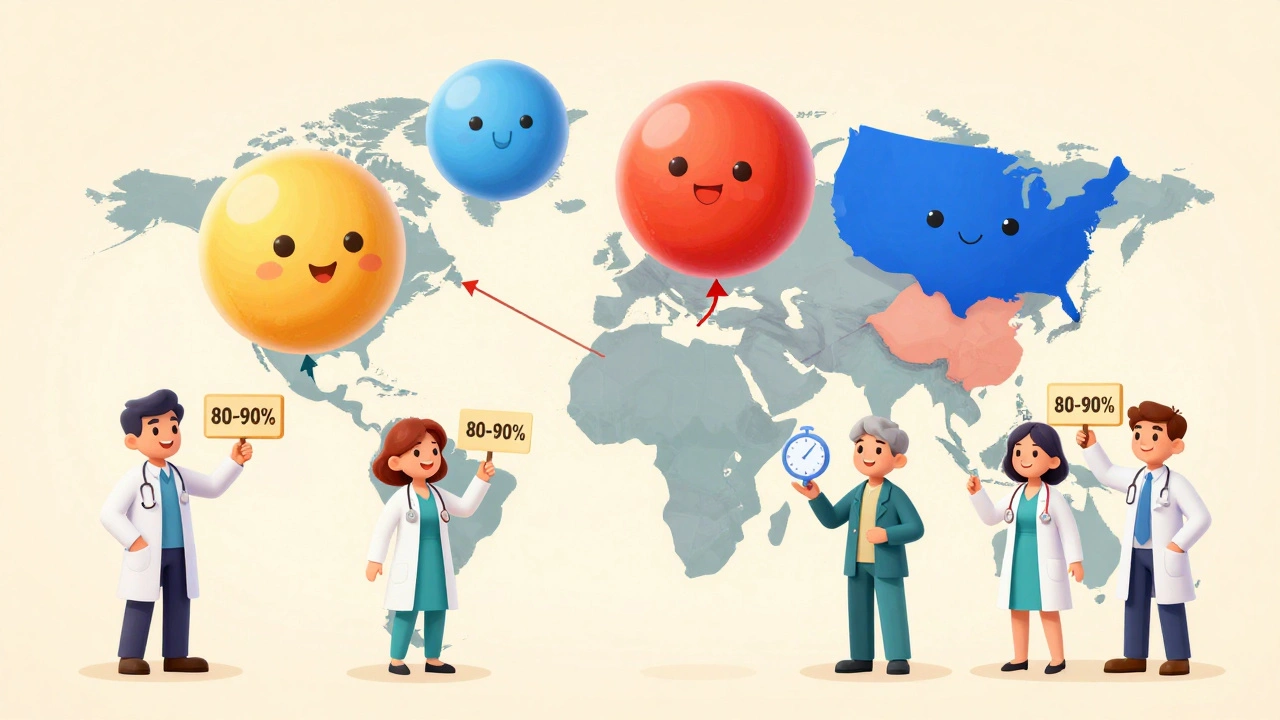
The global generic drug market isn’t just growing-it’s reshaping how the world accesses medicine. By 2030, it could be worth anywhere from $530 billion to over $800 billion, depending on who you ask. What’s clear is that cheaper versions of branded drugs are no longer a niche option. They’re the backbone of affordable healthcare for billions. And with dozens of blockbuster drugs losing patent protection between now and 2030, the next five years will be the biggest inflection point this industry has ever seen.
Why Generic Drugs Are Becoming the Default Choice
Generic drugs aren’t knockoffs. They’re exact copies of branded medications in active ingredients, dosage, safety, and effectiveness. The only difference? Price. A generic version of a drug can cost 80-90% less than the brand-name version. That’s not marketing-it’s math. And healthcare systems are finally catching on.In the U.S., where drug prices have long been a political flashpoint, the FDA approved over 1,500 generic drugs in 2024 alone. In Europe, countries like Germany and the UK have mandated generic substitution in pharmacies for years. In India and China, where out-of-pocket spending on medicine is high, generics are the only realistic option for most patients. The result? A global shift from branded to generic prescriptions that’s accelerating every year.
The Patent Cliff Is Here-And It’s Massive
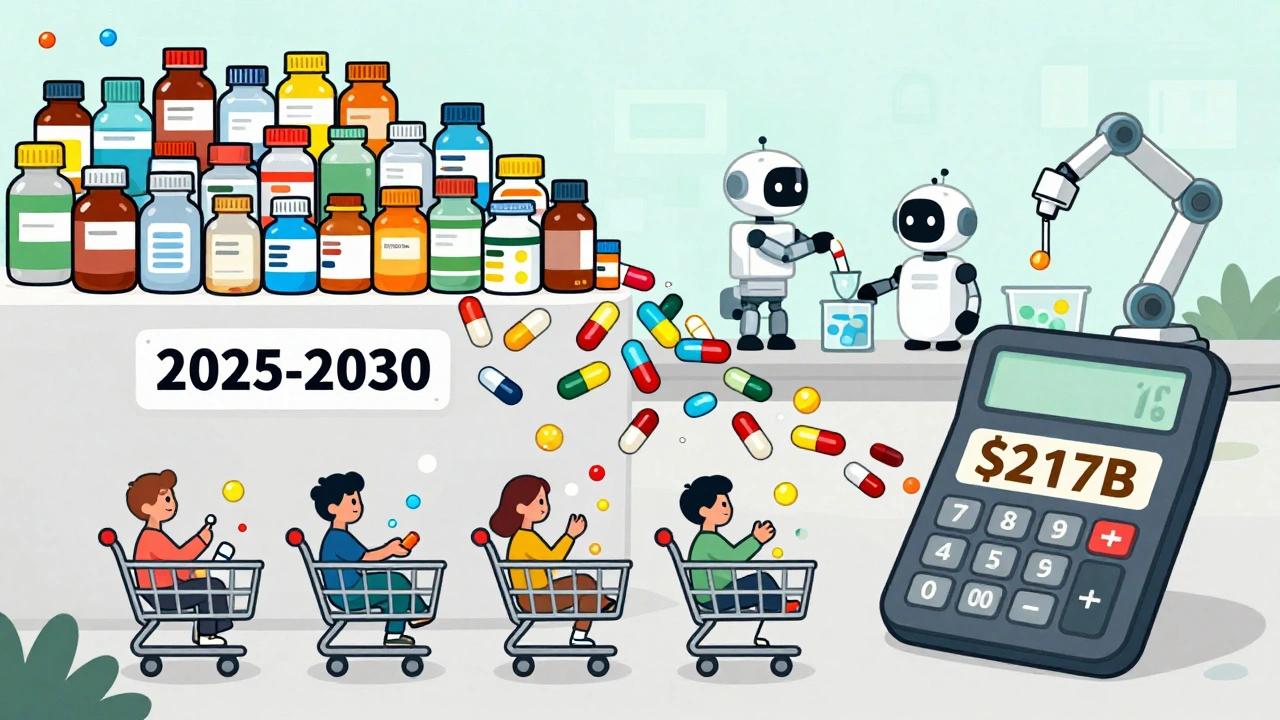
Between 2025 and 2030, drugs generating $217 billion to $236 billion in annual sales will lose patent protection. That’s not a trickle. That’s a flood. Drugs like ustekinumab (Stelara), vedolizumab (Entyvio), and liraglutide (Victoza) are among the biggest names coming off patent. These aren’t obscure pills. They’re top-selling treatments for psoriasis, Crohn’s disease, and type 2 diabetes.What makes this moment different is the scale. In past years, patent expirations happened one or two at a time. Now, dozens are hitting at once. The 2025-2027 window is especially critical because it includes high-cost biologics-complex drugs made from living cells. These used to be off-limits for generics. But now, biosimilars-near-identical copies of biologics-are entering the market. And they’re growing faster than traditional generics, at an 8.2% annual rate.
Where the Growth Is: Regions and Therapeutic Areas
Not all markets are growing at the same pace. Asia-Pacific is leading the charge, with India and China driving most of the expansion. India produces 20% of the world’s generic drugs and 60% of its vaccines. China doesn’t just make them-it sets the price. Through its national volume-based procurement system, China negotiates bulk purchases that force global manufacturers to slash prices. That’s why a generic version of a diabetes drug made in China can cost less than a dollar per pill, even in the U.S.In the U.S. and Europe, growth is steady but slower. The U.S. market is dominated by a few big players: Teva, Viatris, Sandoz, and Amneal. These companies have the scale to handle complex manufacturing and regulatory hurdles. But in Latin America, the Middle East, and Africa, the market is still developing. Brazil and South Africa are starting to build regulatory frameworks to support generic access, but supply chains and distribution remain weak.
Therapeutically, the biggest demand is in three areas: diabetes, oncology, and inflammatory diseases. Drugs for type 2 diabetes-like metformin and GLP-1 analogs-are seeing surging use as obesity rates climb. Oncology is the most valuable therapy area globally, with over $300 billion in sales projected by 2030. Many of those drugs will soon have generic or biosimilar versions. And for conditions like psoriasis and rheumatoid arthritis, drugs like Dupixent and Skyrizi are still branded, but their patents expire in the early 2030s, setting up the next wave of generic competition.
Biosimilars: The New Frontier
Biosimilars are the most exciting-and complicated-part of the future of generics. Unlike simple pills, they’re made from living organisms. That means they’re harder to copy. But they’re also more expensive to produce. A single course of a branded biologic can cost $50,000 a year. A biosimilar? Around $20,000.The EU has been the leader in approving biosimilars, thanks to streamlined regulatory pathways. Japan is catching up fast, with new fast-track approvals expected by 2026. In the U.S., the FDA has approved over 40 biosimilars since 2015, and more are coming. Early entrants are already capturing market share by offering reliable supply chains and robust pharmacovigilance programs. Companies that invest in dual-source manufacturing-having backup production sites-are winning contracts in Southeast Asia, where pooled procurement systems now favor suppliers with redundancy.
By 2029, the biosimilar market alone could be worth $25 billion, mostly from oncology and immunology drugs. That’s bigger than the entire generic market was two decades ago.
Manufacturing and Technology Are Changing the Game
Making generics isn’t just about chemistry anymore. It’s about automation, data, and logistics. Robotic process automation is now standard in large-scale generic manufacturing plants in India and China. AI-driven quality control systems detect impurities at levels older methods couldn’t catch. And digital tools are helping patients stick to their meds-apps that remind users to refill prescriptions, sync refills with pharmacies, and even track adherence through smart pill bottles.These aren’t just convenience features. They’re economic levers. Better adherence means fewer hospital visits, lower overall healthcare costs, and higher demand for generics. In the U.S., pharmacies that offer medication synchronization programs see 30% higher refill rates for chronic condition drugs like blood pressure and cholesterol meds.
Challenges: Price Pressure, Complexity, and Regulation
Growth doesn’t mean easy profits. The biggest threat to generic manufacturers isn’t competition-it’s pricing pressure. China’s procurement system has forced global prices down so hard that some manufacturers are leaving the market entirely. A generic drug that once sold for $0.10 per pill might now sell for $0.02. Margins are razor-thin.And as drugs get more complex-from oral solids to injectable biologics-the cost to develop and approve generics rises. It used to take $1 million and two years to bring a simple generic to market. Now, for a complex biosimilar, it can cost $100 million and take five years. That’s pushing out smaller players. Only companies with deep pockets and technical expertise can compete.
Regulatory uncertainty is another risk. In the U.S., patent litigation can delay generic entry by years. A single lawsuit can hold up a drug for a decade. And in some countries, regulatory agencies lack the resources to review applications quickly. That slows access-even when the science is ready.
What’s Next? The Road to 2035
By 2035, the generic drug market could be worth over $900 billion. That’s more than double its size in 2024. The growth won’t come from more pills-it’ll come from more complex drugs, more patients, and smarter systems. The winners will be companies that can scale production, navigate regulation, and build trust with payers and patients alike.For patients, this means more access to life-saving drugs at prices they can afford. For health systems, it means staying financially sustainable. For investors, it’s a sector with long-term momentum, even if margins are tight.
The future of generic drugs isn’t about cutting corners. It’s about delivering high-quality medicine at scale. And that’s a future worth betting on.
What percentage of drugs in the U.S. are generic?
In the U.S., generics make up about 90% of all prescriptions filled, but they account for only 15-20% of total drug spending. That’s because branded drugs, especially biologics and specialty medications, are priced much higher. Even though most people take generics, most of the money spent on drugs still goes to branded products.
Why are generic drugs so much cheaper?
Generic manufacturers don’t have to repeat expensive clinical trials to prove safety and effectiveness. They only need to show their product is bioequivalent to the branded version. That cuts development costs dramatically. They also avoid the marketing and advertising expenses that branded companies spend on doctors and consumers. These savings get passed on to patients and payers.
Are biosimilars the same as generic drugs?
No. Generic drugs are exact copies of small-molecule drugs-chemical compounds made in labs. Biosimilars are copies of biologics, which are large, complex proteins made from living cells. Because biologics are harder to replicate exactly, biosimilars are “similar but not identical” to the original. They still require rigorous testing, but they’re not called generics. They’re a separate category with their own approval rules.
Which countries are the biggest producers of generic drugs?
India is the largest global supplier of generic drugs by volume, producing about 20% of the world’s supply and 60% of its vaccines. China is the second-largest producer and has become a major price setter through its national procurement system. The U.S. and Europe produce generics too, but mostly for their own markets. India and China dominate global exports.
Will generic drugs replace branded drugs completely?
No-and they shouldn’t. Branded drugs still play a critical role in innovation. They fund the research that leads to new treatments. But for most conditions, once a drug’s patent expires, generics are the better choice for patients and payers. The goal isn’t to eliminate branded drugs-it’s to make sure patients aren’t overpaying for medicines that have been available for years.
How do patent expirations affect drug prices?
When a patent expires, multiple generic manufacturers enter the market. Competition drives prices down rapidly-often by 80-90% within the first year. For example, when Lipitor (atorvastatin) lost its patent in 2011, its price dropped from $4 per pill to under $0.10 within months. The more competitors that enter, the lower the price goes. That’s why the next wave of patent expirations is so important-it will trigger massive price declines across dozens of high-cost drugs.
8 Comments
Ugh, another article about generics. I just want my insulin to not cost $300 a vial. Can we skip the econ talk and just make it affordable already? 🙄
Oh honey, let me explain why this is all just a neoliberal fantasy wrapped in a lab coat. 🤡 The real crisis isn’t pricing-it’s the fact that we’ve outsourced our entire pharmaceutical sovereignty to Chennai and Shanghai. Biosimilars? More like bioslaves. 🇮🇳🇨🇳
When you think about it the whole system is just a mirror of our relationship with suffering. We don’t want to pay for healing we want to pay for the illusion of control. The generic pill is the most democratic object in modern medicine. No status. No branding. Just chemistry and compassion. And yet we still treat it like a second-class citizen. Why? Because we fear simplicity. We fear equality. We fear what happens when medicine stops being a luxury and becomes a right
India producing 20% of the world’s generics? Great. Now explain why 40% of those are contaminated. The FDA can’t even inspect half the facilities. This isn’t healthcare it’s a global lottery. And you’re celebrating it? Pathetic. 💀
Wait so biosimilars are like the Pokémon of pharma? Evolved form of generics? 😅 I didn’t know we were in a bio-rpg now. But seriously though-this is wild. $50k to $20k? That’s like upgrading from a flip phone to a smartphone and the price drops from $800 to $200. Mind blown 🤯
From a supply chain and regulatory perspective, the real bottleneck isn’t manufacturing-it’s the fragmented payer landscape in the U.S. Even when biosimilars are approved and produced, reimbursement protocols lag by 18–24 months. PBM bundling and formulary restrictions create artificial scarcity. The technology exists. The science is sound. The policy infrastructure is the bottleneck. We need value-based contracting and mandatory substitution policies-not just approval pathways.
It’s funny how we celebrate generics like they’re some kind of revolution when really we’re just accepting what should’ve been normal all along. A pill is a pill. A molecule is a molecule. If it works, why does it cost ten times more just because someone slapped a logo on it? We didn’t start paying extra for aspirin because Pfizer invented it. We didn’t. But we do for everything else. And we call that progress? We call that capitalism? We call that a system that rewards greed over grace? And then we wonder why people are sick and broke at the same time
India make most generics but we also make sure quality is good. My cousin work in pharma plant in Hyderabad and they test every batch 5 time before ship. USA and Europe think we just copy and sell cheap but no no no. We work hard. 💪❤️