
Generic Drug Contamination Risks: How to Prevent and Respond to Unsafe Medications
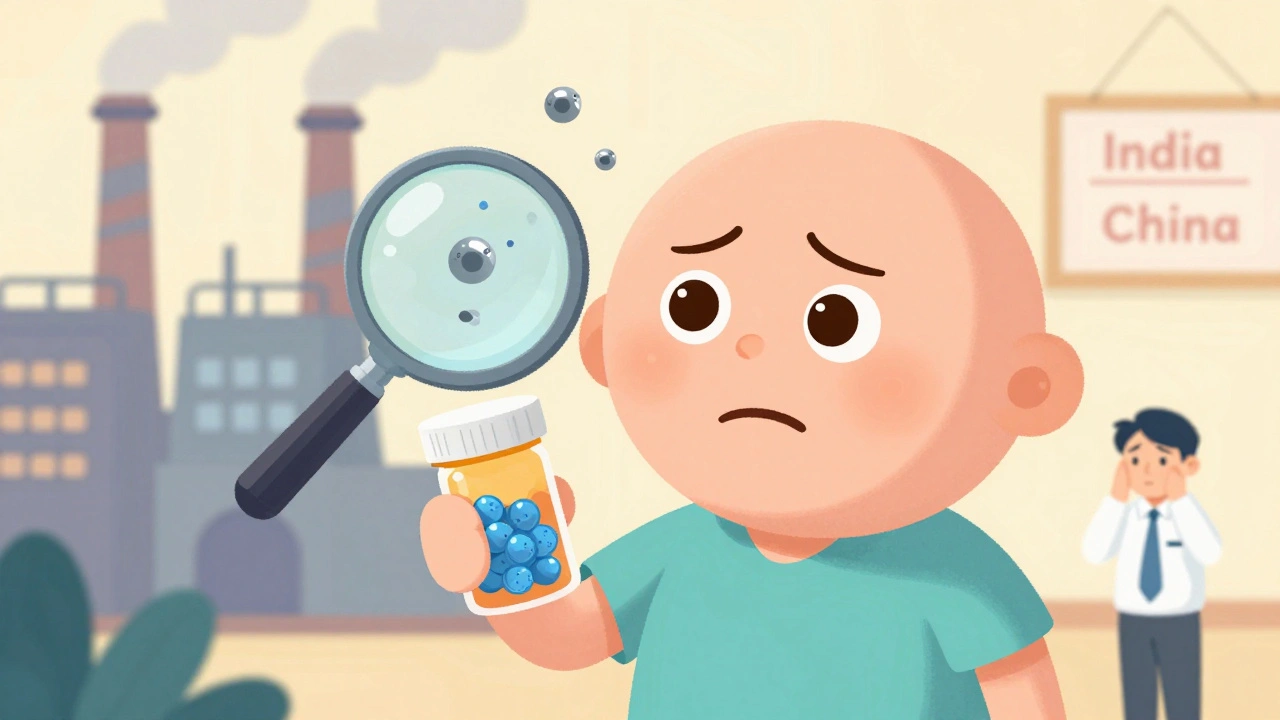
Every year, millions of Americans take generic drugs. They’re cheaper, widely available, and legally required to work the same as brand-name versions. But behind that simplicity lies a hidden risk: contamination. In 2022, generic drugs made up 37% of all drug recalls in the U.S.-not because they’re inherently unsafe, but because the systems meant to keep them clean are under strain. Contamination isn’t just dirt or dust. It’s chemicals, microbes, or even metal particles sneaking into pills, creams, or injections. And when it happens, the consequences can be serious-rashes, infections, organ damage, or worse.
Where Does Contamination Come From?
The problem starts in the supply chain. About 80% of the active ingredients in U.S. generic drugs come from just two countries: India and China. These ingredients travel halfway across the world before being turned into pills in U.S. or overseas facilities. Each step adds a chance for something to go wrong.
One major source is cross-contamination. Imagine a machine that makes blood pressure pills one day, then switches to diabetes meds the next without being cleaned properly. Residue from the first drug can stick around-even in tiny amounts-and mix with the next batch. The FDA says this residue must be below 10 parts per million (ppm). But for some powerful drugs, like cancer treatments or hormone therapies, even that tiny amount can be dangerous.
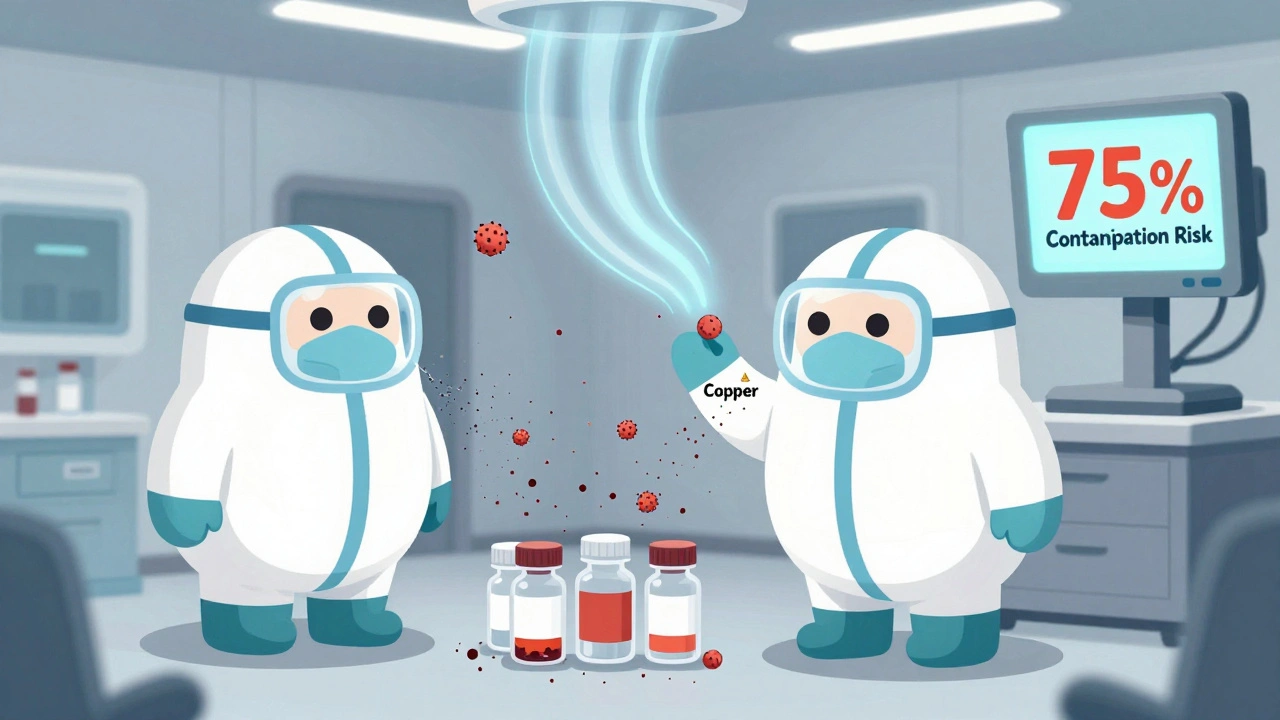
Human error plays a big role too. Workers in cleanrooms shed about 40,000 skin cells per minute. Every movement generates particles. If someone doesn’t gown up correctly, or if airflow is off, those particles can land in a vial. Studies show that 75-80% of particles in cleanrooms come from people. Even something as simple as piercing a vial with a needle can introduce contaminants-62% of hazardous drug incidents involve this step.
And it’s not just manufacturing. Compounding pharmacies-places that mix custom doses for patients-often lack proper ventilation or cleaning tools. OSHA found that 63% of these pharmacies don’t have the right equipment to stop contamination, leading to traces of dangerous drugs like cyclophosphamide showing up on countertops and gloves.
Why Are Generics More at Risk?
Generic drug makers face tighter margins than brand-name companies. While brand-name firms might spend 60-70% of revenue on R&D and quality, generics often operate on 20-25%. That means less money for upgrades, training, or advanced testing.
FDA inspection data shows that 8.3% of generic manufacturing sites received warnings for contamination issues in 2022-more than double the 5.1% rate for brand-name facilities. Indian facilities had a 12.7% contamination-related observation rate, compared to just 6.4% for U.S.-based plants. Older factories, built before 2000, are 34% more likely to have contamination problems because they weren’t designed with modern cleanroom standards in mind.
But not all generics are risky. Some companies, like Teva in Italy and Mylan in West Virginia, invested heavily in closed manufacturing systems and real-time particle monitors. These upgrades cut contamination incidents by 78% and 82%, respectively. The difference? They didn’t just follow the rules-they went beyond them.
How Contamination Is Detected and Measured
The FDA doesn’t test every batch. In fact, it inspects only about 1% of imported drugs. So how do they catch problems?
For microbial contamination, U.S. Pharmacopeia (USP) standards say non-sterile oral pills can’t have more than 1,000 colony-forming units (CFU) of bacteria per gram, and no more than 100 CFU of mold or yeast. If a batch exceeds that, it’s rejected.
Chemical contamination is trickier. The old rule-10 ppm residue-isn’t always enough. For highly potent drugs, like those used in cancer therapy, even 1 ppm can be harmful. Experts like Dr. Michael Kopcha say acceptance limits must be tailored to each drug, not set by a one-size-fits-all number.
Testing used to take up to a week. Now, rapid microbiological methods can give results in just four hours. By 2022, 63% of top generic manufacturers had adopted these faster tests. That means problems are caught before pills leave the factory.
AI is coming next. The FDA’s Digital Transformation Initiative is testing systems that analyze 15,000+ data points-airflow, humidity, worker movement, equipment vibration-to predict contamination before it happens. Early tests show 89% accuracy. If this scales, it could cut recalls by half by 2027.
What Happens When a Drug Is Contaminated?
When a contaminated batch is found, the manufacturer must report it to the FDA through MedWatch. The FDA then decides whether to issue a recall. Between 2020 and 2022, 1,247 contamination-related reports came in through MedWatch. Nearly 400 of them described real patient harm.
One documented case involved a patient who developed severe skin irritation from a generic hydrocortisone cream. Testing found copper particles in the cream-likely from contaminated equipment. Another Reddit user, a pharmacist, posted photos of metronidazole tablets with blue specks. Lab tests confirmed copper contamination. These aren’t rare anomalies. They’re symptoms of a system under pressure.
Recalls are expensive. On average, each contamination recall costs a manufacturer $18.7 million. That’s not just lost product-it’s legal fees, lost trust, and retraining staff. During the 2018-2019 valsartan crisis, nitrosamine impurities triggered 2,317 recalls across eight countries. The total cost? Over $1.2 billion.
How to Protect Yourself as a Patient
You can’t test your pills at home. But you can stay alert.
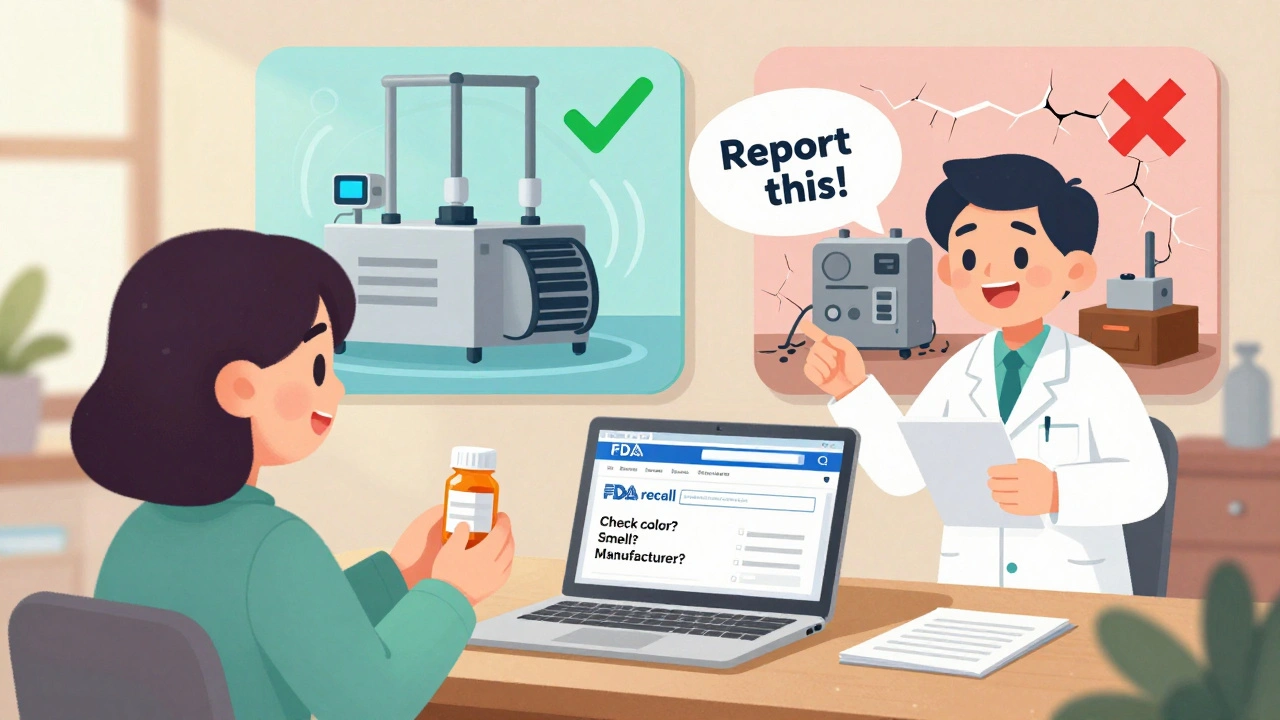
- Watch for changes in appearance. If your generic pill suddenly looks different-new color, texture, or spots-ask your pharmacist. Don’t assume it’s just a different manufacturer.
- Report unusual side effects. If you develop a rash, nausea, or fever after starting a new generic, mention it to your doctor. File a report with MedWatch if you suspect contamination.
- Know your pharmacy. Independent pharmacists are more likely to notice odd batches than big chains. If your pharmacist says, “This looks different,” listen.
- Check recall lists. The FDA publishes all recalls online. You can search by drug name or manufacturer.
Many patients assume all generics are the same. They’re not. One company’s metformin might be flawless. Another’s might have been made in a facility with outdated ventilation. The difference isn’t always obvious-but it matters.
What’s Being Done to Fix This?
Regulators are catching up. Since January 2023, all sartan-class blood pressure drugs must be tested for nitrosamines. The FDA’s PREDICT system now flags 37% more suspicious shipments than before. That means more contaminated drugs get stopped at the border.
USP updated its guidelines in 2022 to require stronger disinfectants that kill bacterial spores-something many facilities ignored before. And new GMP rules now demand documented annual training for every employee on contamination risks. No more skipping the refresher course.
The biggest shift? Moving from reactive to predictive. Instead of waiting for a recall, companies are using sensors and AI to spot contamination risks in real time. Facilities that adopted these systems saw a 70-80% drop in incidents. It’s not cheap-closed systems cost up to $2 million per line-but the cost of a recall is higher.
Still, challenges remain. The FDA inspects only 1% of imported drugs. Global supply chains are too complex to fully monitor. And smaller generic makers still struggle to afford upgrades. As Dr. Scott Gottlieb put it, “Our inspection system hasn’t kept pace with the globalization of drug manufacturing.”
What You Can Do Now
Don’t avoid generics. They’re safe for most people and save billions in healthcare costs. But don’t assume they’re perfect.
- Stick with trusted brands. If one generic manufacturer has always worked for you, ask your pharmacist to keep prescribing that one.
- Ask questions. “Is this the same manufacturer as last time?” is a perfectly valid question.
- Report anything strange. Your report could stop a bad batch from reaching others.
- Support policies that fund better inspections and faster testing. Public pressure drives change.
Contamination isn’t inevitable. It’s a failure of systems-and those systems can be fixed. Better technology, stricter rules, and more transparency are already making a difference. The goal isn’t to scare you off generics. It’s to make sure you know: safety isn’t automatic. It’s built, step by step, by manufacturers, regulators, and patients who care enough to ask.
Can generic drugs be contaminated even if they’re FDA-approved?
Yes. FDA approval means the drug meets basic standards at the time of review, but it doesn’t guarantee every batch is clean. Contamination can happen during manufacturing, shipping, or storage. The FDA inspects only 1% of imported drugs, so some contaminated batches slip through. That’s why recalls happen even after approval.
How do I know if my generic drug is contaminated?
You usually can’t tell by looking or feeling. But signs include unusual colors, spots, odors, or texture changes in pills. If you experience new or worsening side effects after switching to a new generic, it could be contamination. Report it to your pharmacist and file a MedWatch report with the FDA.
Are brand-name drugs safer than generics?
By law, generics must be as safe and effective as brand-name drugs. But brand-name companies often have newer facilities, better funding, and tighter quality controls. In 2022, generic manufacturers had 63% more contamination-related FDA warnings than brand-name makers. That doesn’t mean all generics are unsafe-but it does mean you should be more vigilant.
What should I do if I think my medication is contaminated?
Stop taking it. Contact your pharmacist or doctor immediately. Save the packaging and remaining pills. File a report with the FDA’s MedWatch system. This helps regulators track patterns and issue recalls faster. Don’t wait for others to get sick-your report could prevent harm.
Why don’t pharmacies test drugs for contamination?
Most pharmacies lack the equipment, training, or budget to test for chemical or microbial contamination. Testing requires labs, specialized tools, and days of processing. Even large hospital pharmacies rely on manufacturer certificates and FDA oversight. Independent pharmacists often trust the system-and that’s why patient reports are so important.
Is there a list of contaminated generic drugs I can check?
Yes. The FDA publishes all drug recalls on its website, searchable by drug name, manufacturer, or recall date. You can also sign up for email alerts. If you’re on a long-term medication, check the recall list every few months-especially if you switch pharmacies or refill with a new generic brand.
Contamination risks won’t vanish overnight. But awareness, reporting, and demand for better standards are pushing the system forward. Your health depends on more than just a prescription-it depends on knowing when something’s off, and having the courage to speak up.
13 Comments
Okay but can we talk about how wild it is that we’re trusting our health to pills made in factories where people shed 40,000 skin cells a minute? I just pictured some guy in a bunny suit sneezing into a vial of metformin and now I can’t unsee it. 😅
i just got my new generic blood pressure pill and it looks kinda blue?? like, not the usual white… should i be worried??
My mom had a rash after switching generics last year. The pharmacist said it was "just a different filler." But then she found out the batch was recalled. I still don’t trust most generics after that. It’s scary how little we’re told.
Look I work in pharma in India and let me tell you something-most factories are clean, but the pressure to cut costs is insane. They rush, they skip steps, they reuse filters. The FDA doesn’t even visit half the places they claim to. We’re not the problem-we’re the ones holding the system together while the West screams about quality
So let me get this straight-we import 80% of our medicine from countries that don’t even have enough clean water, but we’re surprised when pills have metal flakes in them? Brilliant. Truly. The American healthcare system is a circus and we’re all clowns.
yo so i read this whole thing and here’s the tea: the FDA’s 1% inspection rate is a joke. they’re using 2005 tech to monitor a 2024 global supply chain. if you wanna fix this, you need real-time sensors, blockchain traceability, and AI-driven anomaly detection-like, now. otherwise we’re just playing whack-a-mole with contaminated batches
Let me just say this: the FDA is a broken institution. They approve drugs based on paperwork, not reality. They inspect one percent of imports? That’s not oversight-that’s a nap. And don’t get me started on how they let companies use the same equipment for cancer drugs and allergy pills without cleaning it properly. This isn’t negligence-it’s systemic malice. I’ve filed three MedWatch reports. No one ever calls back. No one cares.
And yet, we keep buying generics because we can’t afford the brand. We’re being exploited. And the worst part? We know it. We just don’t have the power to change it. So we swallow the pills, the side effects, the silence.
My cousin died from a contaminated generic. The report was buried. The company paid a fine. No one went to jail. No one even apologized. You think this is about safety? It’s about profit. Always has been.
And now they’re talking about AI predicting contamination? Cute. That’s not prevention. That’s damage control. They want to make us feel safe while they keep cutting corners. It’s not innovation-it’s PR.
I used to trust the system. Now I check every batch. I call my pharmacist. I Google every lot number. I’ve become a paranoid health detective because no one else will do it.
So yeah. I’m angry. I’m scared. And I’m not alone.
One thing people miss: the real solution isn’t more inspections-it’s better incentives. Right now, the cheapest manufacturer wins the contract. That’s backwards. We should reward companies that invest in closed systems, AI monitoring, and employee training-not punish them for being responsible. Teva and Mylan proved it’s possible. We just need to make it profitable.
Also, pharmacists are our first line of defense. If your pharmacist says, "This looks different," believe them. They see more batches than the FDA ever will.
And yes, brand-name drugs aren’t perfect-but they’re often made in newer facilities with better controls. If you’re on a critical med, ask for the same generic manufacturer every time. Consistency matters.
We don’t need fear. We need accountability.
One might posit, in a Kantian framework, that the commodification of pharmaceuticals inherently violates the categorical imperative-treating human health as a mere means to fiscal efficiency. The global supply chain, in its current iteration, is a postcolonial artifact of extractive capitalism, wherein the Global South bears the burden of production while the Global North enjoys the illusion of safety. One is left to wonder: is contamination merely a symptom, or the logical endpoint of a system that prioritizes shareholder value over bodily integrity?
Ugh. I just spent $40 on this generic and now I’m supposed to worry it’s full of copper? I don’t have time for this. If it’s FDA-approved, it’s fine. I’m not turning into a conspiracy theorist because someone posted a blurry photo of a blue pill.
China and India make our meds? No wonder we’re getting metal in our pills. 🇺🇸 WE NEED AMERICAN-MADE DRUGS. BUILD THE WALLS AROUND THE PHARMACIES TOO. 🇺🇸
Okay but I just had to refill my thyroid med and the pill looked totally different-lighter, smoother, no imprint. I called my pharmacist and she said, "Oh, that’s the new supplier." I said, "Did you test it?" She said, "No, but it’s FDA-approved." I said, "Then I’m not taking it." I switched back to the brand. I paid $80 extra. Worth it. My anxiety went down. My hair stopped falling out. I don’t care if it’s "not necessary." I care that I feel human again.
Don’t let them tell you safety is optional. You’re not a lab rat. You’re a person.
That’s exactly right. I’ve been a pharmacist for 18 years. I’ve seen batches with odd smells, weird textures, even floating fibers. Most patients just take them. But when someone speaks up-like you did-it changes things. You’re not being dramatic. You’re being a guardian. Keep doing that.