
How Government Controls Generic Drug Prices in the U.S. Today
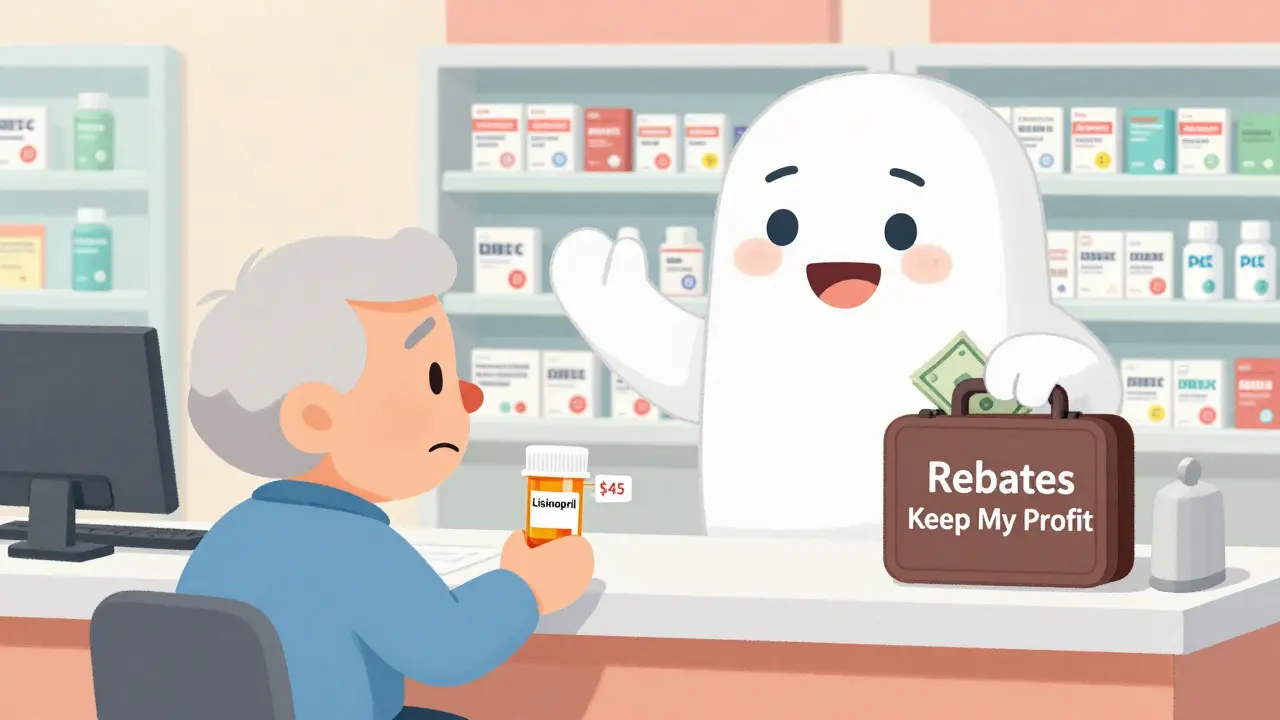
When you fill a prescription for generic lisinopril, metformin, or atorvastatin, you might expect to pay a few dollars. But sometimes, that same pill costs $45-or even $90. Why? Because in the U.S., generic drug pricing isn’t set by the government like it is in most other rich countries. Instead, it’s a messy mix of competition, hidden rebates, and patchwork rules that leave patients guessing what they’ll pay at the pharmacy counter.
How Generic Drugs Are Priced in the U.S.
The U.S. doesn’t have a national drug price list. There’s no agency that says, "This generic blood pressure pill costs $2." Instead, prices are shaped by what manufacturers charge, what pharmacies charge, and what insurers and government programs pay. The real story is in the gap between what a drug costs to make and what patients actually pay.
Generic drugs enter the market after a brand-name drug’s patent expires. Once that happens, dozens of companies can start making the same medicine. In theory, that competition should drive prices down. And it usually does. By 2025, generic drugs made up 90% of all prescriptions filled in the U.S. but only 23% of total drug spending. That’s because most generics cost 80-85% less than their brand-name versions.
But here’s the catch: when only one or two manufacturers make a generic drug, competition disappears. In 2024, the price of pyrimethamine (Daraprim), a life-saving drug for parasitic infections, jumped 300% because only two companies were left making it. No one was bidding against each other. No one was forcing prices down. And patients paid the difference.
The Medicaid Rebate Program: The Hidden Engine Behind Low Prices
The federal government doesn’t set generic prices directly-but it does force manufacturers to give discounts. The key tool is the Medicaid Drug Rebate Program (MDRP), created in 1990. Every company that sells drugs to Medicaid must pay a rebate. For generics, that rebate is the greater of:
- 23.1% of the Average Manufacturer Price (AMP), or
- The difference between AMP and the lowest price they offer to any commercial buyer (called the "Best Price").
This system means manufacturers can’t charge Medicaid more than they charge anyone else. In 2024, these rebates totaled $14.3 billion, with generics making up 78% of that total. Without this program, Medicaid-and by extension, taxpayers-would be paying way more for basic medicines.
But here’s the twist: those rebates don’t go to you. They go to the state Medicaid program. If you’re on Medicaid, you still pay your copay. The rebate just keeps the system from collapsing under the cost.
Medicare Part D and the Inflation Reduction Act
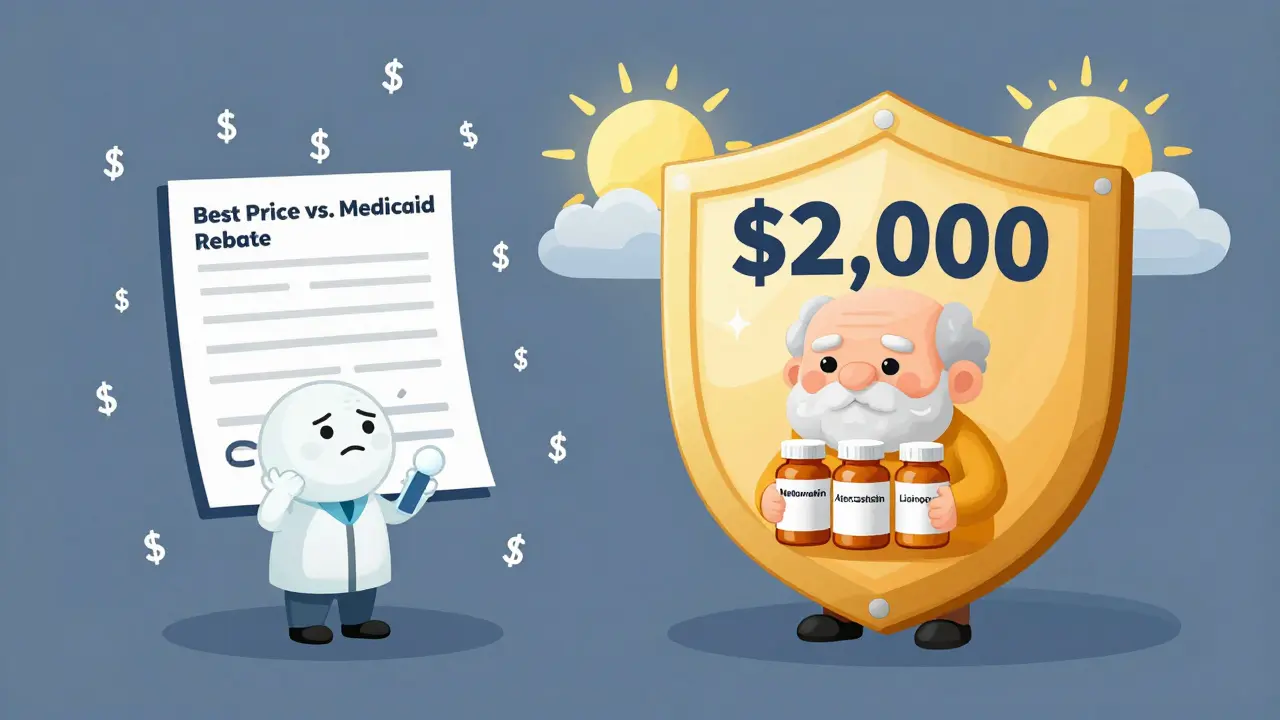
If you’re on Medicare, your generic drug costs changed dramatically in 2025. The Inflation Reduction Act (IRA) capped out-of-pocket spending for Medicare Part D beneficiaries at $2,000 per year. Before that, some seniors paid thousands just to get their daily pills.
Now, if you take multiple generics, your annual cost is capped. For example, a senior taking generic metformin, lisinopril, and atorvastatin might have paid $412 out of pocket in 2022. In 2024, that dropped to $327-and it’ll keep falling as the cap tightens.
Low-Income Subsidy (LIS) beneficiaries pay even less: between $0 and $4.90 per generic prescription. That’s because the government covers most of the cost. But here’s the problem: even with these protections, your pharmacy might switch your generic brand without telling you. One manufacturer’s lisinopril might cost $15 a month. Another’s, made by a different company, might cost $45-even though they’re chemically identical. That’s because insurance plans have different contracts with different makers.
Why Your Pharmacy Bill Keeps Changing
Have you ever gone to pick up your prescription and been shocked by the price? You’re not imagining it. A 2025 Consumer Reports study found that 22% of insured patients faced unexpected generic drug costs over $50 a month. Why?
It’s because of pharmacy benefit managers, or PBMs. These are middlemen hired by insurance companies to manage drug benefits. They negotiate rebates with drug makers-but they don’t always pass those savings on to you. A 2025 Senate report found that 68% of the "savings" from generic drug rebates never reach the patient. Instead, PBMs keep them as profit or use them to lower premiums for big employers.
And it’s not just PBMs. The 340B Drug Pricing Program gives discounts to safety-net clinics and hospitals that serve low-income patients. Those clinics can offer generics for 20-50% below market price. But if you’re not treated at one of those clinics, you don’t get that discount-even if you’re poor.
How Other Countries Do It Better
Compare this to Canada, the U.K., or Germany. In those countries, the government negotiates drug prices directly. The U.K.’s NICE agency decides if a drug is worth the cost. Germany evaluates whether a new generic offers real benefits over existing ones. If it doesn’t, they cap the price lower.
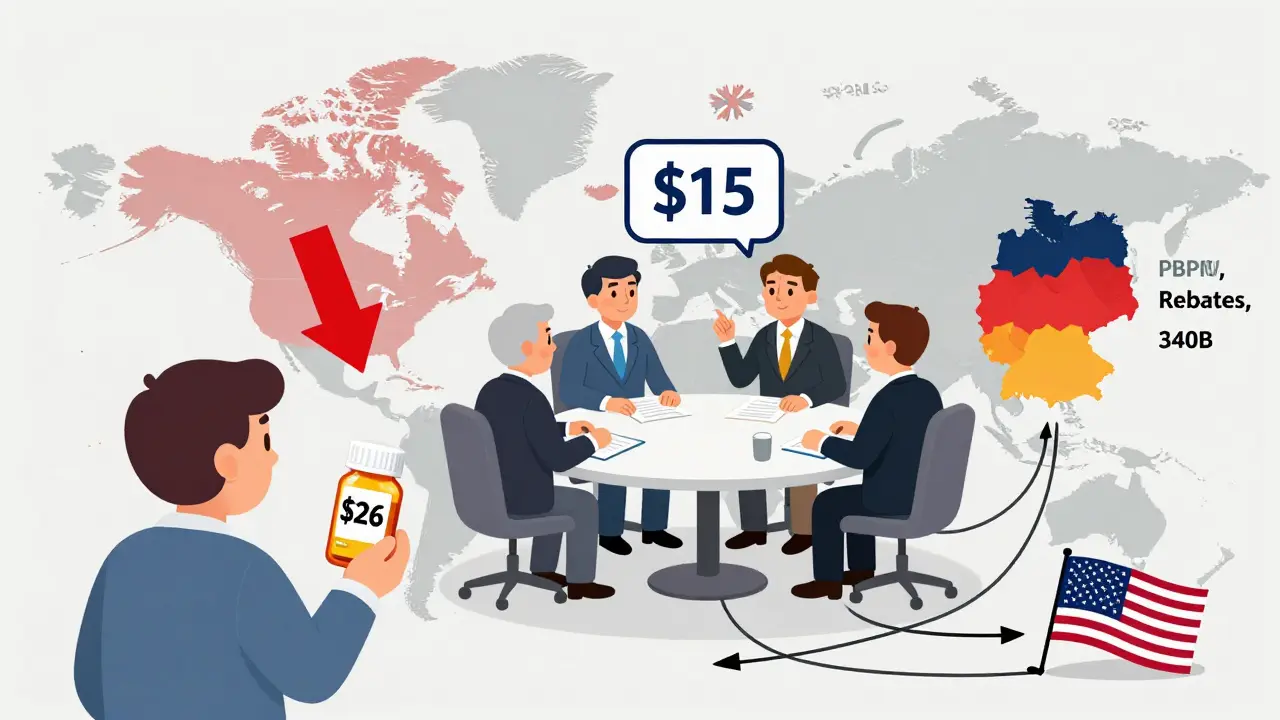
In 2025, the U.S. paid 1.3 times more for generic drugs than the average of 32 other wealthy nations. That gap is small compared to brand-name drugs, where Americans pay 3-5 times more. But for people living on fixed incomes, even a 30% difference matters. A $20 monthly generic can become a $26 monthly burden. That’s enough to make someone skip doses.
And yet, the U.S. has one big advantage: speed. Once a patent expires, generics flood the market faster here than anywhere else. In the U.S., 90% of prescriptions are filled with generics. In Europe, it’s 65%. That’s because the FDA has streamlined approvals for simple generics. But for complex ones-like inhalers or injectables-it still takes years.
Who’s Winning and Who’s Losing?
Big generic makers like Teva, Mylan, and Sandoz control nearly 40% of the market. But 65% of the market is made up of smaller companies. Many of them operate on margins under 15%. If the government starts capping prices too low, some of them could go out of business.
That’s what industry leaders warn. David Epstein, former CEO of Novartis, says excessive price controls could hurt innovation in how generics are made. If companies can’t make money, they won’t invest in better delivery systems or more reliable manufacturing.
But critics like Dr. Peter Bach from Memorial Sloan Kettering say the current system is broken. "The U.S. pays 138% more for generics than other high-income countries," he told the Senate in 2025. He points to the VA, which negotiates prices directly and gets 40-60% discounts. Why can’t Medicare do the same?
The Congressional Budget Office estimated that letting Medicare negotiate prices for a few select generics could save $12.7 billion over ten years. That sounds small next to the $500 billion U.S. spends on drugs annually. But for seniors on fixed incomes, it could mean the difference between taking their pills and skipping them.
What’s Changing in 2026 and Beyond
The biggest shift is coming in 2027. For the first time, Medicare will negotiate prices for generic versions of two blockbuster drugs: apixaban (Eliquis) and rivaroxaban (Xarelto). These are blood thinners used by over 5 million Medicare patients. Together, they cost $40.7 billion a year. If prices drop by 25-35%, as analysts predict, it could save billions-and set a precedent.
That’s a big deal. For the first time, the government is stepping into a market it’s avoided for decades. And it’s not just about generics. The IRA also lowered the Part D deductible from $595 to $545 in 2026. More people will hit the catastrophic coverage phase faster. More people will pay less.
But legal battles are brewing. PhRMA, the drug industry lobby, sued over a proposed "Most-Favored-Nation" rule that would tie U.S. drug prices to what other countries pay. They argue it’s an unconstitutional taking of property. The case is still pending.
What You Can Do Right Now
You can’t control drug manufacturing. But you can control what you pay at the pharmacy:
- Use the Medicare Plan Finder tool. Compare Part D plans every year. A plan that covers your generic at $0 might be different next year.
- Ask your pharmacist if there’s a cheaper version of your generic. Sometimes switching manufacturers drops your copay by $30.
- Check if your local community health center offers 340B discounts. Even if you’re not on Medicaid, you might qualify.
- Use GoodRx or SingleCare. These apps show cash prices that are often lower than your insurance copay.
- Call your insurer. Ask why your generic price jumped. They might be able to override it.
And if you’re struggling, you’re not alone. In 2025, 30% of Americans said they had trouble affording their meds. For 18% of them, it was generic drugs. That’s not a market failure. It’s a policy failure. And it’s fixable.
2 Comments
Okay, I just read this whole thing and I’m honestly shocked-how is it possible that we’re paying 138% more for the exact same pills that someone in Germany gets for half the price? I mean, I take lisinopril every day, and last month my copay jumped from $12 to $45-no warning, no explanation. I called my pharmacy, they said it was a ‘formulary change.’ WHAT DOES THAT EVEN MEAN? It’s not like the pill changed. It’s still the same damn chemical. I’ve been calling my reps, writing letters, even started a local Facebook group. People are skipping doses because they can’t afford it. This isn’t capitalism-it’s exploitation. And no, I don’t care if ‘the market’ says it’s okay. My life isn’t a spreadsheet.
Stop crying about drug prices. If you can’t afford your meds, don’t take them. Simple. The government shouldn’t be controlling prices. That’s socialism. We have the best pharma in the world because we let companies make money. If you want cheap pills, move to India. They make generics there for pennies. But they don’t have FDA standards. You want safe drugs? Pay for them. End of story.