
How to Confirm Monitoring Labs and Follow-Up for Medications

Getting medication levels right isn’t just about running a blood test. It’s about making sure that test is accurate-because a wrong number can mean too much drug, too little, or even a dangerous reaction. For drugs like vancomycin, lithium, or tacrolimus, the difference between a safe dose and a life-threatening one can be as small as 0.5 ng/mL. That’s why confirming your lab’s monitoring tests isn’t optional-it’s a matter of patient safety.
What’s the Difference Between Verification and Validation?
You’ll hear these terms used interchangeably, but they’re not the same. Verification is what you do when the lab uses a test kit that’s already been approved by the FDA. You’re not building the test-you’re checking that your lab’s setup matches the manufacturer’s claims. Think of it like testing a new thermometer: does it read 98.6°F when you put it in a known-temperature water bath? Validation is for tests the lab creates itself-like those for rare drugs with no commercial kits available. This means you have to prove the test works from scratch: how sensitive it is, what interferes with it, how accurate it is across different patient samples. It’s like designing your own thermometer and then proving it works better than any store-bought one. Most hospitals use verified tests. Only about 15% of labs still validate their own, mostly for complex drugs like clozapine or new biologics. But validation takes longer, costs more, and has a higher chance of failure. If you’re setting up a new monitoring program, start with FDA-cleared tests whenever possible.The 9-Step Verification Process (No Fluff)
If you’re verifying a test-say, for vancomycin-here’s what you actually need to do, step by step:- Write a plan-List the test, the manufacturer’s specs, and what you’ll measure. This takes 4-8 hours. Don’t skip this. A bad plan means wasted time later.
- Get approval-Your lab director must sign off. Most take 24-72 hours to respond. Don’t wait until the last minute.
- Run the tests-For precision, run at least 20 replicates over 5 days. For trueness, use certified reference materials. For linearity, test samples from 5 to 80 mcg/mL (the full therapeutic range). This step takes 40-60 hours.
- Check for interference-Test common drugs that might mess with results. For carbamazepine, that includes phenytoin, valproate, and even some antibiotics. If your test gives a false high because of another drug, someone could get an overdose.
- Analyze the data-Use basic stats: mean, standard deviation, coefficient of variation. Your precision must be under 1/4 of the total allowable error (TEa). For vancomycin, that’s under 3.75% CV. For digoxin? Under 2.5%.
- Re-evaluate if needed-About 30% of labs find something off. Maybe your instrument’s calibration drifts at high levels. Fix it. Retest.
- Write the report-Summarize everything: what you did, what you found, whether it passed. Keep it clear. Auditors will read it.
- Create SOPs and training docs-Your techs need to know how to run the test, what to do if results look weird, and how to document it. This takes 20-40 hours. Don’t rely on memory.
- Get final approval-Your director signs off again. Then-and only then-can you start reporting results to doctors.
What Happens If You Skip This?
In 2021, a hospital in Ohio misreported digoxin levels because their test didn’t account for antibody cross-reactivity. Twenty-three patients got wrong doses. One died. The FDA flagged it. The lab was fined $22,000. And they had to shut down their entire monitoring program for six months. That’s not rare. Between 2018 and 2022, 32% of therapeutic drug monitoring recalls came from poor verification of cross-reactivity. That’s not a glitch-it’s a failure to follow basic steps. Even worse, only 64% of labs verify the lower limit of quantitation for narrow-therapeutic-index drugs. That means they can’t tell if a patient’s level is dangerously low. They assume it’s fine. But low levels mean treatment fails-seizures, rejection, infections. That’s not just a mistake. It’s negligence.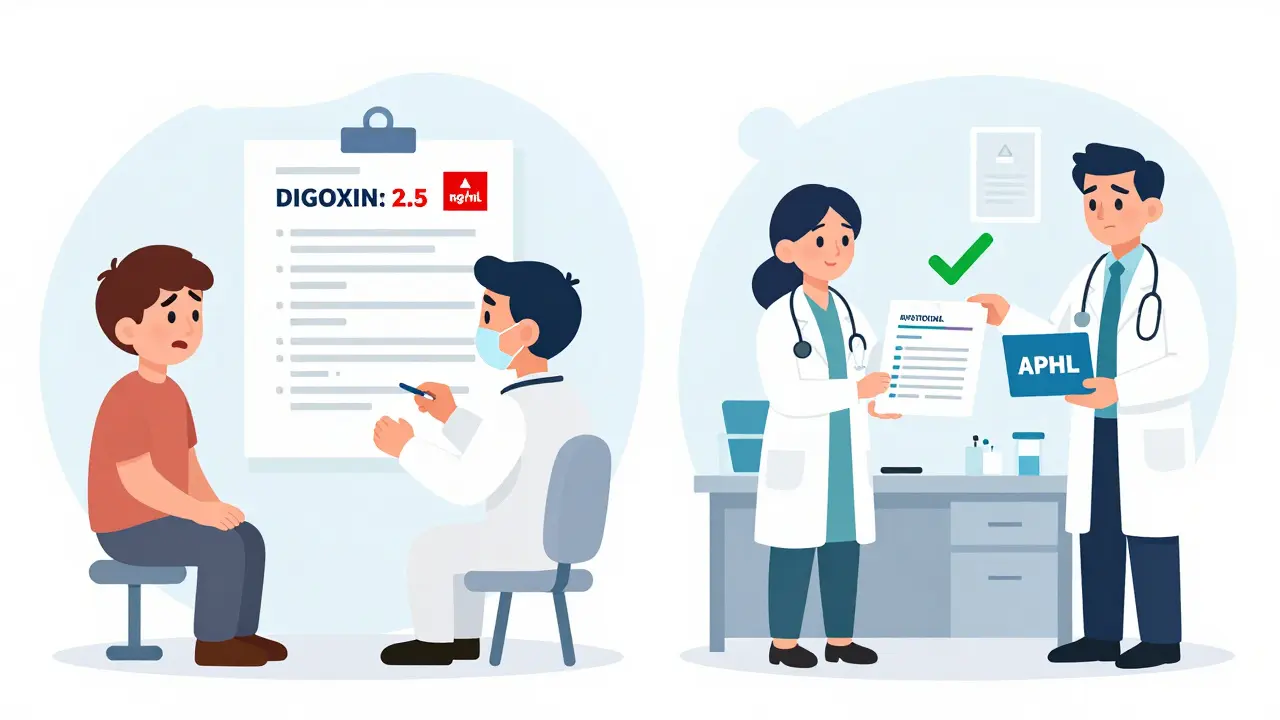
Who’s Doing It Right?
Mayo Clinic’s 2022 tacrolimus verification caught 17% of samples with metabolite interference. That’s a huge win. Those patients got corrected doses before transplant rejection happened. How? They used the APHL toolkit. It’s free. It’s detailed. It has templates for every step. Labs using it reduce non-conformities by 63%. Sarah Chen, a lab director in Oregon, said their vancomycin verification template saved them three weeks of work-and caught a linearity issue at 75 mcg/mL that would’ve made them miss toxic levels. Meanwhile, community hospitals? Only 38% have full verification protocols. Academic centers? 99%. It’s not about skill-it’s about time, staff, and resources. But if you’re a small clinic, you can still do this. Start with one test. Use the APHL worksheets. Borrow equipment if you need to. The goal isn’t perfection-it’s preventing harm.Common Pitfalls (And How to Avoid Them)
Here’s what goes wrong-and how to fix it:- “The manufacturer’s specs are wrong.” 63% of labs report this. Always test yourself. Don’t trust the brochure. If they say “linearity up to 100 mcg/mL,” test it at 80, 90, 100. If your instrument can’t read it, don’t report it.
- “We don’t have enough samples.” 41% of labs struggle with this. Use leftover patient samples with consent. Or partner with a nearby hospital. Don’t wait for perfect conditions-use what you have.
- “We don’t have time.” 68% of lab directors say staffing is a problem. But verification isn’t optional. If you’re short-staffed, prioritize. Start with the most dangerous drugs: digoxin, lithium, vancomycin, cyclosporine. Get those right first.
- “We don’t know how to analyze the data.” Use free tools like R or Excel templates from APHL. You don’t need a statistician. You just need to follow the steps.
What’s Changing in 2026?
The FDA just updated its draft guidance in January 2024. Now, for immunosuppressants like tacrolimus, you must test for 15 metabolites-not just 8. That’s a big jump. Labs that haven’t updated their protocols are already behind. Also, CLSI is finalizing EP44-Ed2, which will standardize verification for narrow-therapeutic-index drugs. Expect this to become mandatory by late 2026. Meanwhile, EHR systems like Epic are now auto-flagging sub-therapeutic levels. If a patient’s vancomycin is below 10 mcg/mL, the system alerts the prescriber. That’s a huge step forward. But if the lab’s test is wrong? The alert is useless. The future isn’t just better tech-it’s better verification. If your lab doesn’t keep up, you’re not just falling behind. You’re putting patients at risk.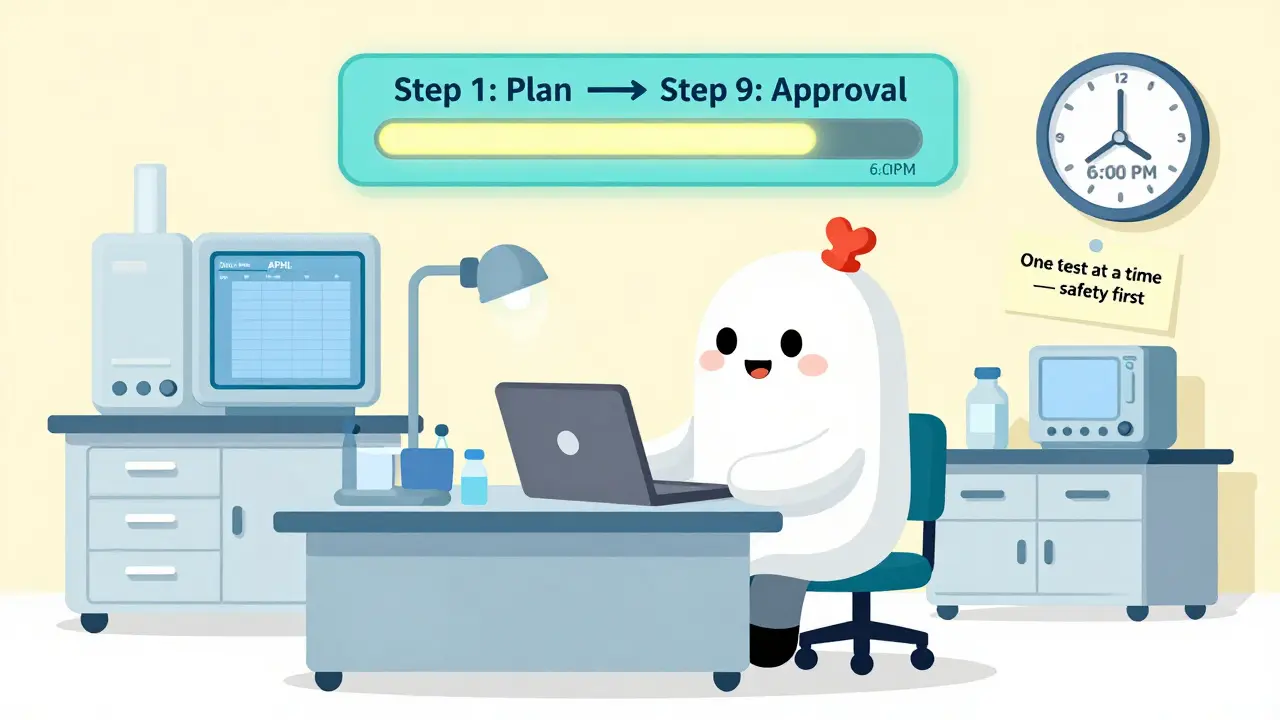
What You Should Do Today
If you’re a provider: Ask your lab if they verify their medication monitoring tests. If they say “yes,” ask how they did it. Request their verification report. If they can’t show it, push back. Your patient’s life depends on it. If you’re in the lab: Start with one test. Download the APHL toolkit. Use their worksheets. Don’t try to reinvent the wheel. Document everything. Train your team. Make verification part of your routine-not a project. If you’re a hospital administrator: Fund this. Hire a quality specialist. Pay for the time. The cost of one medication error-hospitalization, lawsuit, death-far outweighs the $5,000 it costs to verify a test. This isn’t about compliance. It’s about trust. When a doctor prescribes a drug based on a lab result, they’re trusting that number. That trust has to be earned. And the only way to earn it is to prove the test is right.Frequently Asked Questions
What’s the most common mistake in medication lab verification?
The biggest mistake is skipping interference testing. Many labs only check for one or two common drugs, but metabolites from other medications can cause false highs or lows. For example, carbamazepine’s metabolites can interfere with its own test. If you don’t test for them, you’ll misread levels-and patients could get too much or too little. Always test with at least six clinically relevant interfering substances at concentrations you’d see in real patients.
Can I use a reference lab instead of verifying in-house?
Yes, but only if you’re sure they verify their own tests. Many reference labs outsource to third parties. Ask for their verification documentation for the specific test you’re using. If they can’t provide it, find a lab that can. You’re still responsible for the result, even if someone else ran the test.
How often should I re-verify a test?
Re-verify after any major change: new instrument, new reagent lot, major maintenance, or if you notice inconsistent results. Most labs do it annually, but if you’re running high-risk drugs like digoxin or tacrolimus, do it every six months. Also, re-verify if the manufacturer updates their test or if CLIA or CAP changes their guidelines.
Do I need to verify every drug I monitor?
Yes-if you’re reporting the result. Even if you only run a test once a month, you still need to verify it. There’s no exception for low-volume tests. The risk isn’t about frequency-it’s about consequence. One wrong digoxin level can kill. Verification isn’t optional, even for rare drugs.
What if my lab doesn’t have the budget for verification?
Start small. Use free tools from APHL. Borrow equipment from a nearby hospital. Focus on one high-risk drug first-like lithium or vancomycin. Get that verified, then expand. The cost of one error-legal fees, patient harm, lost license-can be $500,000 or more. Verification is an investment, not an expense.
What’s the difference between CLIA and CAP requirements?
CLIA is the law. CAP is the gold standard. CLIA requires verification of all tests. CAP goes further: they require you to verify the therapeutic range, not just analytical performance. That means you must prove the test accurately reflects what the doctor needs-like confirming that a vancomycin level of 15 mcg/mL actually means therapeutic, not just measurable. CAP accreditation is voluntary, but most hospitals require it. If you’re not CAP-accredited, you’re already operating below the standard.
10 Comments
man i read this whole thing and honestly? most labs are just winging it. i work in a community hospital and our vancomycin test? we got the kit, stuck it in the machine, and called it a day. no interference testing, no linearity checks, just ‘it prints a number so it must be right.’ and yeah, we had that one guy whose level was 32 mcg/mL but he was fine-turns out his blood was full of antibiotics that messed with the assay. we didn’t know. now i’m terrified every time i see a digoxin result. we need to do better. or people are gonna keep dying.
thank you for writing this 🙏 i’ve been trying to get my lab to verify our tacrolimus test for 8 months and everyone says ‘we’re busy’ or ‘it’s not CAP-required yet.’ but this? this is why we do this job. i downloaded the APHL toolkit and started Step 1 today. if one kid doesn’t reject their new kidney because we caught a metabolite interference, it’s worth it. also, if anyone needs help with the stats part, i’ve got Excel templates. DM me!
verification vs validation? pfft. everyone knows it’s just CLIA theater. the real issue is that no one cares until someone dies. and even then, it’s ‘oops, sorry, we’ll update our SOPs next fiscal quarter.’ the FDA doesn’t enforce anything until there’s a lawsuit. meanwhile, our techs are running 12-hour shifts and still expected to ‘validate’ a new biologic test with no training. this isn’t science-it’s a bureaucratic farce.
i read this from nigeria. we don’t have most of these kits here. but i still see patients with wrong drug levels. i think the point is not perfection-it’s trying. even if you just check one drug, just once, you’re doing more than most. start small. keep going. i’m sharing this with my lab here.
the part about re-verifying after reagent lot changes? that’s the one we always skip. we say ‘it’s the same manufacturer, same catalog number.’ but the batch-to-batch variability in some reagents is wild. last year we had a 12% drift in lithium results after switching lots. no one noticed until a patient had seizures. now we test every new lot against a control. it adds 3 hours a month. worth it.
let’s be real-this entire post is just a 3000-word LinkedIn post disguised as a clinical guideline. ‘trust the number’? the number is a lie. every lab has bias, drift, interference, and human error. the only thing that matters is clinical correlation. if the patient feels worse and the level is ‘therapeutic,’ the level is wrong. stop fetishizing the machine. the doctor’s brain is still the most accurate diagnostic tool we have. also, why is everyone acting like APHL is the holy grail? it’s a free PDF. not a miracle.
oh wow. 9 steps. 40 hours. a whole damn manual. and i thought my job was hard. congrats, you just turned a blood test into a six-month project. meanwhile, in the real world, we’re still using a 1998 centrifuge and praying the reagent hasn’t expired. if your lab can afford this level of rigor, great. for the rest of us? we do our best. and sometimes, that’s enough. also, ‘you’re putting patients at risk’? dramatic. but i’ll give you that one.
the real tragedy isn’t the labs that skip verification-it’s the ones that think they did it right. i’ve seen SOPs that say ‘verified’ but have zero data. just a checkbox. if you don’t have raw numbers, you didn’t verify. you just wrote a story. and no, your director’s signature doesn’t make it true. if you’re going to claim verification, show the data. or shut up.
i love this so much. i work in a small clinic in india and we don’t even have a proper lab-but we started verifying our lithium test last month. used a borrowed spectrophotometer, borrowed reference samples, and my cousin who’s a bio student helped with the math. we got a 4.1% CV. not perfect. but better than before. if we can do it, anyone can. you don’t need a big hospital. you just need to care. ❤️
the FDA guidance update in 2026 is just more paperwork. we’re already drowning. no one has time for 15 metabolites. just let us run the test and move on.