
How to Read Dose Measurements on Liquid Prescription Labels

Imagine picking up a bottle of liquid medicine for your child. The label says "Take 5 mL twice daily." You grab the kitchen spoon you've used for years. But what if that spoon actually holds 7 mL? That extra 2 mL could mean the difference between a helpful dose and an accidental overdose. This is exactly why understanding how to read dose measurements on liquid prescription labels matters so much.
Mistakes with liquid medications are more common than most people realize. According to the FDA, about 1.3 million injuries in the U.S. each year are linked to medication errors. A big chunk of those comes from simply measuring the wrong amount. For kids under 12, who make up 75% of liquid prescription users, getting this right is critical. The good news? Once you know what to look for, reading these labels becomes straightforward.
The Core Numbers You Need to Find
Every liquid prescription label has three key pieces of information. If you can identify these, you're 90% of the way to safe dosing.
- Total Container Volume: This is the total amount of medicine in the bottle. It usually appears near the top or bottom of the label, like "Net Contents: 118 mL" or "237 mL." Don't confuse this with your dose. It's just telling you how much is in the container.
- Concentration: This tells you how much active ingredient is in each unit of volume. You'll see it written as something like "125 mg/5 mL" or "240 mg/5 mL." This means there are 125 milligrams of medicine in every 5 milliliters of liquid. This number stays the same no matter how much you pour.
- Dosage Instructions: This is the actual amount you should give per dose. It will say things like "Take 10 mL twice daily" or "Give 2.5 mL every 6 hours." This is the number you use when measuring.
Here's where people trip up: confusing concentration with dosage. If the label says "125 mg/5 mL" and your doctor prescribed "125 mg," you need to give 5 mL. But if they prescribed "250 mg," you'd give 10 mL. The concentration doesn't change; only the volume you measure does.
Why Milliliters Beat Teaspoons Every Time
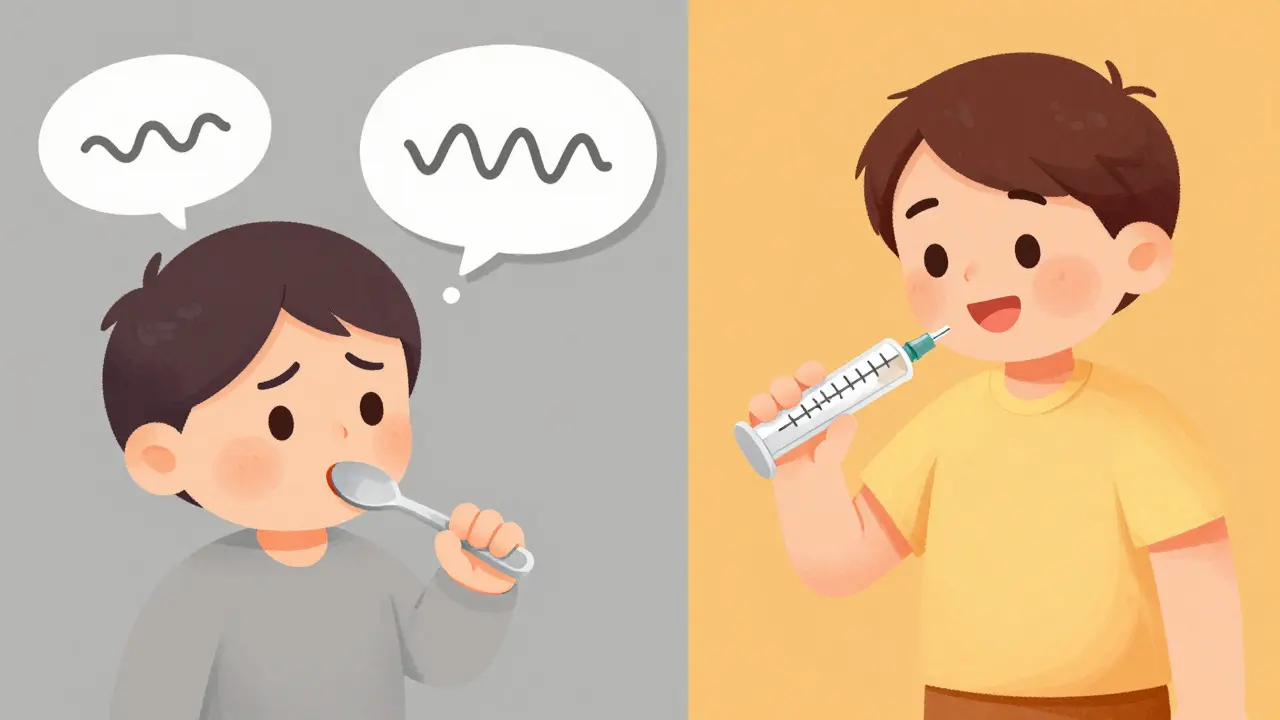
You might be tempted to use a teaspoon because it's handy. But here's the problem: household spoons aren't standardized. Consumer Reports found that regular teaspoons can hold anywhere from 2.5 to 7.5 mL, and tablespoons range from 5 to 20 mL. That's a huge difference for a tiny dose.
The National Council for Prescription Drug Programs (NCPDP) set clear guidelines in 2015 to fix this. They recommended that all liquid prescription labels use milliliters (mL) as the only unit of measurement. No teaspoons. No tablespoons. Just mL. This standard was adopted by major pharmacy chains like CVS, Walgreens, and Rite Aid by 2020, according to FDA inspection reports.
Why does this matter? A 2017 study in the Journal of Patient Safety showed that using milliliter-based labeling reduced administration errors by 52% compared to teaspoon/tablespoon labeling. For infants and toddlers who need very small doses-like 0.8 mL-precision isn't optional. It's essential.
| Measurement | Milliliters (mL) | Typical Household Spoon Variability |
|---|---|---|
| 1/2 teaspoon | 2.5 mL | 1.25-3.75 mL |
| 1 teaspoon | 5 mL | 2.5-7.5 mL |
| 1/2 tablespoon | 7.5 mL | 3.75-10 mL |
| 1 tablespoon | 15 mL | 5-20 mL |
Notice how wide the range is for household spoons? That variability is exactly why the NCPDP pushed for metric-only labeling. When you use a proper measuring device marked in mL, you eliminate that guesswork.
Reading the Fine Print: Decimals and Spacing
Small details on the label can make a big difference. Here are two formatting rules that prevent serious mistakes:
- Leading Zeros: Any dose less than 1 mL must have a zero before the decimal point. So you'll see "0.5 mL," not ".5 mL." Why? Because a missing zero can turn 0.5 mL into 5 mL-a tenfold error. A 2018 Johns Hopkins study found that this simple rule reduced 10-fold dosing errors by 47%.
- No Trailing Zeros: Doses should never end with a zero after the decimal. So it's "5 mL," not "5.0 mL." This keeps things clean and reduces confusion.
- Spacing: There should always be a space between the number and the unit. "5 mL" is correct; "5mL" is not. This small gap helps your eye separate the value from the unit, reducing misreads.
These might seem like minor typographic choices, but they're based on real-world error data. The FDA's 2016 guidance document explicitly mandates these formats to improve clarity and safety.
Using the Right Measuring Device
Your pharmacy should include a measuring device with your liquid prescription. These come in several forms:
- Oral Syringes: Best for small doses under 10 mL. They have fine markings, often down to 0.1 mL increments. Great for infants and young children.
- Dosing Cups: Good for larger volumes, typically up to 30 mL. Look for ones with both mL and teaspoon markings, though you should rely on the mL side.
- Graduated Droppers: Used for very precise, tiny doses, like eye drops or certain infant formulas. Not common for standard oral liquids.
Here's a pro tip: always check that the measuring device matches the units on your label. If your label says "5 mL," use the mL markings on your cup or syringe. Ignore the teaspoon lines entirely. A 2016 PMC study found a 98.6% discrepancy rate between label instructions and measuring devices in over-the-counter products, so double-checking is smart.
If you don't have a measuring device, ask your pharmacist for one. The Centers for Medicare & Medicaid Services (CMS) requires pharmacies to provide appropriate measuring tools with liquid prescriptions. It's part of their quality metrics for Medicare Part D coverage.

Common Mistakes and How to Avoid Them
Even with clear labels, people still make errors. Here are the top three pitfalls and simple fixes:
- Confusing Total Volume with Dose: Seeing "118 mL" on the bottle and thinking that's what you should give. Fix: Always look for the specific dosage instruction line, which will say "Take X mL Y times daily."
- Misreading Decimals: Reading "0.5 mL" as "5 mL." Fix: Use the leading-zero rule as a mental checkpoint. If there's no zero before the decimal, pause and re-read.
- Using Kitchen Utensils: Grabbing a random spoon instead of the provided measuring device. Fix: Keep your measuring device in a visible spot, like next to the medicine cabinet. Make it the default tool.
One parent shared on a parenting forum: "I used my kitchen spoon for my baby's fever medicine for three days before realizing the label said 5 mL and my spoon held 7 mL - no wonder he was so sleepy!" That story highlights how easy it is to slip into bad habits. The solution? Practice the "teach-back" method. After your pharmacist explains the dose, repeat it back to them in your own words. Ask them to watch you measure once. This simple step reduces errors by 63%, according to AHRQ guidelines.
When to Call Your Pharmacist
Sometimes the label isn't clear enough, or you're unsure about something. Don't hesitate to call your pharmacy. Here are situations where a quick phone call saves trouble:
- The concentration and dosage seem inconsistent with what you remember being told.
- You're switching from one brand to another and the concentrations differ.
- Your child refuses the taste, and you're considering diluting it (ask first!).
- The expiration date is close, and you're unsure if the medicine is still effective.
Pharmacists are trained to explain dosing clearly. A 2022 report from Nationwide Children's Hospital found that 78% of parents who received a hands-on demonstration made no dosing errors, compared to only 60.6% without education. So asking for help isn't a sign of weakness-it's a smart safety move.
What does "mg/mL" mean on a liquid prescription label?
It stands for milligrams per milliliter. It tells you how much active drug is in each milliliter of liquid. For example, "125 mg/5 mL" means there are 125 milligrams of medicine in every 5 milliliters of liquid. To find the dose for a specific milligram amount, divide the prescribed milligrams by the concentration.
Can I use a kitchen spoon to measure liquid medicine?
It's not recommended. Household spoons vary widely in size, with teaspoons holding anywhere from 2.5 to 7.5 mL. This variability can lead to significant dosing errors. Always use the measuring device provided by your pharmacy, which is calibrated in milliliters.
Why do some labels still show teaspoons?
Most new prescriptions follow NCPDP standards and use only milliliters. However, some older stocks or independent pharmacies may still display teaspoon equivalents for convenience. Even if you see teaspoons, rely on the milliliter amount for accuracy. If you're unsure, ask your pharmacist to clarify.
How do I calculate the dose if the concentration changes?
Use this formula: (Prescribed Dose in mg) ÷ (Concentration in mg/mL) = Volume to Measure in mL. For example, if you need 250 mg and the concentration is 125 mg/5 mL (which is 25 mg/mL), you'd calculate 250 ÷ 25 = 10 mL. When in doubt, confirm with your pharmacist.
What if my measuring device doesn't have mL markings?
Ask your pharmacy for a replacement. CMS requires pharmacies to provide appropriate measuring devices with liquid prescriptions. A proper oral syringe or dosing cup should have clear milliliter markings. Using a device without mL markings increases the risk of dosing errors.