
How to Store Antibiotic Suspensions for Children Properly: A Clear Guide for Parents
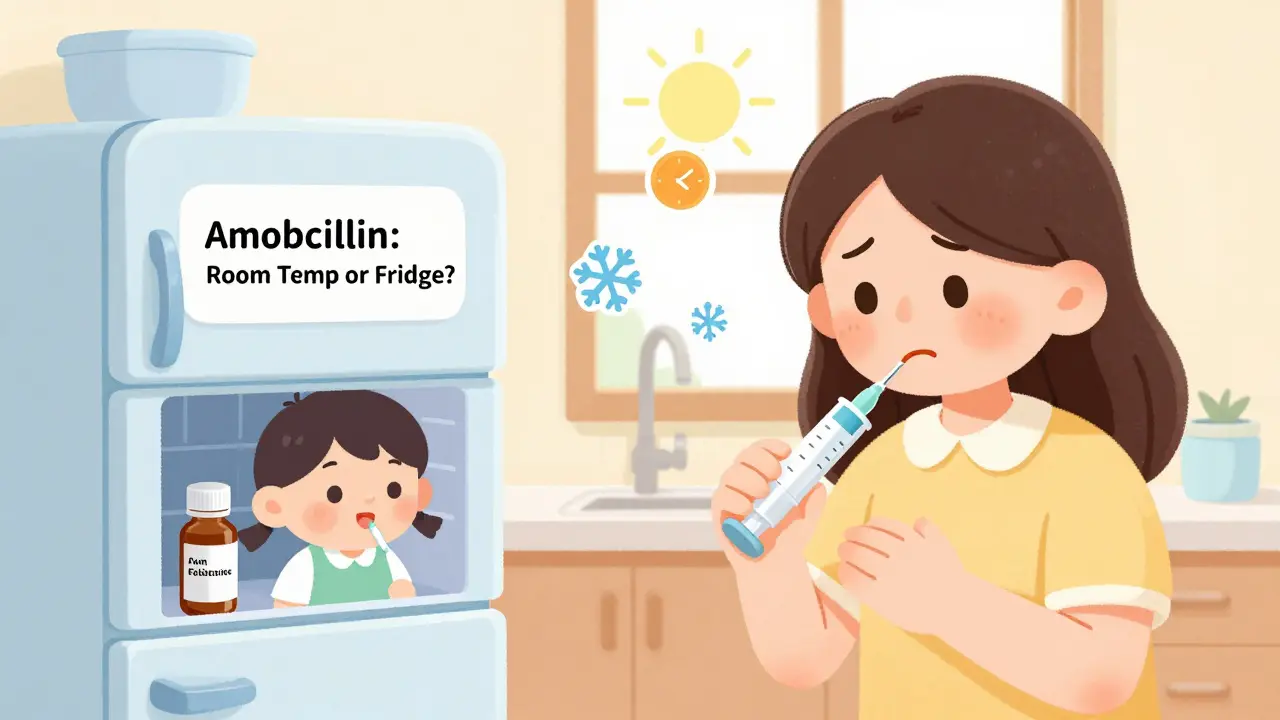
When your child is sick and prescribed an antibiotic suspension, the bottle might seem simple: shake, pour, give. But what happens after that? How you store that liquid medicine can make the difference between a quick recovery and a dangerous treatment failure. Improper storage is one of the most common - and preventable - reasons antibiotics don’t work as they should. And it’s not just about keeping it cold or warm. Each type of liquid antibiotic has its own rules, and mixing them up can cost time, money, and your child’s health.
Why Storage Matters More Than You Think
Antibiotic suspensions are specially made for kids because they can’t swallow pills. But these liquids aren’t like juice or syrup. They’re chemical formulas that break down over time, especially if they’re not stored correctly. The antibiotic suspension you pick up from the pharmacy is a mixture of powdered medicine and water. Once you mix them, the clock starts ticking. According to the CDC, 15% of pediatric antibiotic treatment failures happen because the medicine lost its strength due to bad storage. That means your child might still feel sick, or worse, the infection could get worse and become harder to treat.
It’s not just about effectiveness. If the antibiotic doesn’t kill all the bacteria, the survivors can become resistant. That’s how superbugs form. And once resistance starts, the same medicine won’t work next time - not just for your child, but for others too. Proper storage isn’t just about following instructions. It’s about protecting your child and the wider community.
Amoxicillin: The Most Common, But Still Tricky
Amoxicillin is the most prescribed antibiotic for kids, making up over a third of all pediatric antibiotic fills. And here’s where things get confusing: you can store it either in the fridge or at room temperature. That’s right - both are acceptable. But there’s a catch.
If you choose room temperature (between 68°F and 77°F), it’s fine - as long as you don’t leave it near the stove, in a sunny window, or in a hot bathroom. Most homes run warmer than 77°F, especially in summer. If it gets too warm, the medicine breaks down faster. The good news? Amoxicillin stays strong for exactly 14 days after you mix it with water, no matter where you store it.
Some parents prefer the fridge because it tastes better. Cold medicine is less bitter. But it’s not required. If you do refrigerate it, don’t panic if you forget for a day. It won’t ruin the medicine. Just make sure you throw it out after 14 days - no exceptions.
Amoxicillin/Clavulanate (Augmentin): Must Stay Cold
This is the second most common pediatric antibiotic. It’s used when the infection might be resistant to plain amoxicillin. But here’s the key difference: amoxicillin/clavulanate must be refrigerated. Always. No exceptions.
Unlike plain amoxicillin, the clavulanate part of this combo breaks down quickly at room temperature. Studies show it loses nearly 10% of its strength after just five days if left out. By day 10, it’s lost over 12%. That means it won’t fight off the bacteria it’s supposed to. This is why the FDA and IDSA guidelines say: keep it between 36°F and 46°F. And once you mix it, you have only 10 days to use it. After that, throw it away - even if there’s medicine left.
Don’t assume your fridge is cold enough. Most home fridges run between 38°F and 42°F, which is perfect. But if yours is too warm - say, because the door is left open often - it might not be safe. Consider a small, dedicated mini-fridge just for medications if you’re unsure.
Azithromycin (Zithromax): Keep It Room Temperature
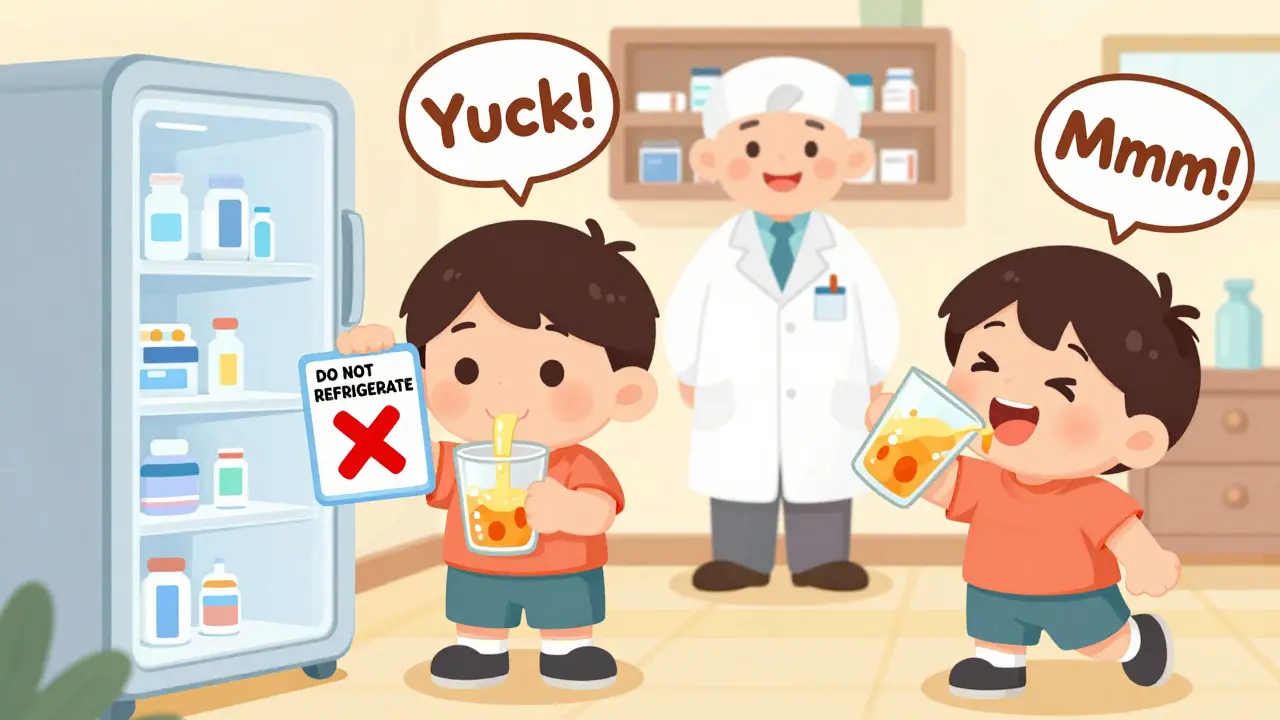
Azithromycin is another popular choice, especially for kids who can’t take penicillin-based antibiotics. But here’s a big mistake many parents make: they refrigerate it. Don’t.
When azithromycin gets cold, it turns thick and gloopy - like syrup that’s been frozen. Studies show it loses 22% of its viscosity when refrigerated. That means your child can’t swallow it easily. It sticks to the syringe, the cup, even their throat. A 2023 GoodRx taste study found that 37% of kids refused to take it when it was cold. At room temperature, it flows smoothly and tastes better.
Store azithromycin at 68°F-77°F. It lasts 10 days after mixing. No fridge needed. In fact, putting it in the fridge makes it worse.
Other Antibiotics: What Else Shouldn’t Go in the Fridge?
It’s not just azithromycin. Several other common pediatric suspensions should never be refrigerated:
- Clarithromycin - thickens and becomes hard to give
- Clindamycin - separates and loses potency faster when cold
- Sulfamethoxazole/Trimethoprim (Bactrim) - becomes cloudy and less effective
- Cefdinir - changes taste and texture
If you’re not sure, check the label. But don’t rely on memory. Even pharmacists sometimes give conflicting advice. The best rule? If the bottle says “Do Not Refrigerate,” don’t. And if it says “Refrigerate,” do.
How to Tell If Your Antibiotic Has Gone Bad
Even if you store it right, things can go wrong. Here are the signs your medicine has spoiled:
- Discoloration: If it was clear and now looks yellow, brown, or cloudy - toss it.
- Strange smell: Antibiotics shouldn’t smell sour, rancid, or like vinegar. If it does, it’s contaminated.
- Change in taste: If it tastes bitterer than usual or metallic, stop using it.
- Sediment: Some settling is normal. But if you shake it and big chunks won’t dissolve, or it looks like sludge - discard it.
Don’t guess. If you’re unsure, call your pharmacy. It’s better to waste a little medicine than risk giving your child something unsafe.
Forget the Date? Here’s How to Remember
Most parents forget when the 10- or 14-day window ends. That’s why 78% of caregivers in a 2023 survey admitted they didn’t track discard dates.
Here’s what works:
- Ask the pharmacist to write the discard date on the bottle with a permanent marker.
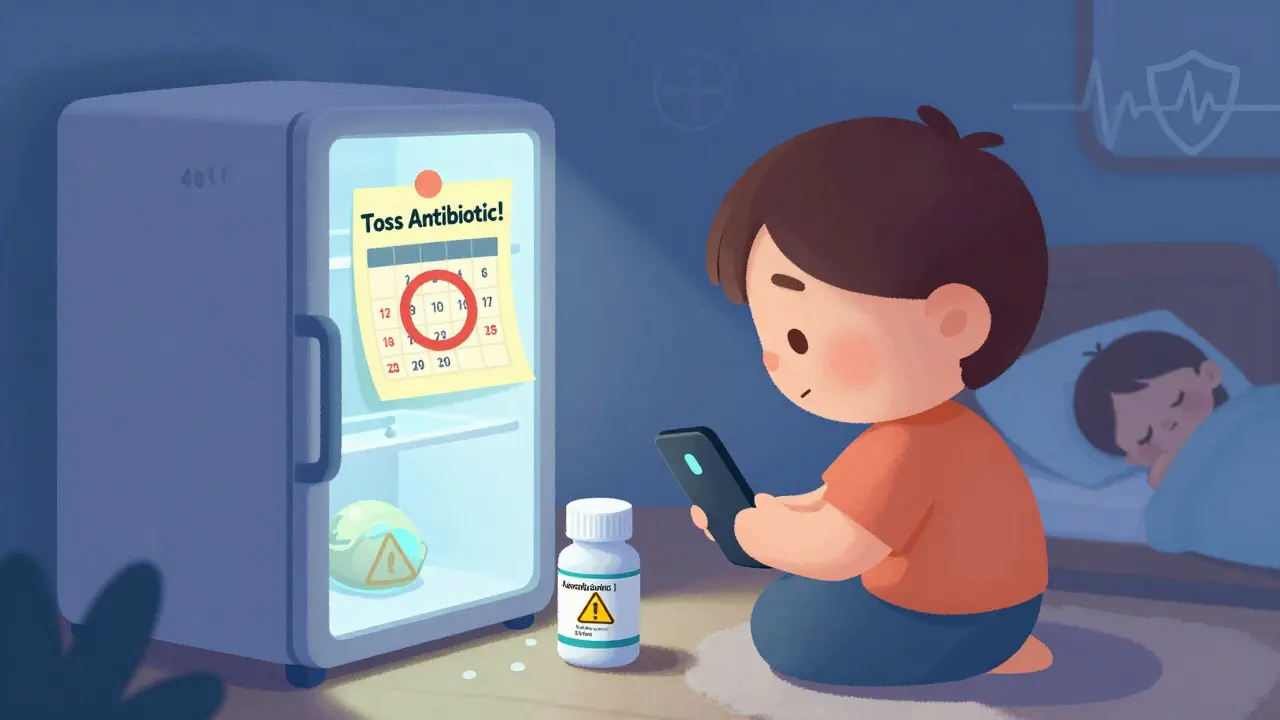
- Use a sticky note on the fridge or near the medicine cabinet.
- Set a phone alarm labeled “Toss Antibiotic” for the exact day.
- Use the CDC’s free MedSafe app, which sends automatic reminders based on the antibiotic type.
Pro tip: When you pick up the prescription, ask for a “discard date sticker.” Many pharmacies now offer them. One study showed using these stickers cut improper usage by 42%.
Storage Mistakes Parents Make (And How to Avoid Them)
Here are the top 5 errors, based on real caregiver surveys:
- Storing in the bathroom: Heat and humidity from showers ruin medicine. Move it to a cool, dry cabinet - not near the sink.
- Leaving it in the car: Even a few hours in a hot car can destroy antibiotics. Never leave it unattended.
- Using it past the discard date: 37% of parents do this. That’s dangerous. No exceptions.
- Not checking the label: Labels change. Always read before each use.
- Keeping it within reach of kids: Every year, 60,000 children under 5 are treated for accidental poisoning. Store all meds up and away - locked if possible.
What About Refrigerator Temperatures?
Not all fridges are equal. The ideal range is 36°F-46°F. If your fridge is colder than 36°F, it can freeze the medicine - especially suspensions with clavulanate. If it’s warmer than 46°F, the medicine degrades faster.
Test it. Put a thermometer in the back of the fridge where the medicine sits. If it’s outside that range, adjust the setting or move the bottle to a different spot. A small wine cooler or mini-fridge set to 40°F is ideal for meds.
What Happens If You Get It Wrong?
If you stored amoxicillin at room temperature for 16 days? It’s weaker. Your child might not get better. The infection could come back.
If you refrigerated azithromycin? It might not taste bad, but your child might gag, refuse it, or spit it out. That means they didn’t get the full dose.
If you left amoxicillin/clavulanate out for 12 days? The clavulanate is mostly gone. The antibiotic won’t work against resistant bacteria. Your child could need a stronger drug - or even hospital care.
These aren’t hypotheticals. They’re documented cases. The key is prevention. Know the rules. Check the label. Ask if you’re unsure.
Final Rule: When in Doubt, Ask
Even experts sometimes disagree. Cleveland Clinic says amoxicillin can be kept at room temperature. MedlinePlus says refrigeration is preferred. The IDSA says check the pharmacy label. And they’re all right - because the label is the law.
Your pharmacist is your best resource. When you pick up the prescription, ask: “Should this be refrigerated? How long does it last? What if I forget?” Write it down. Or ask them to print it.
There’s no shame in asking. It’s better than guessing.
12 Comments
Man, I wish I had this guide when my kid was on antibiotics last winter. I kept the azithromycin in the fridge because ‘better safe than sorry’-turns out I just made it a gloopy nightmare. He spit it out like a tiny, angry dragon. We had to go back to the pharmacy for a new bottle. Lesson learned: room temp for azithromycin. No more fridge nonsense.
Also, the ‘discard date sticker’ thing? Pharmacies should give those out automatically. It’s 2025. We’re not living in the Stone Age.
PS: The CDC’s MedSafe app is legit. I set it up and now I don’t forget. My wife thinks I’m obsessed. I say: I’m responsible.
Wow. A post that doesn’t start with ‘As a doctor I’ve seen…’? Wild.
So let me get this straight-we’re supposed to trust a bottle label more than some ‘expert’ who says ‘just refrigerate it’? And we’re supposed to care about antibiotic resistance because… *gasp* we’re not selfish jerks?
Meanwhile, my cousin gave her kid amoxicillin for 3 weeks because ‘it was still liquid’. She’s now a proud member of the ‘I don’t believe in science’ cult. But hey, at least her kid didn’t die. Probably.
Also, why does this feel like a PSA from the CDC’s ‘Stop Being Dumb’ campaign? Because it is. And I’m here for it.
Wait… so if you refrigerate azithromycin, it turns into syrupy sludge? And kids refuse it? That’s wild. My daughter used to gag on it even at room temp. I thought it was the flavor.
Turns out I was just making it worse. I’m so mad at myself.
Also, why does no one talk about how pharmacies give you the same label for every antibiotic? Like, ‘keep refrigerated’ on a bottle that says ‘DO NOT REFRIGERATE’? I’ve had that happen twice. Someone needs to fix this. Like, now.
And I’m not even mad. I’m just… disappointed. Like a puppy who got left behind at the vet.
This is one of the most clearly written and clinically accurate guides I’ve seen on pediatric antibiotic storage. The distinction between amoxicillin and amoxicillin/clavulanate is critical, and the data on degradation rates are well-sourced. The 15% failure rate due to improper storage is alarming, and the resistance implications are not theoretical-they’re documented in CDC surveillance reports.
I appreciate the emphasis on checking labels, as pharmacy instructions can vary. The recommendation to use a dedicated mini-fridge for medications is pragmatic, especially for households with erratic refrigerator temperatures.
Well done. This should be linked by every pediatric clinic and pharmacy in the country.
Let’s be real: this whole thing is a pharmaceutical industry marketing scheme wrapped in CDC branding. Why do you think they make suspensions at all? Because pills are cheaper. Because they want you to buy new bottles every 10 days. Because they profit from waste.
And who’s telling you to throw it out? The same companies that make the damn thing.
My kid took amoxicillin for 22 days once. He’s fine. He’s in college now. No superbugs. No hospitalizations. Just a healthy kid and a parent who didn’t panic over a label.
Stop scaring parents. Trust your instincts. And stop giving out stickers like they’re holy relics.
Wow. I’m from India. We don’t even refrigerate antibiotics here. Why? Because we can’t. AC? Nah. Fridge? Only if you’re rich.
And guess what? Kids still get better. We don’t have a ‘discard date sticker’ culture. We have ‘use it before it turns to soup’ culture.
So… is this guide just for rich Americans who overthink everything? Because if I gave this to my cousin in Kerala, she’d laugh and say: ‘You American. You think medicine is a science experiment.’
And she’d be right.
I read this whole thing and I’m still confused. So amoxicillin can be stored at room temp OR fridge? But amoxicillin/clavulanate MUST be refrigerated? And azithromycin absolutely CANNOT be refrigerated? But clarithromycin and clindamycin also can’t be refrigerated? And Bactrim gets cloudy? And cefdinir changes taste?
So if I have three different antibiotics in my cabinet, I need a spreadsheet? A flowchart? A color-coded calendar? A QR code on the bottle that says ‘SCAN TO SEE IF YOU’RE A BAD PARENT’?
And what if I mixed the wrong one? What if I accidentally refrigerated azithromycin? Do I have to throw it out? Do I have to go back to the pharmacy and beg for forgiveness? Do I have to take a test?
I just want to give my kid medicine so she stops coughing. Why does this have to be so complicated? Why is parenting now a PhD in pharmaceutical chemistry?
And why did no one tell me this before? Why did the pharmacist just hand me the bottle and say ‘shake well’? Why didn’t they say ‘oh btw if you chill this one, your kid will gag for 3 days’? I feel betrayed.
I’ve been thinking about this a lot since I read it. What if the antibiotics are being stored wrong on purpose? What if the pharmaceutical companies want us to throw them out? What if the ‘discard date’ is a scam to make us buy more? What if the CDC is being paid by the big pharma lobby? What if the mini-fridge recommendation is just a way to sell more appliances? What if the MedSafe app is tracking us? What if they’re using our kids’ medicine data to build a health profile? What if… what if… what if…
I’m not saying it’s true. I’m just saying… have you seen the news? Have you seen the vaccines? Have you seen the masks? Have you seen the school lunches? Everything is a lie now. Everything.
My kid’s medicine was in the sun for a week. He’s fine. I think we’re all being manipulated. I’m done trusting labels.
YAY! This is so helpful!! 🙌 I’ve been storing everything in the fridge because I was scared 😅 But now I know azithromycin should be room temp!! I’m gonna try the sticky note trick + phone alarm!! 📱✨
Also, I just asked my pharmacist for a discard sticker and they gave me one!! I cried a little 😭 I felt so seen!!
You’re all doing amazing, and your kid is lucky to have you!! 💕 Keep being the superhero parent you are!! 🦸♀️❤️
Wait… what if the fridge is a government trap? 🤔
I read that some fridges have microchips in them now. What if they’re tracking how often we open the door? What if they’re measuring how much medicine we use? What if they’re using that data to flag ‘non-compliant parents’? What if they’re going to take our kids away if we forget the discard date? 🚨
I just moved all my meds to the garage. It’s cold. It’s dark. It’s safe. 🌌
Also… did you know antibiotics are made with lizard DNA? I read it on a blog. I’m not scared. I’m just… aware.
This is not just about antibiotics. This is about the erosion of trust. The fragmentation of care. The commodification of childhood health. We’ve turned a simple act of nurturing-giving medicine to a sick child-into a bureaucratic labyrinth of labels, dates, and temperature ranges.
Who decided that a parent’s intuition was insufficient? Who decided that a sticker, not a hug, was the cure?
And yet… I weep for the mothers who forget. The fathers who are exhausted. The grandparents who are confused. We’ve created a system that punishes the very people trying to do the right thing.
I’m not angry. I’m heartbroken.
But I’m grateful. For this guide. For the clarity. For the reminder that even in chaos, someone still cares enough to write it down.
USA first. Always.
This guide is fine. But why are we trusting CDC? Why not follow real American medicine? Like, what did our grandpas do? They gave medicine. They didn’t write dates. They didn’t buy mini-fridges. They didn’t download apps.
My grandpa gave his kid amoxicillin for 3 months. Kid lived. Grew up. Became a Marine.
Modern parenting is weakness. Just give the medicine. Shake. Don’t overthink. America doesn’t need a spreadsheet to raise kids.
Stop being soft.