
International Provider Views: How Doctors and Systems See Generic Drugs Globally

Walk into a pharmacy in Austin, Texas, and you’ll likely see a pharmacist hand you a white bottle with a generic label. Now imagine walking into a clinic in Mumbai or a hospital in Berlin. The scene looks similar, but the story behind that pill is completely different. For healthcare providers around the world, generic medications are not just cheaper copies of brand-name drugs; they are central pillars of national health strategy, economic survival, and patient access. The way doctors, pharmacists, and health administrators view these medicines depends heavily on where they practice. In some countries, generics are the default first choice for almost every prescription. In others, they are still fighting for trust against entrenched brand loyalty. As we look at the landscape in 2026, it’s clear that the global conversation about generics has shifted from "are they safe?" to "how do we manage the massive wave of patent expiries coming our way?"
The European Model: Generics as Policy, Not Choice
In Europe, the perspective on generics is shaped less by individual doctor preference and more by strict government policy. If you’re a provider in Germany, France, or the United Kingdom, prescribing a generic isn’t just a cost-saving move-it’s often a regulatory requirement or a strong financial incentive.
Europe holds nearly 30% of the global generic market share. Countries like Germany lead this charge, accounting for over 15% of that European slice. Here, providers view generics through the lens of system sustainability. With aging populations and rising chronic disease rates, European healthcare systems simply cannot afford to pay premium prices for brand-name drugs when effective alternatives exist.
| Region/Country | Market Share (%) | Provider Perspective |
|---|---|---|
| Germany | 15.58% | Policy-driven substitution; high trust |
| France | 13.58% | Cost containment focus |
| United Kingdom | 12.67% | NHS budget reliance |
| India | ~20% (Global Volume) | Essential infrastructure; export hub |
| United States | 90% (Prescription Volume) | Affordability necessity; supply chain concerns |
The growth in Europe is modest-around 2-5% annually-because the market is already saturated. Providers here don’t debate whether generics work; they debate how to maximize their use to keep public health budgets intact. The European Medicines Agency (EMA) sets strict standards, which gives local doctors confidence that a generic from Poland performs identically to one from Italy.
Asia-Pacific: The Engine of Global Supply
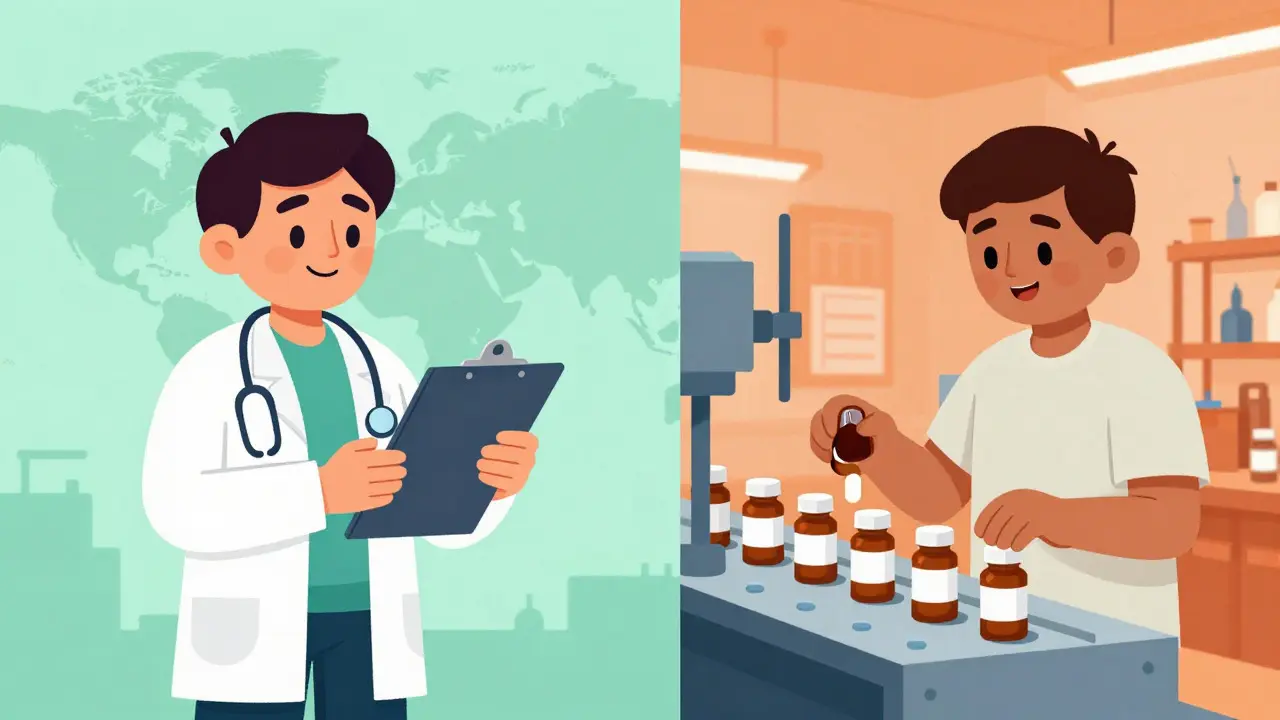
If Europe is the regulator, Asia-Pacific is the manufacturer. This region dominates the global generic market, driven by a mix of massive population needs and industrial capacity. For providers in India and China, generics are viewed as essential healthcare infrastructure, not just an alternative option.
India alone accounts for roughly 20% of the world’s generic drug volume. But here’s the kicker: Indian manufacturers supply about 40% of the generic medication demand in the United States. This creates a unique dynamic. Asian providers see themselves as both consumers and suppliers. They rely on low-cost production methods to treat their own growing populations while exporting quality-assured medicines globally.
The growth rate here is explosive, projected between 5% and 6.5% annually. Why? Because the demand is undeniable. Aging populations and rising rates of diabetes, cancer, and cardiovascular diseases require affordable, long-term treatments. Providers in these regions prioritize accessibility. If a patient can’t afford a branded drug, the generic isn’t a compromise; it’s the only path to treatment.
North America: Affordability vs. Trust
In the United States, the relationship with generics is complex. On paper, generics represent about 90% of all prescriptions written. That sounds like total adoption, right? Not quite. While they dominate in volume, they make up a much smaller share of pharmaceutical spending value because the price difference is so stark.
American providers view generics as a critical tool for affordability. With the high cost of name-brand medications, prescribing generics is often the only way to ensure patients actually fill their prescriptions. However, U.S. providers face two major hurdles that don’t affect their European or Asian counterparts as severely: drug shortages and quality perception issues.
Because the U.S. relies so heavily on imports-particularly from India and China-supply chain vulnerabilities are a constant worry. When a manufacturing plant in another country faces a regulatory issue or a natural disaster, U.S. hospitals feel the impact immediately. Additionally, some American patients remain skeptical of generics due to marketing campaigns by brand-name companies or past isolated quality incidents. Providers spend significant time educating patients that FDA-approved generics must meet the same rigorous standards as brand-name drugs.
The Emerging Markets: Generics as Default Care
In what analysts call "pharmerging" markets-including Brazil, Russia, Turkey, and parts of Africa-the perspective is shifting rapidly. These regions are expected to contribute around $140 billion in increased pharmaceutical spending by 2025. But unlike the West, where generics are used to save money on existing budgets, in these markets, generics are enabling care that wouldn’t otherwise exist.
Providers in these countries increasingly view generics as the default treatment option. There is no luxury of choosing expensive brands when basic healthcare infrastructure is still developing. Government policies actively promote generic adoption to stretch limited resources further. For a doctor in São Paulo or Moscow, prescribing a generic is a practical necessity driven by economic reality rather than just clinical preference.
The Next Frontier: Biosimilars and Specialty Generics
The most exciting shift in provider views right now involves complex generics, specifically biosimilars. Between 2025 and 2030, branded drugs generating over $217 billion in annual sales will lose their patent exclusivity. This includes high-revenue biologics used for oncology and immunology, such as ustekinumab and vedolizumab.
This is the largest wave of patent expiries in pharmaceutical history. For providers, this means the era of cheap pills is expanding into the realm of complex injections and infusions. The global specialty generics market is projected to grow at an impressive 11.74% CAGR, reaching nearly $186 billion by 2033.
Hospital pharmacies are seeing a surge in demand for these advanced generics. Patients admitted for cancer or autoimmune disorders are increasingly receiving biosimilar versions of expensive biologics. Providers who were once hesitant about generic versions of complex proteins are now embracing them as they prove clinically equivalent and dramatically reduce hospital costs. This marks a fundamental change: generics are no longer just for simple conditions like hypertension; they are becoming standard care for life-threatening diseases.
Why Regional Differences Matter for You
Understanding these international perspectives helps explain why your experience with medications might differ from someone else’s. It also highlights the importance of regulatory frameworks. Whether you’re in a country with strict substitution laws like Germany or a market-driven system like the U.S., the goal is the same: ensuring safe, effective, and affordable care.
As the global market continues to evolve, providers everywhere are aligning on one key truth: generics are not a temporary trend. They are the backbone of sustainable healthcare. With demographic pressures increasing and healthcare costs rising, the reliance on generic medications will only deepen. The question is no longer if providers will prescribe them, but how quickly they can adapt to the new generation of complex, high-value generic therapies.
Do generic drugs work as well as brand-name drugs?
Yes. Regulatory agencies like the FDA in the U.S. and the EMA in Europe require generic medications to have the same active ingredients, strength, dosage form, and route of administration as the brand-name product. They must demonstrate bioequivalence, meaning they perform similarly in the body. Clinical studies consistently show that generics are therapeutically equivalent to their brand-name counterparts.
Why do some countries have higher generic usage than others?
Usage rates depend on government policy, reimbursement structures, and cultural factors. In countries like Germany and Japan, governments mandate or strongly incentivize generic substitution to control healthcare costs. In other markets, brand loyalty or lack of awareness may slow adoption. Economic conditions also play a role; in lower-income nations, generics are often the only affordable option.
What are biosimilars, and how are they different from traditional generics?
Biosimilars are generic versions of biologic drugs, which are made from living organisms rather than synthesized chemically. Because biologics are more complex, biosimilars must undergo extensive testing to prove they are highly similar to the reference product with no clinically meaningful differences in safety or efficacy. Traditional generics are exact chemical copies of small-molecule drugs.
Are there risks associated with relying on imported generic drugs?
While most imported generics meet strict quality standards, supply chain vulnerabilities can lead to shortages if a foreign manufacturing facility faces issues. Quality concerns can also arise if regulatory oversight varies by country. However, major importing nations like the U.S. conduct regular inspections of foreign plants to mitigate these risks. Diversifying supply sources helps reduce dependency on single regions.
How will the upcoming wave of patent expiries affect my medication costs?
The expiration of patents for high-cost brand-name drugs, particularly biologics, is expected to significantly reduce prices. As biosimilars enter the market, competition increases, driving down costs for both insurers and patients. This trend should make advanced treatments for conditions like cancer and autoimmune diseases more accessible and affordable in the coming years.
15 Comments
Seeing this data really highlights how we in Nigeria are just scratching the surface of what India has achieved. We have so much potential to become a manufacturing hub for Africa, but the regulatory hurdles are tough. It is inspiring to see how generics can be the backbone of healthcare access rather than just a cost-cutting measure.
The article glosses over the fact that 'bioequivalence' is often a statistical fiction when you look at real-world patient outcomes. Big Pharma spends millions lobbying to keep brand loyalty alive because they know generics fail more often in sensitive populations like the elderly or those with narrow therapeutic index drugs. The European model works only because their systems absorb the failures quietly.
I always wonder if the trust issue in the US is just marketing noise or if there is some truth to it. My pharmacist once swapped my thyroid med and I felt terrible for weeks until I switched back to the brand name. Is that placebo or actual chemistry?
You probably didn't read the label on that bottle properly. Thyroid meds are notoriously sensitive to fillers and binders which vary by manufacturer. If your doctor prescribed the specific brand, the pharmacy shouldn't have substituted without consent. Blaming the generic itself is lazy thinking.
Fair point about the fillers. I guess I should have fought harder with the pharmacist instead of assuming the drug was just different. Thanks for clarifying that distinction.
Oh please, spare me the lecture on fillers. In India, we make the world's generics and we don't have these neurotic issues about every little molecule. You Americans are just spoiled by high prices and fear-mongering ads. If it works, it works. Stop whining.
Absolutely riveting stuff. Truly. Who knew that pills could be such a geopolitical chess game? I suppose while we were busy worrying about our own healthcare costs, the rest of the world was playing 4D chess with bioequivalence studies. Brilliant.
Look, folks, let's not get too carried away with the doom and gloom. : ) The reality is that biosimilars are going to change everything. I've been working in hospital procurement for years and the shift is undeniable. Yes, there are supply chain risks, sure, but the savings are massive. We need to embrace the complexity rather than fear it. It's all about adaptation and staying ahead of the curve. Trust me, I've seen enough contracts to know where this is heading. The future is bright, shiny, and significantly cheaper for everyone involved! :)
supply chain risks are understated. one factory fire in india and us hospitals run dry. its not about trust its about logistics. big pharma knows this thats why they lobby against full substitution
The concept of value shifts depending on geography. In Europe, value is systemic stability. In America, it is individual affordability. Both are valid but lead to different policy outcomes.
It is imperative that we recognize the structural differences in healthcare financing before making broad generalizations. The European model relies on collective bargaining power which is absent in the fragmented American market. This discrepancy necessitates a nuanced approach to generic adoption strategies across different jurisdictions.
Let's cut through the academic jargon for a second. The real issue here is the 'reference product' bias. Doctors prescribe brands because they feel safer, even though the pharmacokinetic profiles are identical. It's a psychological crutch. We need to educate providers on the statistical insignificance of minor variations. : )
Actually, the reference product bias is less about psychology and more about liability. If a generic fails, the doctor gets sued. If a brand fails, it's considered an anomaly. The legal framework in the US incentivizes brand prescribing despite the cost. It's a simple economic calculation disguised as medical caution.
i think people just want to feel safe you know. when you are sick you dont want to take chances. even if the stats say its fine the fear is real. maybe we should focus more on empathy than just cold hard numbers
It is interesting to observe how cultural attitudes towards authority influence medication adherence. In hierarchical societies, the doctor's word is law, whereas in more egalitarian cultures, patients question the substitution. This dynamic plays out differently in Berlin versus Austin.