
Manufacturing Changes and Generic Approval: What Triggers FDA Re-evaluation
Imagine you have a perfectly working machine that produces millions of pills every day. You want to upgrade one part to make it faster or cheaper. In the world of generic drugs, you can’t just swap out that part and keep running. The U.S. Food and Drug Administration (FDA) is the federal agency responsible for protecting public health by ensuring the safety, efficacy, and security of human and veterinary drugs watches closely. If your change affects the drug’s identity, strength, purity, or quality, you must ask for permission first. This process is called re-evaluation.
For generic drug manufacturers, navigating these rules is critical. A single misstep in reporting a manufacturing change can delay approvals for months, costing millions in lost revenue. Understanding what triggers an FDA review helps companies plan better and avoid costly surprises. This guide breaks down exactly which changes require attention, how they are classified, and what you need to do to get approval smoothly.
Why Manufacturing Changes Matter for Generic Drugs
Generic drugs must be bioequivalent to their brand-name counterparts, known as Reference Listed Drugs (RLDs). When you approve a generic via an Abbreviated New Drug Application (ANDA), you promise the FDA that your product matches the RLD in dosage form, safety, strength, route of administration, and intended use. Any change to how you make that drug could break that promise.
The regulatory framework relies on Chemistry, Manufacturing, and Controls (CMC) data. If you alter your process, you might unintentionally create new impurities or change how the drug dissolves in the body. The FDA requires re-evaluation to ensure these changes do not compromise patient safety. Under the Generic Drug User Fee Amendments (GDUFA III), authorized through 2027, the agency has tightened oversight to maintain high standards while speeding up reviews for compliant manufacturers.
| Concept | Definition | Impact on Approval |
|---|---|---|
| ANDA | Abbreviated New Drug Application | Initial pathway to market for generics |
| RLD | Reference Listed Drug | The brand-name drug used as the benchmark |
| CMC | Chemistry, Manufacturing, and Controls | Data proving drug quality and consistency |
| GDUFA | Generic Drug User Fee Amendments | Funding mechanism setting review timelines |
The Three Categories of Post-Approval Changes
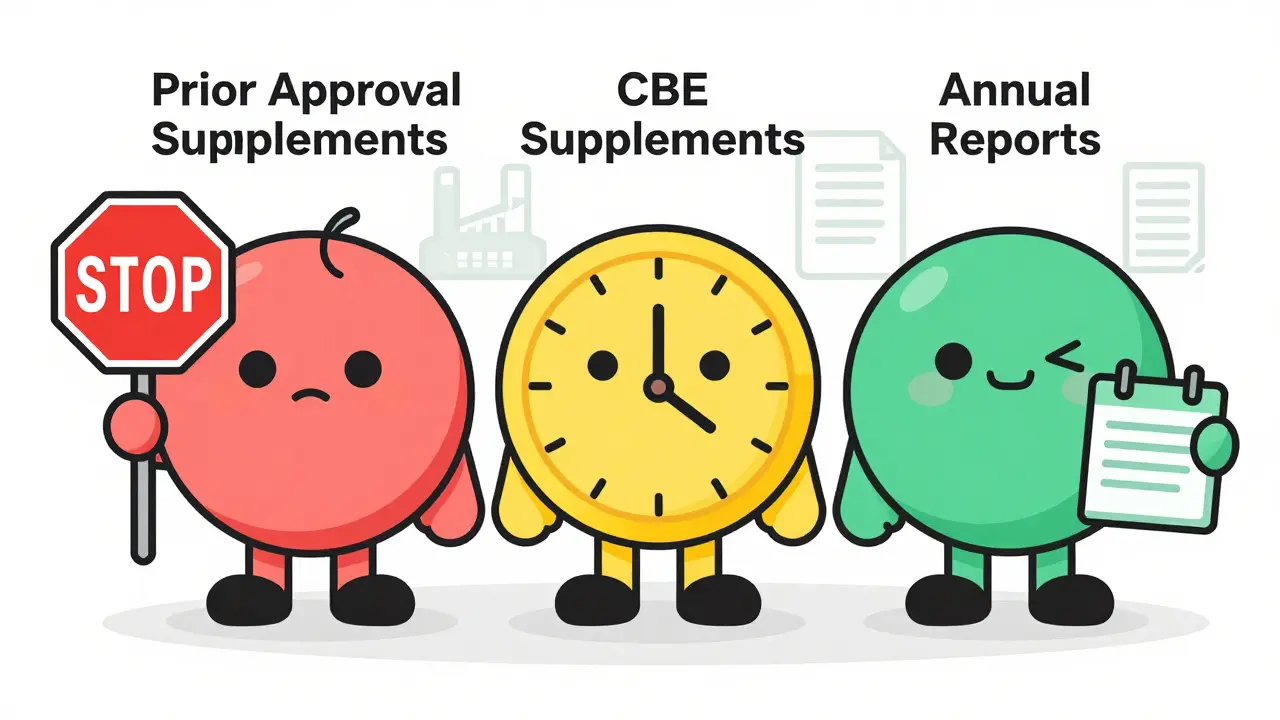
Not all changes are created equal. The FDA classifies post-approval modifications into three risk-based categories. Knowing which bucket your change falls into determines how much paperwork you need and how long you will wait.
- Prior Approval Supplements (PAS): These are major changes with significant potential impact on quality. You cannot implement them until the FDA says yes. Examples include changing the manufacturing site, altering the drug substance synthesis route, or significantly modifying equipment. According to recent data, PAS submissions account for a growing share of CMC filings, with a 27.3% increase between 2018 and 2022.
- Changes Being Effected (CBE) Supplements: These are moderate-risk changes where you can start implementing after notifying the FDA. There are two types: CBE-30 allows implementation 30 days after submission if no response is received, while CBE-0 allows immediate implementation but requires submission within 30 days. Common triggers include minor formulation adjustments or updates to analytical methods.
- Annual Reports (AR): These are minor changes with negligible risk. You report them annually without prior FDA review. Examples include minor packaging changes or small-scale equipment tweaks that don’t affect product quality.
A 2023 survey in Pharmaceutical Technology found that process changes and control alterations each made up about 15.9% of all post-approval submissions. Misclassifying a change can lead to enforcement actions, so accuracy is key.
What Specifically Triggers a Prior Approval Supplement?
If you are wondering whether your planned change needs a full re-evaluation, look at these common triggers. These scenarios almost always require a PAS because they carry higher risks of affecting bioequivalence or safety.
- Facility Transfers: Moving production from one plant to another, especially across different countries, requires extensive validation. The FDA wants to see that the new facility maintains identical conditions.
- Major Equipment Upgrades: Switching from batch processing to continuous manufacturing, or changing critical machinery like tablet presses, often demands new stability data and sometimes new bioequivalence studies.
- New Synthetic Routes: If you find a cheaper way to synthesize the active pharmaceutical ingredient (API), you must prove that the new route does not introduce harmful impurities. For complex generics like peptides, any new impurity must be below 0.5% with justification.
- Significant Scale-Up: Increasing batch size by more than 30% usually triggers a PAS. A case study showed that a 30% scale-up required six months of stability data and took 14 months to approve.
- Formulation Changes: Altering excipients (inactive ingredients) or the drug release mechanism can change how the body absorbs the medication, necessitating rigorous testing.
Data shows that 68.4% of PAS submissions for manufacturing changes receive at least one Complete Response Letter (CRL), meaning the FDA requests more information. Analytical method changes (28.7%) and facility transfers (24.5%) are the most frequent culprits for delays.
The Cost and Timeline of Re-Evaluation
Time is money in the generic drug industry. Margins are thin, and delays can kill profitability. Understanding the timeline helps you budget resources effectively.
Under standard GDUFA goals, a Prior Approval Supplement takes an average of 10 months to review. CBE-30 supplements take about 3 months, while CBE-0 supplements take around 9 months. However, complex changes often exceed these targets. For instance, a tablet press upgrade described by industry professionals took 18 months despite showing identical quality metrics, highlighting the unpredictability of regulatory scrutiny.
The financial burden is also substantial. Industry estimates suggest the average cost per PAS submission is approximately $287,500. This includes internal labor, external consulting fees, stability testing, and potential bioequivalence studies. Small manufacturers with fewer than five ANDAs face even steeper challenges, experiencing review times 43% longer than larger competitors. This disparity creates a barrier to innovation for smaller players who might benefit most from process improvements.
Strategies to Smooth the Approval Process
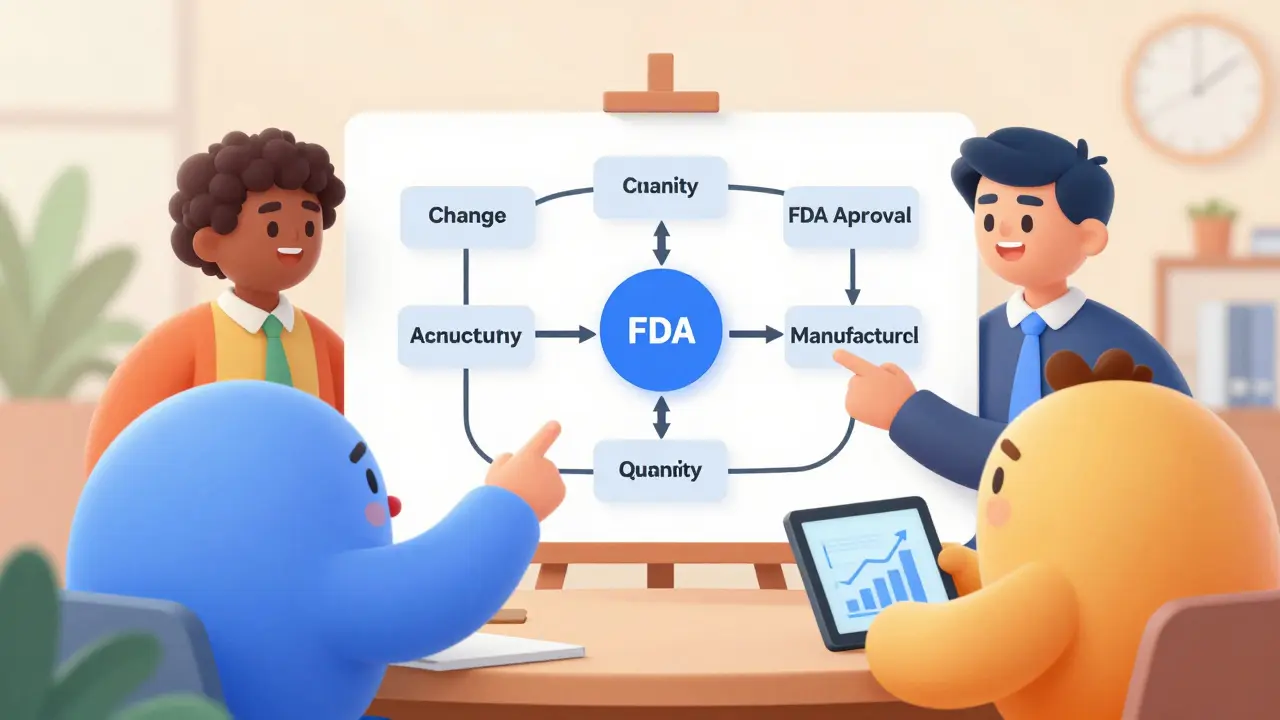
You don’t have to accept delays as inevitable. Smart planning can significantly reduce review times and improve outcomes. Here are practical steps based on expert recommendations and successful case studies.
Invest in Quality by Design (QbD)
Implementing QbD principles during initial ANDA development builds a robust design space. This means understanding how variables interact so that future minor changes fall within acceptable limits. Dr. Jane Smith, former FDA Office of Generic Drugs director, noted that improved process understanding can reduce post-approval CMC changes by up to 40%. Companies using advanced Process Analytical Technology (PAT) reported 32.6% fewer PAS submissions over five years.
Leverage Pre-Submission Meetings
Don’t guess what the FDA wants. Schedule pre-submission meetings to discuss your proposed change early. The FDA recommends 3-5 meetings for complex changes. Teva Pharmaceuticals successfully reduced a PAS review time to 8 months for amlodipine by holding extensive pre-meetings and providing comprehensive comparative analytics. This proactive approach aligns expectations before you spend months generating data.
Utilize Expedited Pathways
If you manufacture in the U.S., consider the ANDA Prioritization Pilot Program launched in September 2023. It offers faster reviews-potentially within 8 months instead of the standard 30-month average for new applications-for generics with U.S.-based manufacturing and domestic API sources. By 2026, analysts project that 37.5% of new generic approvals will qualify for such expedited pathways, reducing financial disincentives for manufacturing improvements.
Build Cross-Functional Teams
Change management isn’t just a regulatory affair. Assemble a team of 8-12 people from quality assurance, regulatory affairs, and manufacturing. They should conduct thorough risk assessments and prepare documentation well in advance. Mature quality management systems have been shown to reduce PAS approval timelines by 31.4%.
Looking Ahead: Regulatory Trends for 2026 and Beyond
The landscape is shifting. The FDA is increasingly focused on supply chain resilience and domestic manufacturing. Commissioner Robert Califf highlighted that faster reviews for domestically manufactured generics could incentivize $4.2 billion in new U.S. manufacturing investments by 2027. This policy direction benefits manufacturers who prioritize local production.
Additionally, draft guidance released in January 2024 proposes a tiered risk assessment framework for complex generic products. This could reduce PAS submissions for minor changes by up to 35%, easing the burden on innovators. As GDUFA IV negotiations proceed in 2025, expect further refinements aimed at standardizing change classification criteria. Currently, there is a 41.7% variation in how different FDA divisions categorize supplements, leading to inconsistent feedback. Standardization would bring much-needed clarity.
Manufacturers adopting advanced technologies now position themselves advantageously. McKinsey & Company projects that those leveraging modern manufacturing tools could reduce post-approval change-related revenue losses by $8.7 billion annually across the industry by 2030. The goal is clear: predictability and speed.
What is the difference between a PAS and a CBE supplement?
A Prior Approval Supplement (PAS) requires FDA approval before you can implement the change, typically for major modifications like facility transfers. A Change Being Effected (CBE) supplement allows you to implement the change after notifying the FDA, either immediately (CBE-0) or after 30 days (CBE-30), for moderate-risk changes.
How long does it take for the FDA to review a manufacturing change?
Review times vary by category. PAS submissions average 10 months, CBE-30 supplements take about 3 months, and CBE-0 supplements take around 9 months. Complex changes may take longer due to additional data requests.
Does moving my manufacturing plant to another country require FDA approval?
Yes, transferring manufacturing facilities, especially internationally, almost always requires a Prior Approval Supplement (PAS). You must demonstrate that the new site maintains identical quality controls and product characteristics.
What happens if I fail to report a manufacturing change?
Failure to report required changes can result in enforcement actions, including warning letters, fines, or suspension of your ANDA. It undermines the integrity of the approved product and poses potential risks to patient safety.
Can small generic manufacturers benefit from expedited review programs?
Yes, if they meet specific criteria such as U.S.-based manufacturing and domestic API sourcing under the ANDA Prioritization Pilot Program. However, small manufacturers often face longer baseline review times and may need additional support to navigate complex requirements.