
Melanoma Prevention, Detection, and Treatment: What You Need to Know in 2026
Melanoma is the deadliest form of skin cancer, but it’s also one of the most preventable-if you know what to look for and when to act. Unlike other skin cancers that grow slowly, melanoma can spread to other parts of the body in weeks if left unchecked. Yet, when caught early, the five-year survival rate is over 99%. That’s not a guess. It’s data from the Surveillance, Epidemiology, and End Results (SEER) Program, tracking thousands of cases between 2018 and 2022. The difference between life and death often comes down to one thing: timing.
What Melanoma Really Is
Melanoma starts in melanocytes, the cells that give your skin its color. These cells can turn cancerous after damage from ultraviolet (UV) light-mostly from the sun, but also from tanning beds. About 90% of melanoma cases are tied to UV exposure, according to the Cure Melanoma Foundation’s 2024 analysis. That means most cases are avoidable. It’s not just about sunburns. Long-term, repeated exposure-even without burning-adds up. People with fair skin, lots of moles, or a family history are at higher risk. But melanoma doesn’t care about skin tone. It shows up differently in people with darker skin, often on the palms, soles, or under nails. That’s why it’s often missed until it’s advanced. There are four main types:- Superficial spreading melanoma (70% of cases): The most common. It spreads sideways across the skin before going deeper.
- Nodular melanoma (15-30%): Grows fast and looks like a raised bump. Often dark, but can be pink or skin-colored.
- Lentigo maligna melanoma (10-15%): Usually on older adults’ faces or arms. Starts as a flat, unevenly colored patch.
- Acral lentiginous melanoma (2-8%): Found on palms, soles, or under nails. More common in Black, Asian, and Hispanic people.
How to Spot It Early: The ABCDE Rule
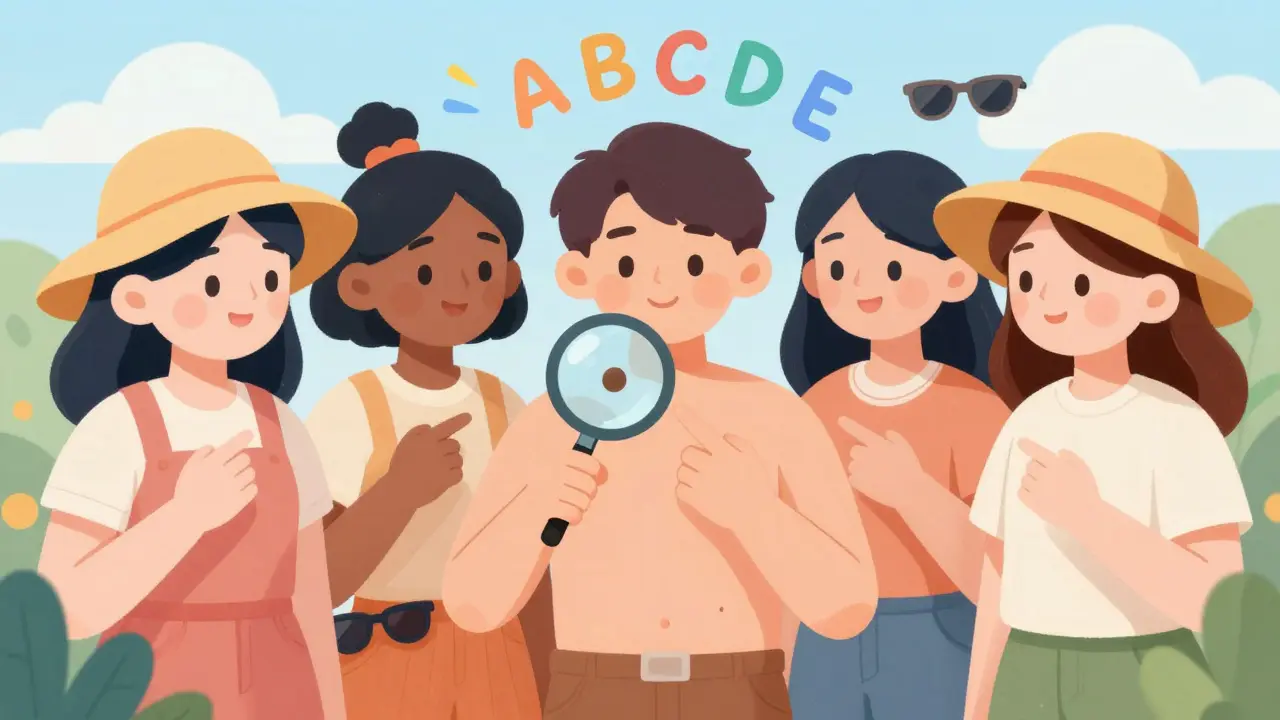
You don’t need a dermatologist to catch melanoma early. You just need to know what to look for. The ABCDE rule is the gold standard used by doctors and patients alike.- A - Asymmetry: One half doesn’t match the other.
- B - Border: Edges are ragged, blurred, or notched.
- C - Color: More than one shade-black, brown, red, white, or blue.
- D - Diameter: Larger than 6mm (about the size of a pencil eraser).
- E - Evolving: It’s changing in size, shape, color, or texture over weeks or months.
Who Needs Professional Screenings?
Not everyone needs to see a dermatologist every month. But if you’re in a high-risk group, you should. The National Comprehensive Cancer Network (NCCN) recommends professional skin exams every 3 to 6 months if you have:- More than 50 moles
- Atypical moles (dysplastic nevi)
- A personal or family history of melanoma
- Fair skin that burns easily
- A history of severe sunburns as a child
Prevention: It’s Not Just Sunscreen
Sunscreen is important, but it’s not enough. The CDC’s 2024 Youth Risk Behavior Survey found only 14.3% of high school students use sunscreen consistently. Cost is a barrier for 67% of low-income families. But prevention is cheaper than treatment. Here’s what actually works:- Seek shade between 10 a.m. and 4 p.m., when UV rays are strongest.
- Wear UPF 50+ clothing, wide-brimmed hats, and UV-blocking sunglasses.
- Use broad-spectrum SPF 30+ sunscreen daily-even on cloudy days. Reapply every two hours, or after swimming or sweating.
- Avoid tanning beds completely. People who use them before age 35 increase their melanoma risk by 58%.
- Check the UV index daily. Apps like QSun’s UV Index now integrate with weather forecasts and send alerts when levels are high.
What Happens If It’s Found?
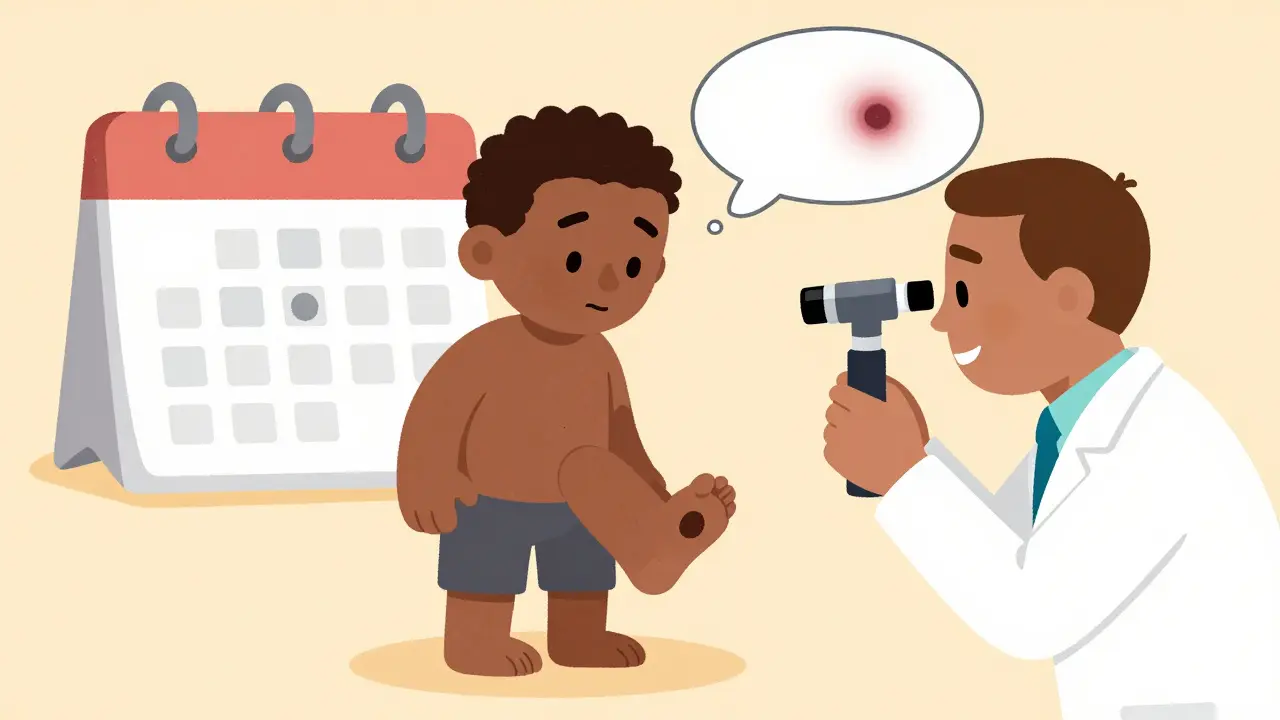
If a doctor suspects melanoma, they’ll do a biopsy. That means removing the spot and sending it to a lab. Results usually come back in a week. Treatment depends on how deep it went and whether it spread.- Stage 0 (in situ): Only in the top layer of skin. Surgery with a 0.5-1 cm margin clears it. Cure rate: nearly 100%.
- Stage I-II: Deeper, but still local. Surgery with wider margins (1-2 cm) is standard. For tumors over 0.8 mm, a sentinel lymph node biopsy checks if cancer reached nearby lymph nodes. Five-year survival for Stage IA: 97%.
- Stage III: Spread to lymph nodes. Surgery plus immunotherapy (nivolumab, pembrolizumab) or targeted therapy (dabrafenib + trametinib). These drugs help your immune system fight cancer or block cancer growth signals.
- Stage IV: Spread to distant organs. Immunotherapy is first-line. The combo of nivolumab and ipilimumab gives a 52% five-year survival rate, according to the CheckMate 067 trial. Targeted therapy works only if you have a BRAF mutation-which about half of melanomas do.
Costs and Access: The Hidden Crisis
Treatment isn’t just medical-it’s financial. A single infusion of nivolumab can cost $28,500 out-of-pocket, even with insurance. That’s what one Reddit user, “MelanomaWarrior99,” shared in February 2025. The annual cost of immunotherapy can hit $200,000. Medicare spent $1.8 billion on melanoma treatment in 2024. Yet, prevention gets just $0.02 per person. Access is unequal. States like Mississippi have only 1.2 dermatologists per 100,000 people. That leads to 22% of cases being diagnosed late. Massachusetts, with 7.8 dermatologists per 100,000, sees only 14% late-stage cases. Rural communities are especially vulnerable. That’s why pilot programs are placing teledermatology kiosks in Walmart clinics in 150 underserved areas.What’s New in 2026?
The field is moving fast. In early 2025, the FDA approved two major advances:- DermEngine’s VisualizeAI: An AI tool that analyzes skin images with 93.2% sensitivity. It’s now being used in clinics to help spot tricky cases.
- mRNA-4157/V940: A personalized cancer vaccine. When combined with pembrolizumab, it cut recurrence risk by 44% in Stage IIB-IV patients. This isn’t a cure yet, but it’s a huge step.
Real Stories, Real Outcomes
One user on Reddit, “SkinCheckSavedMe,” found a 0.4 mm melanoma thanks to a UV alert on their phone. “I went in thinking it was a pimple,” they wrote. “Turned out to be melanoma. My oncologist showed me the 35% survival odds for late-stage. Mine was 99.6%.” Another, “DJohnson_MD,” a Black man from Georgia, was misdiagnosed three times. His melanoma was on his foot. Doctors thought it was a bruise. By the time it was caught, it was Stage III. “No one looks for skin cancer on Black skin,” he said. “We need better training.”What You Can Do Today
You don’t need to wait for a doctor. Start now:- Do a full-body skin check once a month. Use a mirror. Take photos.
- Know your ABCDEs. If something changes, get it checked.
- Wear sunscreen daily-even in winter.
- Protect your kids. Childhood sunburns double melanoma risk later.
- If you’re high-risk, schedule a dermatologist visit. Don’t wait for symptoms.
Can melanoma be cured if caught early?
Yes. When melanoma is caught before it spreads beyond the skin’s top layer (Stage 0 or Stage I), the five-year survival rate is over 99%. Surgery alone is often enough to remove it completely. Early detection is the single most important factor in survival.
Is melanoma only a problem for fair-skinned people?
No. While melanoma is more common in people with lighter skin, it’s often diagnosed later in people with darker skin tones. It tends to appear on palms, soles, or under nails-areas people don’t routinely check. This delay leads to worse outcomes. Everyone, regardless of skin color, should do regular skin checks.
Are tanning beds safer than the sun?
No. Tanning beds emit UVA and UVB radiation at levels up to 15 times stronger than the midday sun. Using them before age 35 increases melanoma risk by 58%. There is no safe level of indoor tanning. It’s not a “base tan”-it’s DNA damage.
How often should I get a professional skin exam?
If you’re at average risk, an annual exam is fine. If you have more than 50 moles, a history of melanoma, or a family history, get checked every 3 to 6 months. The National Comprehensive Cancer Network recommends this for high-risk individuals.
Can I rely on smartphone apps to detect melanoma?
Apps can help you track changes and remind you to check your skin, but they’re not diagnostic tools. Some AI tools like DermEngine’s VisualizeAI are now used by doctors and are over 93% accurate. But no app replaces a dermatologist’s exam. Use apps as a supplement-not a substitute.
Is melanoma treatment covered by insurance?
Most insurance plans cover biopsy, surgery, and FDA-approved immunotherapy or targeted therapy. But out-of-pocket costs can still be high-sometimes tens of thousands of dollars per year. Many patients face financial toxicity. Ask your provider about patient assistance programs from drug manufacturers or nonprofit organizations like AIM at Melanoma.
13 Comments
i read this whole thing and still think the government is hiding the real cause of melanoma. why do they push sunscreen so hard but never mention the 5G towers or fluoride in water? also i skipped the part about tanning beds because my cousin swears his 'base tan' saved him from skin cancer. he's fine, right?
This is one of the most comprehensive, well-researched pieces on melanoma I’ve seen in years. The stats on UV protection ROI? Mind-blowing. $1 spent preventing = $3.50 saved? That’s not healthcare-it’s economic common sense. Why aren’t schools teaching this like math? And the part about acral lentiginous melanoma? Long overdue visibility. Someone finally said it: melanoma doesn’t care about your skin tone.
I just want to say THANK YOU for this post!!! Seriously!!! I’ve been doing monthly skin checks since my dad passed from Stage IV melanoma in 2020, and I’ve caught two pre-cancerous spots myself!! One was on my shoulder-I thought it was a pimple for THREE WEEKS!! I took a photo, showed my dermatologist, and boom-Stage 0!! They removed it with a tiny punch biopsy!! No chemo, no surgery, no drama!! Just a 10-minute visit and now I’m alive!! I use the UV index app every morning now-I even set a reminder on my phone!! If you’re reading this and haven’t checked your skin this month, DO IT TODAY!! You have nothing to lose and EVERYTHING to gain!!
Mate, this is gold. ☀️ I’m from down under-Australia, where the sun’s basically a villain-and I’ve been preaching this to my mates for years. My uncle got melanoma on his foot at 48. No one saw it till it was Stage III. Now I make my whole family do monthly checks. Even my 12-year-old niece uses a mirror to look at her back. We take selfies of moles like they’re TikTok trends. It’s weird, but it works. Also, UPF shirts? Life changer. I wear one even when I’m just walking the dog. No sunburns, no stress.
I appreciate how this breaks down the ABCDE rule clearly. I’ve always been afraid to check my own skin-thought I’d miss something. Now I know what to look for. I started taking photos last month. One spot changed color. Went to the derm. It was benign. Still, I’m glad I checked.
My mom got diagnosed last year. She’s fine now, but this post made me cry. Thank you for writing it. I’m going to do my skin check tonight.
99% survival rate? Sure. Until the insurance company denies your biopsy. Or your dermatologist is booked 6 months out. Or you’re in Mississippi. Or you’re Black and they call your melanoma a 'bruise' for the third time. This article is nice. But it’s not the reality. It’s a luxury pamphlet for people who can afford to care.
My brother had it. Stage I. Biopsy. Removed. Done. No chemo. He lives. Early detection saves lives.
why do they say sunscreen works but my uncle used it every day and still got melanoma on his nose he is dead now so sunscreen is fake and the sun is a government weapon to control us
It’s interesting how we treat melanoma like a personal responsibility issue-check your skin, wear sunscreen, avoid tanning beds. But what about the structural barriers? The lack of dermatologists in rural areas? The cost of immunotherapy? The fact that 67% of low-income families can’t afford sunscreen? We praise early detection, but we don’t make it accessible. Maybe the real question isn’t 'what can you do?' but 'what should society do?'
This is why I love this community. 🙌 I’m a nurse in Ohio, and I’ve seen too many people wait until it’s too late. I hand out free sunscreen samples at the community center every Saturday. I teach kids how to use the ABCDE rule like a game. One girl found a mole on her mom’s back-turns out it was melanoma. Mom’s doing great now. Small actions, big impact. Let’s keep spreading the word. 💪🌞
I’m sorry, but this article is dangerously naive. You talk about 'personal responsibility' and 'early detection' like everyone has the time, money, access, or privilege to do this. What about the single mom working two jobs? The undocumented immigrant afraid to go to a doctor? The person without health insurance? You’re not educating-you’re shaming. And the 'mRNA vaccine' hype? It’s not a cure. It’s a profit machine for Big Pharma. Don’t be fooled. This isn’t science-it’s marketing dressed as public health.
I’ve been told I’m 'overreacting' every time I go to the dermatologist. I’ve had 7 biopsies. 3 were benign. 4 were pre-cancerous. And guess what? The last one was melanoma. They called it 'suspicious' for 8 months before acting. My doctor said 'watch it.' I said 'cut it out.' I’m alive because I pushed. So if you're thinking 'maybe it’s nothing'-it’s not. It’s not. It’s not. Do it now.