
Priority vs Standard Review: How FDA Prioritizes Generic Drug Applications
The U.S. Food and Drug Administration doesn’t treat every generic drug application the same. If you’re a manufacturer trying to get a generic version of a brand-name drug to market, the difference between a priority review and a standard review can mean millions in revenue - or years of delay.
What’s the real difference between priority and standard review?
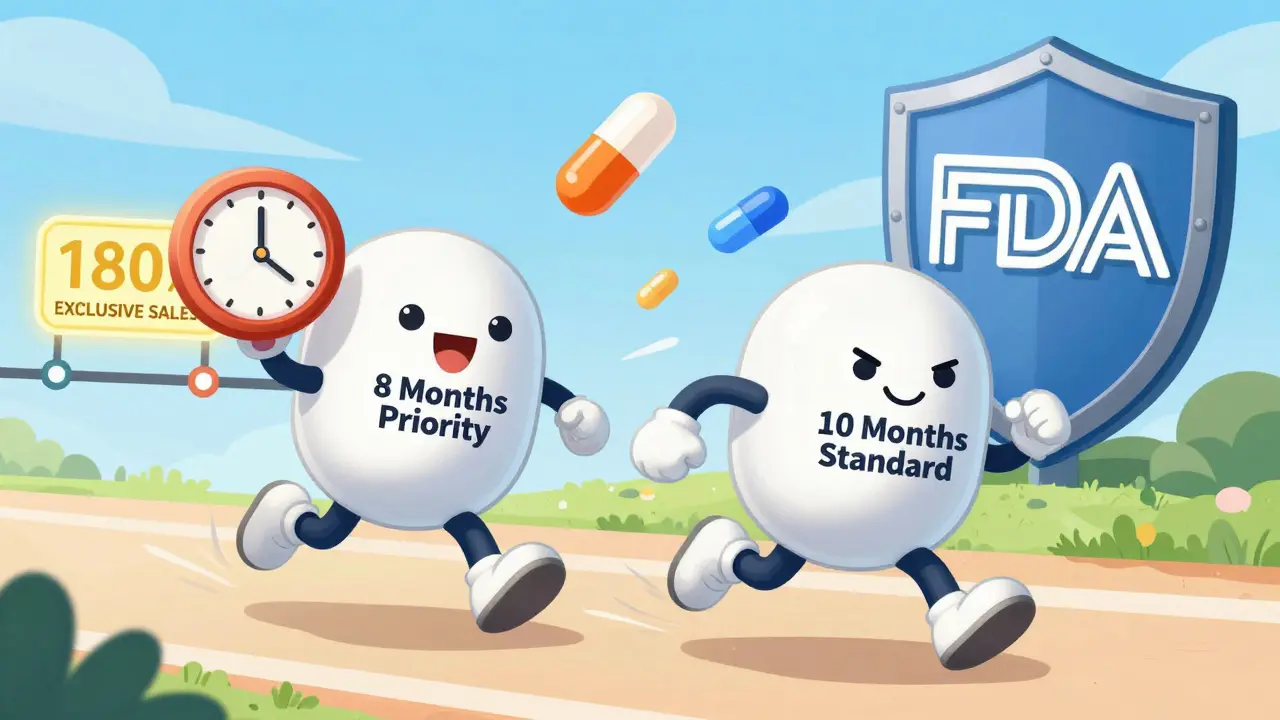
At its core, it’s about time. For most generic drug applications, known as ANDAs (Abbreviated New Drug Applications), the FDA gives you 10 months to get through the review process. That’s the standard timeline. But if your application qualifies for priority review, that clock cuts down to just 8 months.
That two-month gap isn’t just paperwork. It’s a race. In the generic drug world, being first to market after a brand-name drug’s patent expires can lock in 180 days of exclusive sales - no competitors allowed. During that window, a single product can earn $200 million to $500 million in revenue. Two months earlier means you capture more of that window.
The FDA’s Office of Generic Drugs (OGD) handles all of this under rules set by the Generic Drug User Fee Amendments (GDUFA) III, which started in October 2022 and runs through 2027. The system is designed to balance speed with safety. Every application still goes through the same rigorous checks: chemistry, manufacturing, bioequivalence, and labeling. The only thing that changes is the deadline.
Who gets priority review?
Not every generic drug qualifies. Priority review isn’t given out randomly. The FDA has clear, written criteria. You get it if you’re:
- The first generic to file after a brand-name drug’s patent or exclusivity ends
- Producing a drug that’s in shortage - meaning patients can’t get it anywhere
- Offering a medically important advance over existing generics - like a more stable formulation or better delivery system
In 2022, 28.4% of approved ANDAs got priority review. That’s up from 21.1% in 2020. Why? Because more companies are strategically targeting first-to-market opportunities. The FDA’s Orange Book database tracks patents and exclusivity periods so closely that applicants can time their submissions down to the day.
But here’s the catch: being first doesn’t guarantee approval. If your application has flaws - missing data, unclear manufacturing details, or bioequivalence issues - you’ll get a Complete Response Letter (CRL). In 2022, over 30% of ANDAs got at least one CRL. Each one adds about 4.2 months to the timeline. So even with priority review, a sloppy application still loses.
The new U.S. manufacturing push
In October 2023, the FDA dropped a major new rule: the ANDA Prioritization Pilot Program. This isn’t just about speed anymore - it’s about where the drug is made.
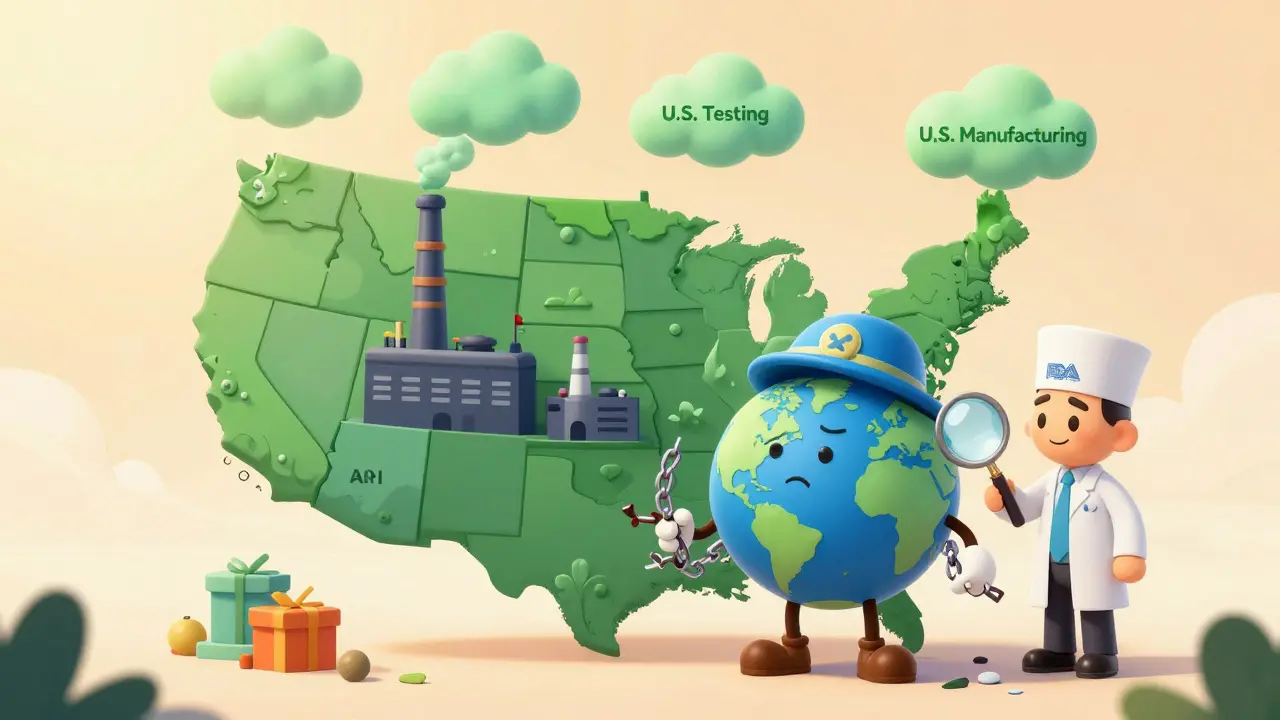
To qualify for priority review under this pilot, your generic drug must meet three strict conditions:
- Biobequivalence testing is done in the United States
- The finished dosage form (the pill or injection) is manufactured in the U.S.
- All active pharmaceutical ingredients (APIs) come from U.S.-based suppliers
This is a direct response to the supply chain chaos of the pandemic. In 2021, the FDA found that 80% of APIs were made overseas. Antibiotics? 97% made outside the U.S. Antivirals? 93%. When global shipping stalled, so did patient access.
The goal? Get 40% of U.S. generic drugs made domestically by 2028 - up from just 28% today. The FDA estimates this pilot will speed up 45 to 60 applications each year. But here’s the reality: only 12.3% of generic manufacturers currently meet all three criteria. Most rely on APIs from India or China, and finished products from facilities in Europe or Southeast Asia.
Big players like Teva and Sandoz are already shifting. IQVIA data shows they’ve increased U.S.-based bioequivalence testing by 22% in just one year. Contract labs like Covance are seeing 35% more U.S. trials. But smaller companies? Many say it’s impossible. One regulatory manager on Reddit wrote: “92% of our specialized excipients still come from Europe and Asia. We can’t just switch overnight.”
Why do so many applications fail?
Even with priority review, most ANDAs don’t get approved on the first try. The biggest reason? Chemistry, Manufacturing, and Controls (CMC) issues. These aren’t flashy problems - they’re about how the drug is made. Is the tablet coating consistent? Are the impurity levels within limits? Is the manufacturing process reproducible?
CMC deficiencies made up 47.2% of all review delays in 2022. That’s why more companies are now using the FDA’s pre-submission meetings. In 2020, only 41% of applicants met with the FDA before filing. By 2023, that number jumped to 63%. These meetings let manufacturers ask questions, get feedback, and fix problems before they waste $164,880 on a filing fee and months of waiting.
The FDA also launched the Complex Generic Drug Product Pilot Program in January 2023. It’s for tricky drugs like inhalers, topical creams, and extended-release pills - products that are harder to copy. These make up 18.3% of pending applications but only 9.7% of approvals. The pilot gives early scientific advice, helping sponsors avoid dead ends.
What’s next for generic drug approval?
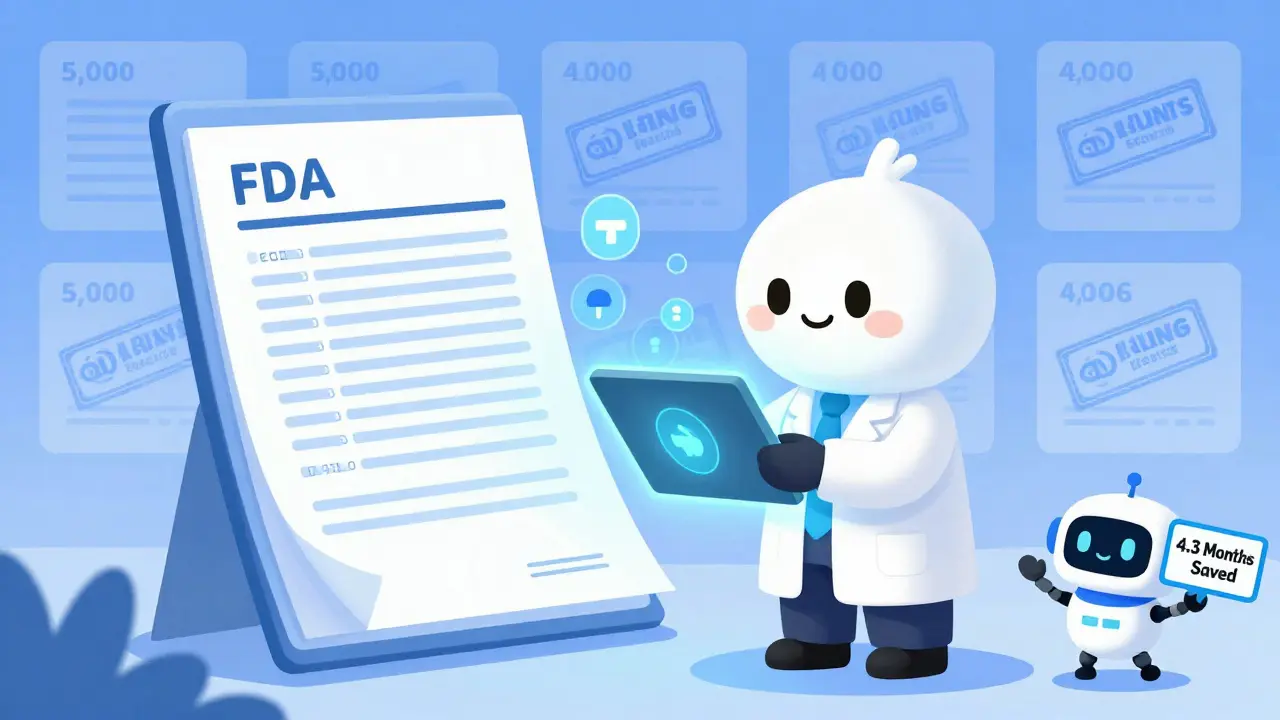
The FDA isn’t stopping here. By late 2024, they plan to roll out AI-assisted review tools. In internal tests, these tools cut review times for straightforward applications by nearly 19%. Imagine an algorithm scanning a 5,000-page application for missing data points, flagging inconsistencies, or comparing bioequivalence results against historical data - all before a human even opens the file.
Industry analysts predict these changes will shave an average of 4.3 months off the total approval timeline by 2026. That could save the U.S. healthcare system $18.7 billion a year in drug costs.
But the bigger story is control. The U.S. government is no longer okay with depending on foreign suppliers for essential medicines. The new rules aren’t just about faster approvals - they’re about building a more secure, reliable drug supply chain. For generic manufacturers, that means adapting. For patients, it means fewer shortages. For the system, it means more predictable access to affordable drugs.
How to win the review game
If you’re a generic drug company, here’s what you need to do:
- Target first-to-market opportunities - check the Orange Book religiously
- Start pre-submission meetings early - don’t wait until the last minute
- Map your supply chain - can you prove U.S. sourcing for API, manufacturing, and testing?
- Invest in quality upfront - fix CMC issues before filing, not after
- Track FDA’s pilot programs - they change the rules, and you need to be ready
The game has changed. It’s no longer enough to just copy a brand-name drug. You have to prove you can make it reliably, safely, and right here in the U.S. The FDA isn’t just reviewing applications anymore - they’re reshaping the entire industry.
What’s the difference between priority review and standard review for generic drugs?
Priority review gives generic drug applications an 8-month timeline for FDA approval, while standard review allows 10 months. Priority review is reserved for first generics, drugs in shortage, or products with significant medical advantages. Both reviews require the same level of scientific rigor - only the deadline changes.
How do I qualify for priority review?
You qualify if you’re the first to file a substantially complete ANDA after a brand-name drug’s patent expires, if your drug treats a shortage, or if it offers a meaningful improvement over existing generics. The FDA also has a pilot program that prioritizes applications using U.S.-based manufacturing, testing, and active ingredients.
What is the ANDA Prioritization Pilot Program?
Launched in October 2023, this program gives priority review status to generic drug applications that conduct bioequivalence testing in the U.S., manufacture the final product domestically, and source all active ingredients from U.S. suppliers. It’s part of a broader effort to reduce reliance on foreign manufacturing.
Why do so many generic drug applications get rejected?
About 31.7% of applications receive a Complete Response Letter (CRL), mostly due to Chemistry, Manufacturing, and Controls (CMC) issues - like inconsistent tablet coatings, impurity levels, or unclear production methods. Many companies now use pre-submission meetings with the FDA to fix these problems before filing.
How long does it take to get a generic drug approved on average?
Even with priority review, the average time from patent expiration to first generic approval is still about 2.7 years. This delay comes from patent litigation, application deficiencies, and multiple review cycles. Each CRL adds roughly 4.2 months to the timeline. The FDA’s new AI tools and U.S. manufacturing incentives aim to cut this down by nearly half a year by 2026.
14 Comments
I get why the FDA wants U.S. manufacturing, but let’s be real-most of these companies can’t just flip a switch. Excipients, equipment, skilled labor-it’s not like you can Amazon Prime a new API plant. This feels like policy without a roadmap.
The FDA's prioritization framework is both scientifically sound and economically strategic. It is imperative that regulatory efficiency does not compromise the integrity of pharmaceutical standards, particularly when public health is at stake.
Interesting how the U.S. is trying to reshore generics. I wonder how this plays out globally-India and China aren’t just sitting still. They’ve got decades of scale and lower costs. This feels like a long game with a lot of friction.
CMC deficiencies remain the primary bottleneck in ANDA submissions. The 47.2% figure is consistent with GDUFA III audit data. Pre-submission meetings have demonstrably reduced CRL incidence, but scalability remains constrained by FDA resource allocation.
So we’re rewarding companies that already have the money to move operations stateside? Meanwhile, the small guys who actually make affordable drugs get crushed? This isn’t about safety-it’s about protecting Big Pharma’s backyard while pretending it’s patriotism.
If you’re filing an ANDA, DO NOT skip the pre-sub meeting. Seriously. I’ve seen teams lose 8 months because they didn’t ask if their dissolution method was acceptable. The FDA will tell you-before you spend $165k. Just call them.
The introduction of AI-assisted review represents a significant advancement in regulatory efficiency. It is imperative that such tools are validated through rigorous, transparent, and peer-reviewed methodologies to ensure equitable outcomes across all applicant types.
I work in a small clinic. We’ve had patients go without their meds because the generic didn’t come in. If this helps get drugs here faster? Sign me up. Even if it’s just a few more a year.
THEY’RE STILL LETTING INDIA MAKE 80% OF OUR DRUGS?! HOW IS THIS STILL A THING?! WE’RE A SUPERPOWER AND WE CAN’T EVEN MAKE OUR OWN PAINKILLERS?! THIS IS A NATIONAL SECURITY ISSUE AND NO ONE’S TALKING ABOUT IT!
Nigeria makes generics too. We don’t have the money for U.S.-made pills. What happens when the price goes up because of this? People die here too.
The FDA has clear guidelines. Companies that follow them succeed. Companies that don’t, fail. It’s not complicated.
This is HUGE. Imagine if every single pill you take was made right here-no shipping delays, no foreign supply chain chaos, no surprise shortages. This isn’t just policy-it’s a lifeline for families.
i think... like... maybe the FDA is trying to fix something that's not broken? i mean, sure, we got a lot of drugs from india and china, but they're CHEAP and they WORK. why are we making this harder? it's like... i dunno... making your own bread when the bakery down the street is cheaper and tastier??
The shift toward domestic production reflects a broader reevaluation of risk in globalized systems. Efficiency must be balanced with resilience. The cost of dependency is measured in lives, not just dollars.