
Sleep Problems and Insomnia Caused by Medications: Practical Tips
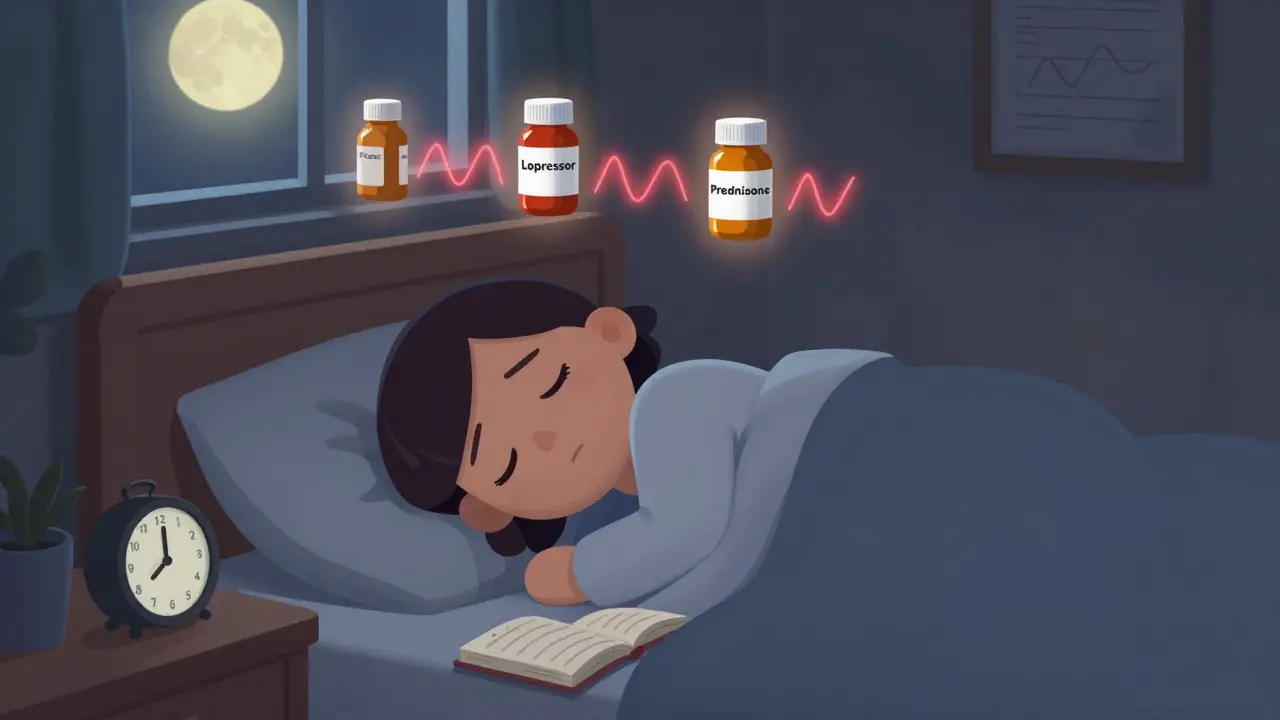
It’s not just stress or too much coffee. If you’ve been lying awake for weeks, staring at the ceiling, and you’re on a regular medication, it might not be your mind-it could be your medicine.
More than one in five adults say their sleep troubles started after they began taking a new prescription or over-the-counter drug. And most of them never connect the dots. They think it’s just aging, or anxiety, or bad luck. But the science is clear: many common medications directly mess with your sleep architecture. They don’t just make you drowsy-they disrupt the rhythm your body depends on to fall asleep, stay asleep, and feel rested.
Which Medications Are Most Likely to Keep You Up?
Some drugs are obvious culprits. Stimulants like Adderall XR, used for ADHD, can delay sleep onset by over an hour in nearly 4 out of 10 users. But the sneaky ones? Those are the ones you don’t suspect.
SSRIs like fluoxetine (Prozac) and sertraline (Zoloft) are prescribed for depression and anxiety, yet they reduce REM sleep by over 20% and increase light sleep. That means you’re sleeping more-but not sleeping well. You wake up tired, even after 8 hours. A 2022 study showed that switching from evening to morning dosing cut sleep disturbances by 45%.
Beta-blockers like metoprolol (Lopressor), used for high blood pressure and heart conditions, lower your body’s natural melatonin by nearly half. That’s why users report frequent nighttime awakenings and vivid nightmares. Even if you take them in the morning, the effect lingers. A 2021 meta-analysis found switching to atenolol (Tenormin), a water-soluble version, reduced awakenings by 37%.
Corticosteroids like prednisone are brutal on sleep. Taking just 20mg daily can slash deep sleep by almost half and triple the number of times you wake up at night. The problem isn’t just the drug-it’s when you take it. Taking prednisone after 9 a.m. cuts insomnia risk by 63% compared to afternoon or evening doses.
Even over-the-counter meds can do damage. Pseudoephedrine (Sudafed) keeps 1 in 8 people awake. Non-drowsy antihistamines like loratadine (Claritin) might not make you sleepy, but they can make it harder to fall asleep. And supplements? St. John’s wort, often taken for mood support, causes insomnia in 15% of users. Glucosamine-chondroitin? That’s a surprise culprit for 7% of people.
Why Do These Drugs Mess With Your Sleep?
It’s not random. Each drug hits a different part of your brain’s sleep system.
SSRIs flood your brain with serotonin. That’s good for mood-but too much serotonin at night can overstimulate areas that should be winding down. Your brain doesn’t know it’s time to sleep.
Beta-blockers block adrenaline, which sounds calming-but they also shut down the pineal gland’s ability to make melatonin. No melatonin? No signal that it’s dark. No signal? Your body stays in alert mode.
Corticosteroids mimic cortisol, your body’s natural wake-up hormone. When you take them late, your cortisol stays high at night, drowning out melatonin. Your body thinks it’s 7 a.m., even at midnight.
Stimulants like Adderall boost dopamine and norepinephrine by 300-400% in key brain zones. These are the chemicals that keep you focused during the day. At night? They keep you wired.
What You Can Do Right Now
You don’t have to suffer. There are practical, evidence-backed fixes.
- Change the time you take your pill. For corticosteroids, take it before 9 a.m. For SSRIs, take it in the morning-not at night. For beta-blockers, ask your doctor if you can switch to a water-soluble version like atenolol.
- Try low-dose melatonin. If you’re on a beta-blocker, taking 0.5 to 3 mg of melatonin 2-3 hours before bed can restore sleep quality by over 50%. It doesn’t make you sleepy-it just tells your body it’s time to sleep.
- Swap the drug. If SSRIs are wrecking your sleep, mirtazapine (Remeron) is a good alternative. It’s an antidepressant that actually helps you sleep. Studies show it resolves insomnia in nearly 7 out of 10 cases.
- Stop the habit of self-discontinuing. A 2023 Consumer Reports survey found 34% of people quit their meds because of sleep issues-and 61% never told their doctor. That’s dangerous. Stopping cold turkey can cause rebound insomnia, withdrawal, or worse. Always talk to your provider first.

When to See a Sleep Specialist
Not every sleep problem is caused by meds. Sometimes, the medication just revealed a hidden sleep disorder.
Dr. Raj Dasgupta, a sleep expert at Keck School of Medicine, recommends the 3-3-3 Rule: If your sleep troubles last more than 3 weeks, happen 3 or more nights a week, and leave you exhausted on 3 or more daytime hours-you need a sleep specialist. About half of people who blame their meds for insomnia actually have undiagnosed sleep apnea, restless legs, or chronic insomnia.
Doctors now recommend keeping a 14-day sleep diary before making changes. Write down: what time you took your meds, when you went to bed, when you woke up, how many times you woke during the night, and how rested you felt. This gives your doctor real data-not guesswork.
What Your Doctor Should Be Asking
Most doctors don’t ask about sleep unless you bring it up. That’s a gap. The American College of Physicians now recommends a 4-step approach:
- Confirm the link with a sleep diary.
- Adjust timing or dosage.
- Switch to a medication with fewer sleep side effects.
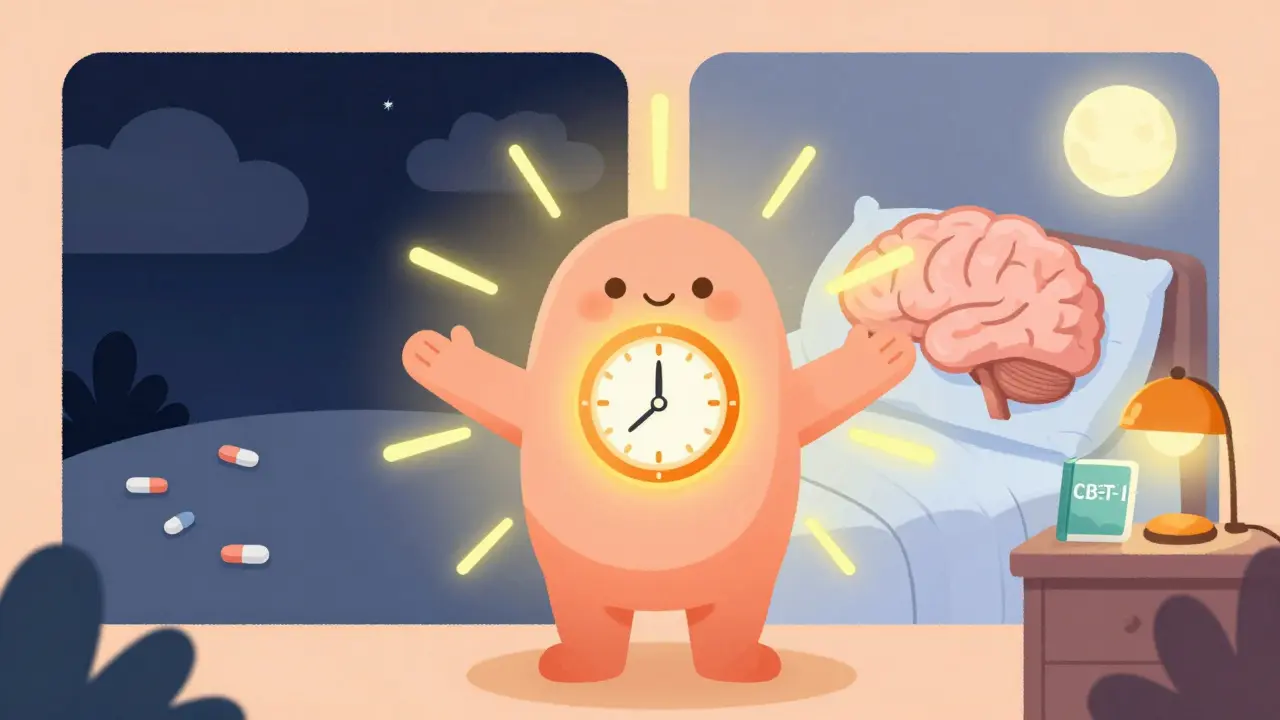
- Try CBT-I-Cognitive Behavioral Therapy for Insomnia.
CBT-I isn’t just for people without meds. In fact, it works better for people whose insomnia is caused by medications. A 2023 meta-analysis found CBT-I improved sleep in 65-75% of these cases. It teaches you how to retrain your brain to associate bed with sleep-not stress, not worry, not lying awake.
And here’s something new: timed light therapy. A 2023 study in Nature Sleep showed that getting 30 minutes of bright morning light (natural or artificial) improved sleep efficiency by 28% in people on insomnia-causing drugs. It helps reset your internal clock.
What to Avoid
Don’t reach for Benadryl or other first-generation antihistamines to fix sleep. The American Geriatrics Society lists them as unsafe for adults over 65-and for good reason. They cause next-day fog, memory issues, and paradoxically, worse sleep over time. A 2021 study found 35-40% of older adults on these drugs had disrupted sleep and cognitive decline.
Also, don’t rely on “natural” sleep aids without checking interactions. Melatonin is safe for most, but St. John’s wort? It can interfere with over 50 medications-including antidepressants and blood thinners-and it’s a known sleep disruptor.
The Bottom Line
You’re not broken. You’re not lazy. You’re not failing at sleep. You’re just on a medication that’s interfering with your biology.
The fix isn’t always about stopping the drug. Sometimes, it’s just about changing the time you take it. Or switching to a different one. Or adding a tiny bit of melatonin. Or starting CBT-I.
But you won’t find any of those answers if you don’t talk to your doctor. And you won’t get better if you just quit the medicine on your own.
Track your sleep. Note your meds. Bring your diary to your next appointment. Ask: Could this be causing my sleep problems? That simple question could change everything.
Can antidepressants really cause insomnia?
Yes. SSRIs like Prozac and Zoloft are among the most common culprits. They increase serotonin, which helps mood but can overstimulate brain areas that control sleep. About 25-30% of users report trouble staying asleep or waking up too early. Switching the dose to the morning can reduce these effects by nearly half.
Is it safe to take melatonin with beta-blockers?
Yes, and it’s often recommended. Beta-blockers reduce your body’s natural melatonin production. Taking 0.5 to 3 mg of melatonin 2-3 hours before bed has been shown to restore sleep quality by over 50% in users of these drugs. Always check with your doctor first, especially if you’re on other medications.
Why does prednisone keep me awake at night?
Prednisone mimics cortisol, your body’s natural wake-up hormone. When taken in the afternoon or evening, it keeps cortisol levels high at night, which blocks melatonin. This tricks your brain into thinking it’s morning. Taking it before 9 a.m. reduces nighttime awakenings by 63%.
Should I stop my medication if it’s causing insomnia?
No-not without talking to your doctor. Stopping abruptly can cause rebound insomnia, withdrawal symptoms, or make your original condition worse. Instead, keep a sleep diary, note when symptoms started, and schedule a visit. Often, small changes-timing, dosage, or switching meds-can fix the problem without quitting.
Can over-the-counter cold medicine cause insomnia?
Yes. Pseudoephedrine (found in Sudafed) is a stimulant that keeps 12-15% of users awake. Even non-drowsy antihistamines like Claritin can delay sleep onset in 8-10% of people. Always check labels for stimulants or decongestants if you’re struggling to sleep.
What’s CBT-I, and can it help if I’m on meds?
CBT-I stands for Cognitive Behavioral Therapy for Insomnia. It’s a structured program that helps retrain your brain to sleep better. Studies show it works just as well-even better-for people whose insomnia is caused by medications as it does for those without meds. It’s drug-free, long-lasting, and covered by many insurance plans.
12 Comments
So let me get this straight-I’m supposed to believe that my 30-year-old blood pressure med is suddenly the villain in my 3am Netflix binge? 😒
Also, why is everyone acting like this is news? My grandma’s been whispering about ‘chemtrail sleep’ since 2007.
Anyway, I switched my Zoloft to morning and now I just stare at the ceiling while wide awake AND emotionally drained. Win-win.
Also, who the hell takes melatonin like it’s gummy vitamins? That’s not a fix, that’s a Band-Aid on a broken leg.
And why is everyone so chill about stopping meds? I’m not gonna risk my mental health because I can’t sleep. I’ll just keep drinking cold brew at 2am like a responsible adult.
Also, CBT-I sounds like a cult. ‘Welcome to the Sleep Temple, where your thoughts are now under surveillance.’
Also, I didn’t know St. John’s Wort was a sleep assassin. I thought it was just a fancy tea for people who think ‘wellness’ is a personality trait.
Also, I’m 27 and already feel like my body is a malfunctioning IKEA shelf. Thanks, modern medicine.
Also, I’m not taking light therapy. I’m not a plant. I’m a human who just wants to sleep without being lectured by a 2023 meta-analysis.
Also, I’m not writing a sleep diary. I’m not a lab rat. I’m a person with a life and zero patience for ‘structured programs.’
Also, I’m still mad that Claritin kept me up. I thought it was called ‘non-drowsy’ because it didn’t make you sleepy. Not because it makes you hallucinate the moon yelling at you.
Also, I’m not talking to my doctor. I’m talking to Reddit. And Reddit says I’m not broken-I’m just medicated. So I’m good.
You people are clueless. This isn't about meds-it's about the government putting fluoride and lithium in the water to keep you docile. The real sleep killers are the NSA's subliminal sleep-disrupting signals broadcast through your smart TV. They don't want you dreaming because dreams expose the truth. SSRIs? That's just the tip of the iceberg. They're designed to dull your intuition so you don't question why you're always tired. The melatonin thing? That's a placebo scam pushed by Big Pharma to sell you more pills. Atenolol? That's just a distraction. The real fix is grounding yourself barefoot on concrete at 4am. I did it for 7 days straight. Slept like a baby. No meds. No apps. Just dirt. The system doesn't want you to know this. But now you do. Share this before it gets taken down.
OMG I’m so glad someone finally said this 🥹 I’ve been on sertraline for 2 years and thought I was just ‘bad at sleep’ 😭
Switching to morning doses changed my life-I actually wake up feeling human now 🌞
Also, melatonin 0.5mg at 8pm? Magic. I used to think it was just for kids or hippies. Turns out it’s just science.
And prednisone at 5pm? Yeah, that’s why I was screaming at my cat at midnight. Whoops.
Thank you for writing this. I’m printing it out to show my doctor. I’m not crazy. I’m just on the wrong schedule. 💙
Wow. So the real problem isn’t stress or anxiety or even my 3 kids waking up at 5am.
It’s my damn antidepressant.
And I’ve been blaming myself for years.
That’s… actually kind of devastating.
But also, thank you. I’m not broken. I’m just poisoned by a pill.
I’m going to ask my doctor about mirtazapine tomorrow.
And I’m throwing out my Claritin. Again.
Also, I’m not taking melatonin. I’m not a lab rat. I’m a person who deserves to sleep without supplements.
Wait-no, I’ll try it. I’m desperate.
And I’m writing the damn diary. I need proof I’m not imagining this.
I’ve been on beta-blockers for 8 years and never connected my nightmares to my heart med.
Now I know why I wake up drenched in sweat, heart pounding, convinced I’m being chased.
Switching to atenolol was the best decision I’ve made since quitting gluten (which I didn’t need to quit, btw).
And melatonin? 1mg, 2 hours before bed. No grogginess. Just… quiet. Like my brain finally got the memo.
Also, CBT-I is real. I did it through my insurance. No magic. Just tools.
And yes, your doctor should ask about sleep. But if they don’t? Ask them.
You’re not being difficult. You’re being smart.
And you’re not alone.
Go talk to someone. Even if it’s just a nurse.
You’ve got this.
USA always make everything complicated. In Nigeria we just take our medicine and sleep like baby. No melatonin no light therapy no diary. We trust God and medicine. Why you people need 7 steps to sleep? You eat too much sugar and watch phone till 3am. This is not medicine problem this is lazy problem. You need to go to church and stop being soft. Also atenolol? What kind of drug name is that? Sounds like a car model. We use amiodarone and it work fine. No drama. Just medicine. And if you cant sleep then pray. God know what you need. Stop blaming pills. Blame your weak mind.
While the article presents a compelling, empirically grounded framework for medication-induced insomnia, it fails to adequately address the confounding variable of circadian misalignment secondary to screen exposure and chronotype mismatch. Furthermore, the recommendation of melatonin supplementation, while statistically supported in randomized controlled trials (e.g., JAMA Intern Med 2021), lacks sufficient granularity regarding pharmacokinetic variability across CYP1A2 polymorphisms. The assertion that CBT-I is equally efficacious in pharmacologically induced insomnia is overstated; subgroup analyses from the 2023 meta-analysis reveal a significant interaction effect between baseline sleep efficiency and treatment response (p=0.03). Additionally, the omission of cortisol awakening response (CAR) monitoring as a diagnostic adjunct is a critical methodological flaw. One must also question the commercial influence of the American College of Physicians’ endorsement of CBT-I, given its alignment with insurance reimbursement structures. In sum: the advice is sound, but the evidence is incomplete-and the tone, while accessible, risks oversimplifying a neuroendocrine cascade of extraordinary complexity.
Just wanted to say-you’re not alone. I was in the same boat. Took Adderall for years, thought I was just ‘a night owl.’ Turns out I was wired 24/7.
Switched to morning dose, started CBT-I, and got a sunrise lamp. Changed everything.
It’s not about fixing your brain. It’s about fixing the timing.
And yes, your doctor should be asking about sleep. But if they’re not? Bring the article. Print it. Highlight it.
You’re not being difficult. You’re being your own best advocate.
And if you’re scared to talk to your doctor? Start with a nurse. They’re the real heroes.
You got this. Seriously. One small change can unlock a whole new night.
I took prednisone for a month last year and slept like a rock for the first 2 weeks then couldn't close my eyes for the last 10
Turns out I was taking it at 6pm
Switched to 8am and boom sleep returned
Also melatonin 1mg before bed helped a ton
Don't stop your meds
Just move the time
And if your doc doesn't get it
Find a new one
Simple as that
The real issue here isn't the medication-it's the illusion of control. We think we're managing our health by taking pills, but we're just outsourcing our biology to corporate pharmacology. The body doesn't need melatonin supplements. It needs silence. Darkness. Stillness. But we've turned sleep into a problem to be optimized, like a smartphone battery. We track, we dose, we swap, we time. All while ignoring the root: we live in a world that never stops screaming. The meds are just the visible symptom. The disease is modernity. The cure? Not a pill. Not a lamp. Not a diary. The cure is withdrawal. From the noise. From the screen. From the idea that we can engineer rest. Sleep isn't a variable. It's a surrender. And we've forgotten how to do that.
Y’all I just realized I’ve been taking my Zoloft at night for 4 years and thought I was just ‘anxious.’
Switched to morning and now I’m actually falling asleep before 11.
Also I threw out my Sudafed. No more 3am heart racing.
And I’m trying the melatonin. Just 0.5mg. No big deal.
Also I’m writing the sleep diary because I’m a nerd who loves spreadsheets.
But mostly-I’m so relieved. I thought I was broken. Turns out I was just on the wrong schedule.
Thank you for this. I’m not weird. I’m just medicated. And that’s okay.
Just wanted to say… you’re not alone 💙
My mom’s on beta-blockers and took melatonin for the first time last week.
She cried because she slept through the night for the first time in 5 years.
It’s not magic. It’s just science.
And it’s okay to ask for help.
Even if it’s just a tiny pill at night.
Or a 30-minute walk in the sun.
Or a diary.
Or telling your doctor you’re tired.
You’re not being dramatic.
You’re being human.
And you deserve to sleep.
🌙