
Statistical Analysis in BE Studies: How to Calculate Power and Sample Size Correctly

Getting a generic drug approved isn’t just about matching the brand-name pill. It’s about proving that your version behaves the same way in the body. That’s where bioequivalence (BE) studies come in. But here’s the hard truth: statistical power and sample size decisions can make or break your entire study. A poorly designed BE study doesn’t just waste time and money-it can delay life-saving generics from reaching patients.
Why Power and Sample Size Matter More Than You Think
Most people think BE studies are simple: give people the test drug, give them the reference drug, compare blood levels, and see if they’re close enough. But behind that simple idea is a complex statistical machine. If your sample size is too small, you might miss a real difference-even if your drug works perfectly. That’s a Type II error. If your sample size is too big, you’re exposing more people than necessary to study procedures, burning through cash, and raising ethical red flags.
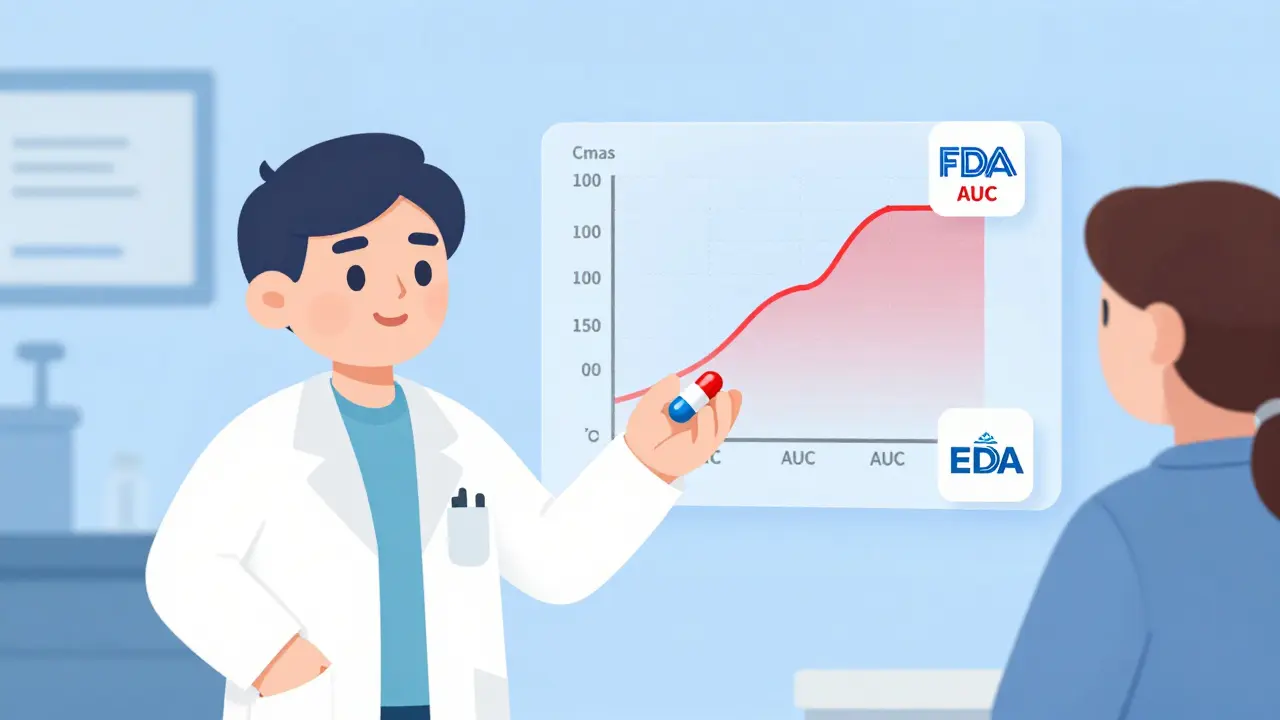
Regulators like the FDA and EMA don’t just ask for data-they demand proof that your study had enough power to detect bioequivalence if it existed. The standard? At least 80% power, with 90% preferred, especially for drugs with narrow therapeutic windows. That means if there’s a true difference between your drug and the brand, your study has an 80-90% chance of catching it. If you drop below that, your application gets rejected.
The Core Numbers: What Goes Into the Calculation
There are four non-negotiable inputs for any BE sample size calculation:
- Within-subject coefficient of variation (CV%) - This measures how much a person’s own blood levels bounce around between doses. For most drugs, it’s between 10% and 35%. But if your drug is highly variable (CV > 30%), you’re in a different ballgame. A 20% CV might need 26 people. A 30% CV? That jumps to 52. And if you’re working with a drug like warfarin or digoxin with CV over 40%, you could need over 100 subjects-unless you use a special method.
- Geometric mean ratio (GMR) - This is your best guess of how your drug’s absorption compares to the brand. Most generic developers assume 0.95-1.05. But if you assume 1.00 and your real ratio is 0.95, your sample size requirement shoots up by 32%. Don’t guess. Use pilot data.
- Equivalence margins - The standard is 80-125% for both Cmax and AUC. But the EMA sometimes allows 75-133% for Cmax, which can cut your needed sample size by 15-20%. Know your region’s rules.
- Study design - Crossover designs (same people get both drugs) are the norm because they reduce variability. Parallel designs (two groups) need twice as many people. Always go crossover unless you can’t.
These numbers feed into a formula based on log-normal distributions. You don’t need to memorize it, but you must understand how each one affects the result. Higher CV? Bigger sample. Lower GMR? Bigger sample. Want 90% power instead of 80%? Add 10-20% more subjects.
Real-World Examples: What Sample Size Looks Like
Let’s say you’re developing a generic version of a common blood pressure drug. Your pilot study shows:
- CV% = 25%
- Expected GMR = 0.98
- Target power = 80%
- Equivalence limits = 80-125%
Plug that into a validated calculator like ClinCalc or PASS, and you get a sample size of 38 subjects. Sounds manageable. But now imagine you used a literature value for CV instead of your own pilot data. The literature said 18%. You’d have calculated only 22 subjects. When you run the study, the real CV turns out to be 25%. Your power drops from 80% to 58%. You fail. Your study is invalid. You lose six months and $200,000.
That’s why experts like Dr. Laszlo Endrenyi say 37% of BE study failures in oncology generics between 2015 and 2020 came from overly optimistic CV estimates. Don’t be one of them.

What Regulators Actually Look For
The FDA doesn’t just want your final number. They want the whole story. Their 2022 Bioequivalence Review Template says you must document:
- The software used (e.g., PASS 15, nQuery, FARTSSIE)
- Version number
- All input values with justification
- How you handled dropouts (always add 10-15%)
- Whether you calculated power for both Cmax and AUC (only 45% of sponsors do)
In 2021, 18% of statistical deficiencies in generic drug submissions were due to incomplete documentation. That’s not a technical error-it’s a paperwork failure. You did the math right, but you didn’t show your work. That’s enough to get a Complete Response Letter.
And it’s not just about paperwork. In 2022, the FDA issued a warning letter to a major contract research organization (CRO) because their power calculations underestimated sample size by 25-35%. That’s not a rounding error. That’s negligence.
Special Cases: High Variability and Adaptive Designs
Some drugs-like those for epilepsy, cancer, or blood thinners-have wild variability. A standard BE study for these might need 120 people. That’s not feasible. That’s where Reference-Scaled Average Bioequivalence (RSABE) comes in.
RSABE lets you widen the equivalence limits based on how variable the reference drug is. If the CV is above 30%, you can use a scaled range instead of the rigid 80-125%. That cuts sample sizes from 120 down to 24-48. But you can’t just use it. You have to prove the drug is highly variable, follow strict formulas, and get regulatory agreement upfront.
Even newer methods are emerging. Model-informed bioequivalence uses pharmacokinetic modeling to predict exposure with fewer subjects. Early data shows it can reduce sample sizes by 30-50%. But as of 2023, only 5% of submissions use it because regulators still see it as experimental. It’s the future-but not your shortcut today.
Common Mistakes That Kill BE Studies
Here’s what goes wrong in the field:
- Using literature CVs - FDA found that literature values underestimate true variability by 5-8% in 63% of cases.
- Forgetting multiple endpoints - If you only power for Cmax but AUC is more variable, your overall power drops by 5-10%.
- Ignoring dropouts - A 10% dropout rate without adjustment means your final sample size has less power than you think.
- Not testing both Cmax and AUC - You need joint power. A study can pass Cmax and fail AUC, and it’s still a failure.
- Assuming perfect GMR - Assuming 1.00 when your drug is actually 0.95? That’s a 32% sample size underestimation.
The FDA’s 2021 Annual Report showed that 22% of deficiencies in Complete Response Letters were about sample size or power. That’s not a small number. That’s the #1 statistical reason studies fail.
What You Should Do Next
Don’t wait until your study is halfway done to think about power. Start here:
- Run a small pilot study (12-24 subjects) to get your own CV and GMR estimates. Don’t rely on papers.
- Use a validated tool like ClinCalc, PASS, or FARTSSIE. Don’t use Excel formulas you found online.
- Calculate power for both Cmax and AUC. Don’t pick the easier one.
- Add 10-15% to your calculated sample size for dropouts.
- Document everything. Save screenshots of your inputs. Write down why you chose each number.
- Get a biostatistician involved early. Not at the end. Not as an afterthought. Early.
There’s no magic number. No shortcut. No “it’s close enough.” Bioequivalence is one of the most rigorously regulated areas in pharma because people’s lives depend on it. Get the numbers right-or your drug won’t make it to market.
What is the minimum acceptable power for a BE study?
The minimum acceptable power is 80%, as required by both the FDA and EMA. However, 90% power is strongly preferred, especially for drugs with narrow therapeutic indices like warfarin or levothyroxine. Studies with less than 80% power are almost guaranteed to be rejected.
Can I use a sample size from a similar drug’s study?
No. Even drugs in the same class can have very different variability. A CV of 20% for one drug doesn’t mean the same for another. Using another study’s sample size without recalculating based on your own data is a major regulatory risk. The FDA found that 63% of submissions using literature-based CVs underestimated true variability.
What’s the difference between CV% and GMR?
CV% (coefficient of variation) measures how much a person’s blood levels vary between doses-this is about variability. GMR (geometric mean ratio) measures how your drug’s average absorption compares to the brand-this is about similarity. High CV means you need more people. Low GMR (like 0.90 instead of 1.00) means you need more people. Both affect sample size, but in different ways.
Why do I need to adjust for dropouts?
If you plan for 30 subjects and 5 drop out, you’re left with 25. That reduces your statistical power. To maintain your target power (e.g., 80%), you need to enroll extra people upfront. Best practice is to add 10-15% to your calculated sample size. If you calculate 40, enroll 44-46.
Do I need to calculate power for both Cmax and AUC?
Yes. Regulatory agencies require bioequivalence for both Cmax (how fast the drug enters the bloodstream) and AUC (how much drug is absorbed overall). If you only power for one, your overall chance of passing both drops by 5-10%. Only 45% of sponsors currently do this correctly, but regulators expect it.
What tools should I use for sample size calculations?
Use specialized tools like PASS 15, nQuery, or FARTSSIE. These are built for BE studies and include regulatory-specific methods like RSABE. Avoid generic power calculators or Excel templates unless they’re validated by your biostatistics team. The FDA requires you to report the software and version used-so make sure it’s industry-standard.
10 Comments
Let’s be real-most of these studies are just box-ticking exercises. I’ve seen teams use literature CVs because ‘it’s easier,’ then panic when the FDA rejects them. Power calculations aren’t magic. They’re just math with consequences. And yeah, 80% is the floor, but if you’re not shooting for 90%, you’re just gambling with patient access.
As someone who’s reviewed dozens of BE submissions, the #1 thing missing isn’t the math-it’s the documentation. I’ve seen perfect calculations buried in a 3-page PDF with no version numbers, no screenshots, no justification for GMR assumptions. Regulators aren’t mind readers. If you don’t show your work, they assume you didn’t do it.
Y’all act like this is rocket science but it’s not. I work in a CRO and half the time the biostats team just copies the last study’s sample size and calls it a day. Then the sponsor gets mad when it fails. And don’t even get me started on those ‘pilot studies’ that are just 8 people who all live in the same city. 😒
you know what's funny? the fda says 'use validated tools' but the same people who wrote the guidelines are the ones who make the software. it's a closed loop. and who funds the pilot studies? big pharma. so the 'real' cv is whatever they want it to be. this whole system is rigged. 💀
Wow. So the solution to 22% of regulatory failures is… actually doing the work? Groundbreaking. 🙄 I mean, who knew that using your own data instead of some 2018 paper from a journal no one reads could prevent a $200K disaster? Next you’ll tell us to wash our hands before surgery.
why do we even bother with all this? i saw a study last year where they used excel to calculate power. not even a template. just a spreadsheet someone made in 2012. and it passed. i swear half the time it’s who you know, not what you calculate.
There’s a lot of nuance here that’s easy to miss. For example, if you’re working with a highly variable drug, RSABE isn’t a loophole-it’s a lifeline. But you need to engage with regulators early, not after you’ve already enrolled 80 subjects. The key isn’t just the numbers. It’s the conversation around them.
Let’s not pretend this is about patient safety. It’s about control. The FDA doesn’t want you to use model-informed methods because they can’t audit them easily. They want you to use PASS 15 because it’s a black box they can demand screenshots from. Innovation is punished if it doesn’t come with paperwork.
Guys. I’ve been there. You think you’ve got a solid pilot. Then the CV spikes. You panic. You call your biostatistician at 2 a.m. They sigh. You add 15% more subjects. You survive. This isn’t about being perfect. It’s about being prepared. Do the work early. Don’t wait until your study’s halfway done to realize you’re underpowered. You’ll thank yourself later.
One sentence: Always calculate power for both Cmax and AUC. Always. Add 10-15% for dropouts. Always. Document every single input. Always. Use validated tools. Always. This isn’t optional. It’s the difference between a drug that saves lives and a rejection letter that kills a project. You got this. 💪