
First Trimester Medication Safety: What You Need to Know About Critical Development Windows
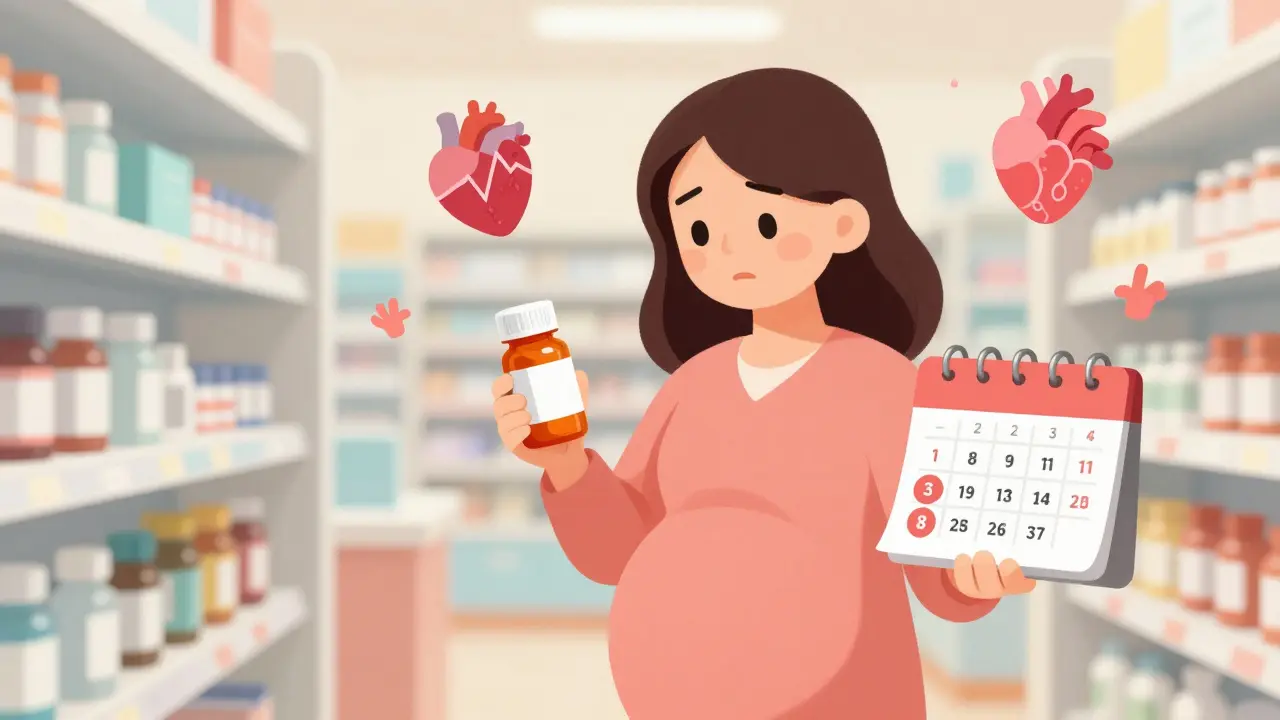
When you’re pregnant, even a simple headache can turn into a panic. You reach for that bottle of acetaminophen, but then you freeze-is this safe? The truth is, the first trimester isn’t just about morning sickness and fatigue. It’s the most dangerous time for your baby’s development, and what you take-or don’t take-can shape their future. Between weeks 3 and 8, every organ in your baby’s body is being built from scratch. That’s why even common medications can carry hidden risks.
Why the First 12 Weeks Are So Critical
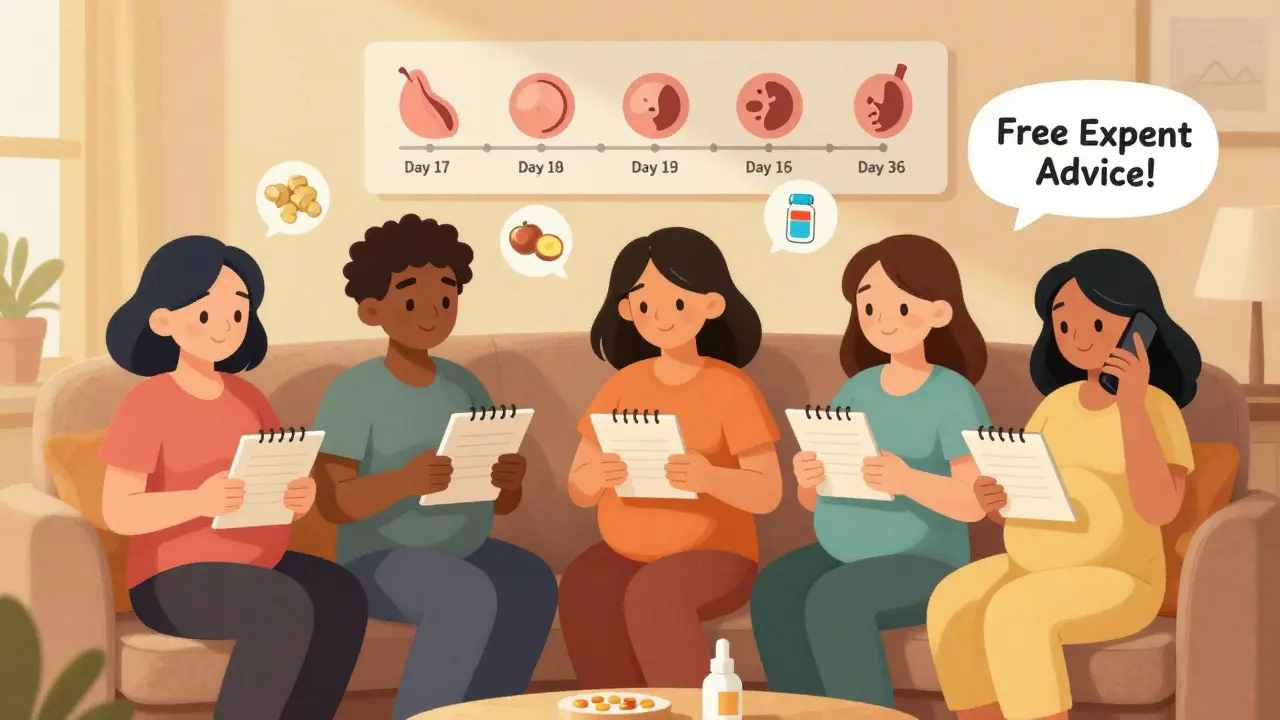
From the moment you conceive, your baby’s cells start dividing and organizing into organs. By day 17, the neural tube-the foundation of the brain and spine-begins to close. By day 24, the heart is beating and forming chambers. By day 36, fingers and toes are taking shape. This process, called embryogenesis, happens fast and with no room for error. If a medication interferes during this window, it can cause major birth defects. After week 12, the risk drops sharply because most organs are already formed.
According to the CDC, 90% of major birth defects occur during this time. That’s not a guess. It’s based on data from thousands of pregnancies. The most vulnerable periods? Days 18-26 for neural tube defects, days 20-40 for heart problems, and days 24-36 for limb issues. Missing these windows means missing the chance to prevent harm.
Common Medications and Their Real Risks
You might think if a drug is sold over the counter, it’s safe. That’s not true. In fact, the most commonly used medication during the first trimester isn’t a prescription-it’s acetaminophen. About 30% of pregnant women take it for fever or pain. For years, it was considered the safest option. But new research is changing that.
A 2023 review from the Birth Injury Center found that long-term or high-dose acetaminophen use during early pregnancy was linked to a 30% higher chance of ADHD and a 20% higher chance of autism spectrum disorder. That doesn’t mean you can’t use it. It means you should use it only when necessary, at the lowest dose, for the shortest time. Stick to 3,000-4,000 mg per day max, and never take it daily without talking to your provider.
NSAIDs like ibuprofen and naproxen are riskier. A 2011 Canadian study of over 4,700 pregnancies showed that taking these drugs in the first trimester increased the risk of miscarriage by 60%. The FDA also warns that after week 20, NSAIDs can cause serious kidney problems in the baby, leading to low amniotic fluid. Even if you’re just taking one pill for a headache, it’s better to avoid them entirely in early pregnancy.
Antibiotics? Not all are equal. Amoxicillin and cephalosporins are generally safe. Erythromycin too. But tetracycline? Avoid it completely. It stains developing teeth and affects bone growth. Fluoroquinolones like ciprofloxacin show cartilage damage in animal studies-even if human data is limited, the risk isn’t worth it.
Antidepressants: Balancing Mental Health and Fetal Risk
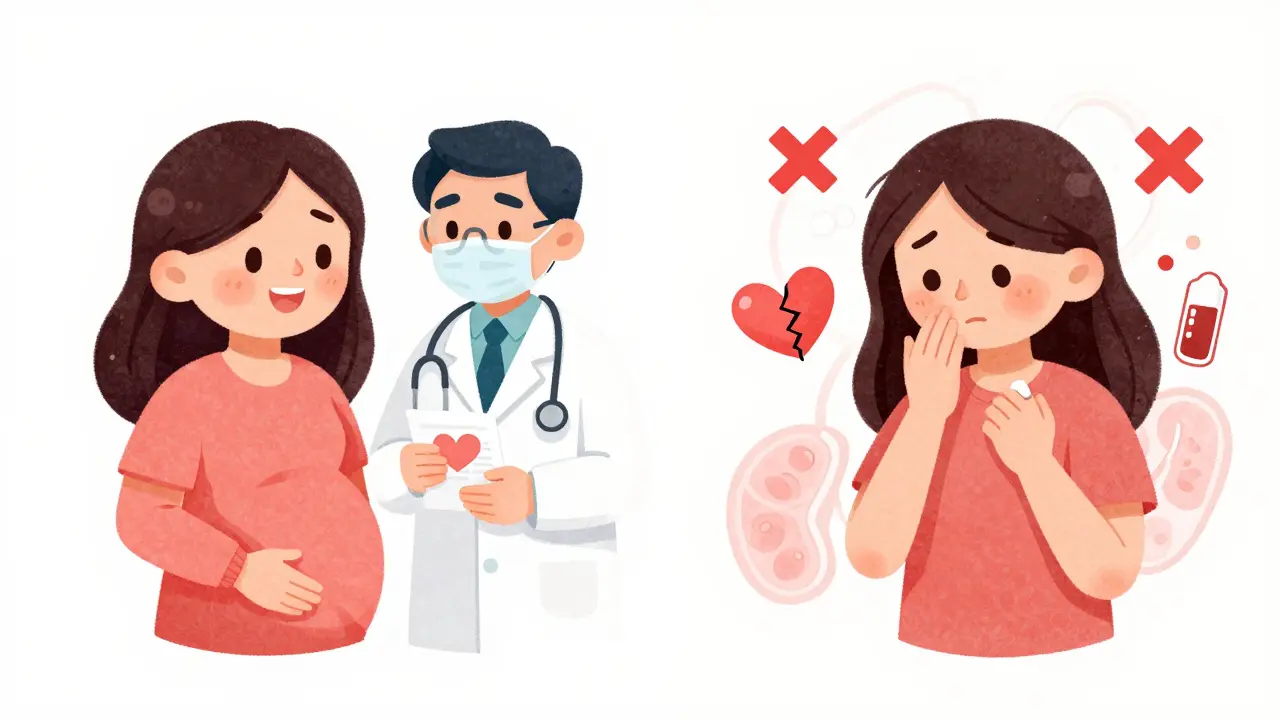
Depression and anxiety don’t pause during pregnancy. But stopping medication can be just as dangerous as continuing it. Paroxetine, an SSRI, carries a 1.5 to 2 times higher risk of heart defects like ventricular septal defects. That’s why many doctors switch patients to sertraline or citalopram before pregnancy. These have no clear link to major birth defects.
But here’s the catch: even “safe” antidepressants can cause neonatal adaptation syndrome-jitteriness, breathing trouble, feeding issues-in newborns if taken late in pregnancy. That’s not a birth defect. It’s a temporary condition. Still, it means you need to work closely with your doctor to find the right balance. Untreated depression increases the risk of preterm birth, low birth weight, and developmental delays. Your mental health matters as much as your baby’s physical health.
What About Allergies, Colds, and Upset Stomach?
First-trimester nausea? Benadryl (diphenhydramine), Claritin (loratadine), and Zyrtec (cetirizine) are considered safe for allergies. But Sudafed (pseudoephedrine)? Avoid it. A 2002 study linked it to a 1.2 to 1.3 times higher risk of gastroschisis-a rare but serious abdominal wall defect.
For heartburn, avoid bismuth subsalicylate (Pepto-Bismol). It contains salicylates, which act like aspirin and can interfere with blood clotting. H2 blockers like famotidine? No solid data yet. Loperamide (Imodium)? One small study found four cases of heart defects out of 226 pregnancies. Too few to prove causation, but too many to ignore.
For constipation, docusate is generally fine. Fiber, water, and movement are better, but if you need help, this is one of the safer options.
Chronic Conditions: When Stopping Is More Dangerous
Some conditions are so serious that skipping medication puts your baby at greater risk than taking it. Epilepsy is a prime example. Stopping seizure meds increases the chance of fetal death by 400% due to oxygen loss during a seizure. The same goes for diabetes-uncontrolled blood sugar raises the risk of major birth defects from 2-3% to 10-15%.
For autoimmune diseases like lupus, hydroxychloroquine (Plaquenil) is safe and often recommended to start early. Corticosteroids? They might slightly increase the risk of cleft lip or palate, but if you need them to stay alive or avoid organ damage, the trade-off is worth it.
Thyroid medication? Levothyroxine isn’t just safe-it’s essential. Your body needs 30-50% more thyroid hormone during pregnancy. If your TSH goes above 2.5 mIU/L, your baby’s brain development suffers. That’s why doctors check your levels every 4-6 weeks in the first half of pregnancy.
The Prescription Information Desert
Here’s the hardest part: we don’t know enough. The FDA says 98% of prescription labels lack good pregnancy safety data. Only 10% of all approved medications have enough human studies to give clear guidance. That’s not because doctors are careless. It’s because pharmaceutical companies have never been required to test drugs on pregnant people.
That’s why you’re left guessing. You might get conflicting advice from your OB, your pharmacist, and your primary care doctor. One says “avoid everything.” Another says “it’s fine.” You’re not alone. MotherToBaby, a national service that handles over 15,000 calls a year from pregnant people, says 68% of callers are terrified of medication risks-and 42% have stopped taking something they needed because they were scared.
What You Can Do Right Now
You don’t need to live in fear. You need a plan. Here’s what works:
- Know your dates. Use your last period and an early ultrasound to confirm how far along you are. Timing matters more than you think.
- Review everything. List every pill, supplement, herb, or OTC drug you take-even if you think it’s harmless. Include caffeine, nicotine, and alcohol.
- Call MotherToBaby. It’s free, confidential, and staffed by specialists. They’ll tell you the real risk-not fear, not myths. Dial 1-866-626-6847 or visit their website.
- Ask about alternatives. Can you manage nausea with ginger or acupressure? Can you use a saline nasal spray instead of Sudafed? Can you try physical therapy before painkillers?
- Use the lowest dose for the shortest time. If you need a medication, take it only when necessary. Never keep it “just in case.”
The goal isn’t to avoid all meds. It’s to avoid unnecessary ones. And when you do need them, to use them wisely.
What’s Next?
There’s hope. The FDA’s Pregnancy Exposure Registry now tracks over 10,000 pregnancies exposed to specific drugs. The NIH’s PregSource project collected data from 12,000 women who self-reported their medication use. These efforts are slowly filling the gaps.
But until then, you’re your own best advocate. If you’re unsure about a medication, don’t guess. Don’t wait. Call a specialist. Ask your provider to check TERIS (Teratology Information System) or MotherToBaby. You deserve clear answers-not silence.
First-trimester medication safety isn’t about perfection. It’s about awareness. It’s about asking the right questions. And it’s about knowing that you’re not alone in trying to do the right thing-for yourself and your baby.
15 Comments
I remember taking Tylenol for my migraines at 6 weeks and panicking every single time. Now I’m 28 weeks and my kid is healthy as a horse. Sometimes you just gotta trust your gut and your doc. No one’s perfect, but we’re trying.
Also, MotherToBaby saved my sanity. Called them twice. They didn’t scare me. They gave me facts. That’s all I needed.
The data presented here is statistically significant, methodologically rigorous, and clinically actionable. To suggest that acetaminophen use is ‘safe’ without contextualizing dose, duration, and gestational timing is not merely irresponsible-it is ethically indefensible. The embryological window is non-negotiable. We are not discussing coffee or sushi; we are discussing neurodevelopmental trajectories.
Every obstetrician must be required to provide a printed risk-benefit summary at the first prenatal visit. This is not optional. It is foundational.
bro i just took ibuprofen for my headache and now im like… is my baby gonna be a robot? 😭
but then i remembered my cousin’s kid who was born with 6 toes and he’s now a pro soccer player so… maybe we’re all just rolling the dice?
also ginger tea is life. no cap.
Stop taking anything. Just don’t. If you can’t handle a headache without pills, you shouldn’t be pregnant. This isn’t a spa retreat-it’s a biological imperative. You’re not a patient. You’re a vessel. Act like it.
Thank you for this. Truly. I’m from India, and here, everyone says ‘take whatever you want, it’s fine.’ I was about to take a cough syrup with codeine until I read this. I called my OB and we switched to honey and lemon. Small change. Big difference. I’m so grateful.
Also, please-no more ‘just one pill’ excuses. One pill can be the one that changes everything.
So let me get this straight: we’re told to avoid all meds, but the FDA admits 98% of them have zero data? So we’re supposed to guess based on… what? Google? TikTok? My mom’s 1987 pregnancy handbook?
It’s not that I don’t care about the baby. It’s that the system has abandoned us. We’re not being cautious-we’re being left in the dark with a flashlight that’s running on fumes.
This is exactly why we need better prenatal education. Not just ‘avoid this, avoid that’-but *why*. We need classes. We need pamphlets. We need doctors who actually sit down and explain the science-not just hand you a list.
And yes, I said it: if you’re pregnant and you’re still drinking 4 energy drinks a day? You need to talk to someone. Not because I’m judging. Because your baby deserves better.
It’s fascinating how the discourse around teratogenicity remains so profoundly anthropocentric. The pharmacokinetic interplay between placental transfer, cytochrome P450 polymorphisms, and epigenetic modulation during gastrulation is rarely contextualized within a bioethical framework that acknowledges maternal autonomy as a dynamic, not static, variable.
Also, I refuse to take acetaminophen. I’ve switched to CBD oil. It’s holistic. And yes, I’ve consulted the literature. The bioavailability profile is superior.
Let’s pause for a moment and reflect on the deeper meaning here. Pregnancy is not merely a biological process-it is a sacred threshold where science, intuition, fear, and love collide. We are not just protecting a fetus. We are protecting the very possibility of future humanity.
When we dismiss the fear of medication, we dismiss the weight of responsibility. When we demand perfect data, we ignore the reality that many of our greatest medical advances came from imperfect, courageous choices.
We are not perfect. But we are trying. And that, perhaps, is the most human thing of all.
Just wanted to say this post made me cry. Not because I’m scared-but because I finally feel seen. I’ve been taking sertraline for 3 years and my OB kept saying ‘it’s fine.’ But I never felt like anyone *really* understood the terror of choosing between my mind and my baby.
Thank you for saying it out loud. I’m calling MotherToBaby tomorrow.
Oh my god. I just realized-I took Zyrtec for my allergies during week 5. And I didn’t even know it could cause gastroschisis. I’m going to die. My baby is going to be born with a hole in their stomach. I’ve been reading every Reddit thread since 3 a.m. I can’t sleep. I can’t eat. I’m spiraling. Someone please tell me I’m not a monster.
Okay so I’m not a doctor but I read a book on pregnancy and I’m pretty sure I know more than your OB. I took 3 Advil at 7 weeks and my friend’s cousin’s niece had a kid with a cleft palate so obviously it’s the same thing right? Also, you’re supposed to avoid all sugar and caffeine and gluten and MSG and soy and fish and eggs and dairy and basically just eat grass and drink rainwater.
Also, I’m 8 weeks and already doing 10 yoga poses a day and I’ve never felt better. My baby is a zen master.
Stop lying to yourselves. If you’re taking meds, you’re already failing. Just admit it. You’re not ‘being careful.’ You’re just scared of being judged. So you Google and then take it anyway. That’s not wisdom. That’s weakness. You want to do right? Don’t get pregnant if you can’t handle a headache without pills.
lol i took benadryl for sleep at 6 weeks and now my kid is 2 and he’s the smartest kid in preschool. so yeah. maybe the science is wrong? or maybe we’re just scared of normal stuff?
also i took 2 tylenol a day for 3 months. my kid’s a genius. so chill.
Here’s the real question no one’s asking: Why are we putting the entire burden of fetal safety on the pregnant person? Why isn’t the pharmaceutical industry required to test on pregnant people? Why is this still a ‘you figure it out’ situation?
We’ve mapped the human genome. We’ve landed on Mars. But we still treat pregnancy like a mystery cult. It’s not just negligence. It’s systemic misogyny wrapped in clinical jargon.
Until we demand better, we’re all just guessing in the dark. And that’s not safe. That’s just sad.