
How to Pack Medications for Long Road Trips and Cruises: Essential Tips to Avoid Delays and Loss
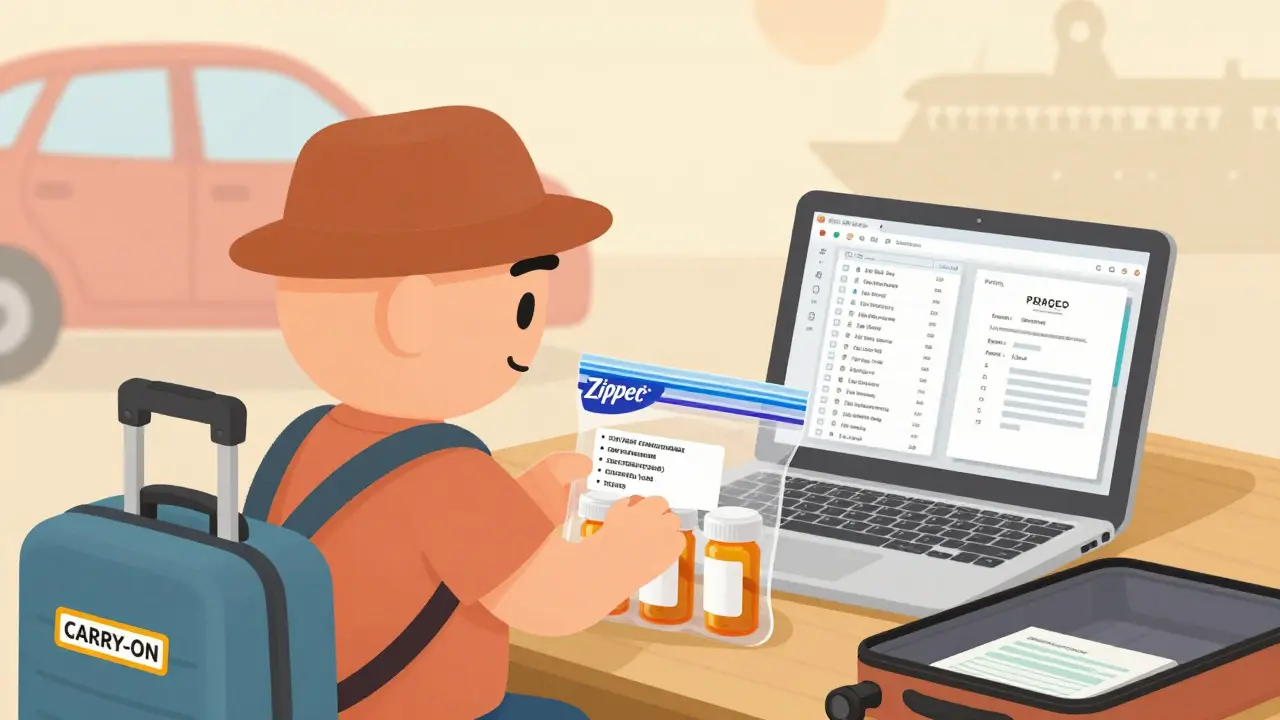
When you’re heading out on a long road trip or a cruise, the last thing you want is to run out of meds or get stopped at a border because your pills aren’t in the right container. It happens more often than you think. People lose medications in checked bags, get denied entry at ports because their prescriptions aren’t labeled right, or end up in a foreign clinic with no idea what’s in their pill organizer. You don’t need to panic-just plan ahead. Here’s exactly how to pack your medications so you stay safe, legal, and in control.
Start 30 Days Before You Leave
Don’t wait until the night before your trip. Start by talking to your doctor. This isn’t just about refills-it’s about legality. Some medications that are legal in the U.S. are banned or tightly controlled in other countries. For example, ADHD meds like Adderall or certain painkillers with codeine are restricted in over 65% of Caribbean destinations. Your doctor can help you figure out if any of your prescriptions might cause issues, and if needed, give you a letter explaining why you need them. This letter should include your name, the medication name (both brand and generic), dosage, and how often you take it.Keep Everything in Original Containers
This is non-negotiable. Whether you’re flying, cruising, or driving across state lines, your medications must stay in their original pharmacy bottles. That means the label with your name, the drug name, the prescriber’s info, and the pharmacy’s details must be visible. The TSA allows unlimited prescription meds in carry-on bags, but international flights and cruise lines like Royal Caribbean and Norwegian require original containers. If you transfer pills to a pill organizer without the original label, you risk having them confiscated. One Reddit user, u/TravelMedNurse, a travel nurse with over a decade of experience, says 90% of medication issues she’s seen came from unlabeled pills. At some ports, that’s enough to deny entry.Bring Extra Pills-More Than You Think
Delays happen. Flights get canceled. Ships dock late. Road trips hit traffic jams. According to OAG Aviation, about 23% of international flights experience delays of more than 3 hours. Cruise lines recommend bringing at least 2 extra days’ worth of meds. For road trips, 1 extra day is fine. But if you’re on insulin, heart meds, or anything life-sustaining, bring 3 to 5 extra days. The FDA says 41% of biologic medications (like insulin, injectables, or certain autoimmune drugs) are sensitive to temperature changes, so extra supply means extra safety. Don’t rely on finding a pharmacy abroad-many countries don’t sell U.S.-brand drugs, and even if they do, the dosage might be different.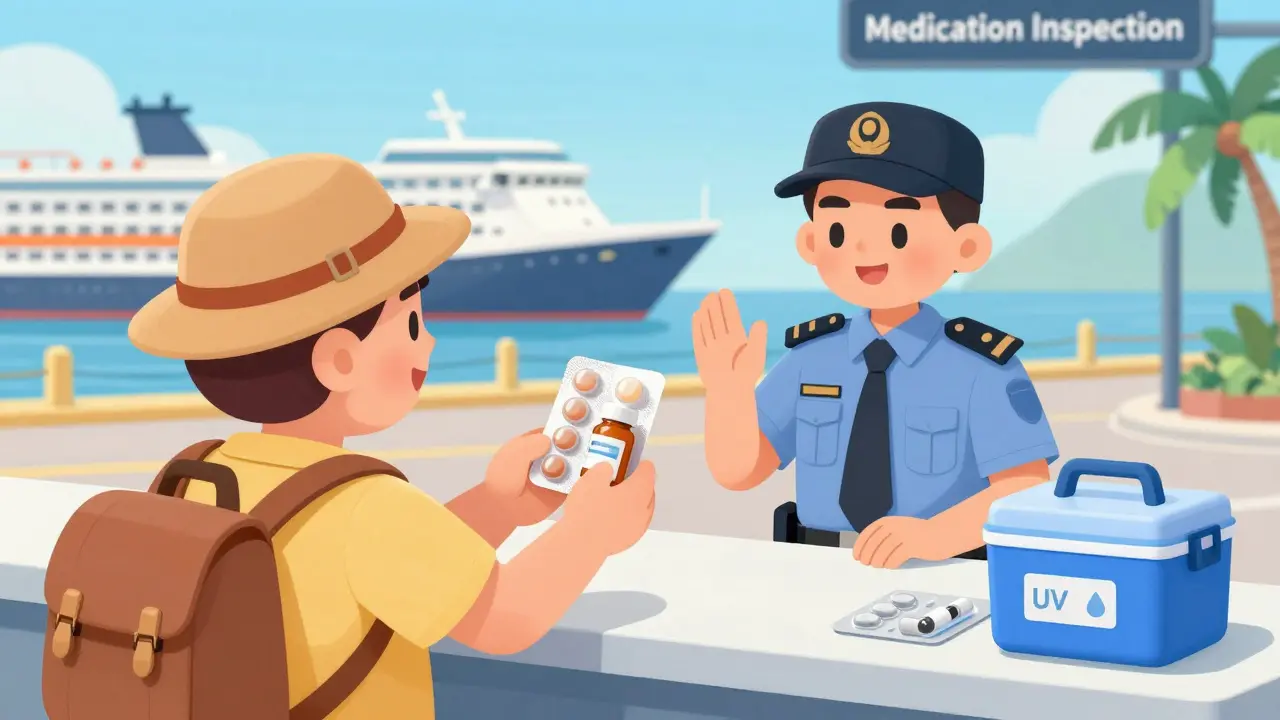
Use the Right Packing System
You’ve got options. The best ones are approved by travel medicine experts:- Original bottles - Best for all meds. Keep them together in a clear quart-sized Ziploc bag. TSA lets you bring unlimited prescriptions, and this keeps them easy to scan.
- Daily blister packs - These are pre-filled by your pharmacy. Many CVS and Walgreens locations now offer free travel blister packs. They’re labeled with the day and time, and come in a box with your name on it. Perfect for cruises.
- Pill minders - Only if you tape them shut and label them clearly. Write your full name, the date, the time of day, and the name of each pill on the outside. If it’s not labeled, security may throw it out.
- Pill envelopes - Small, sealed envelopes labeled with your name, medication, dose, and time. These work well for short trips or if you’re carrying just a few meds.
Avoid plastic bags with loose pills. No matter how organized they look, they’re not legal. And don’t use unlabeled containers-even if they’re from your home pill organizer. That’s a fast track to trouble.
Carry a Digital and Physical Copy
The CDC now recommends carrying your medication list in two places: a printed copy and a digital version. Your list should include:- Brand name
- Generic name
- Dosage
- How often you take it
- Reason for taking it (e.g., “for high blood pressure”)
- Your doctor’s name and phone number
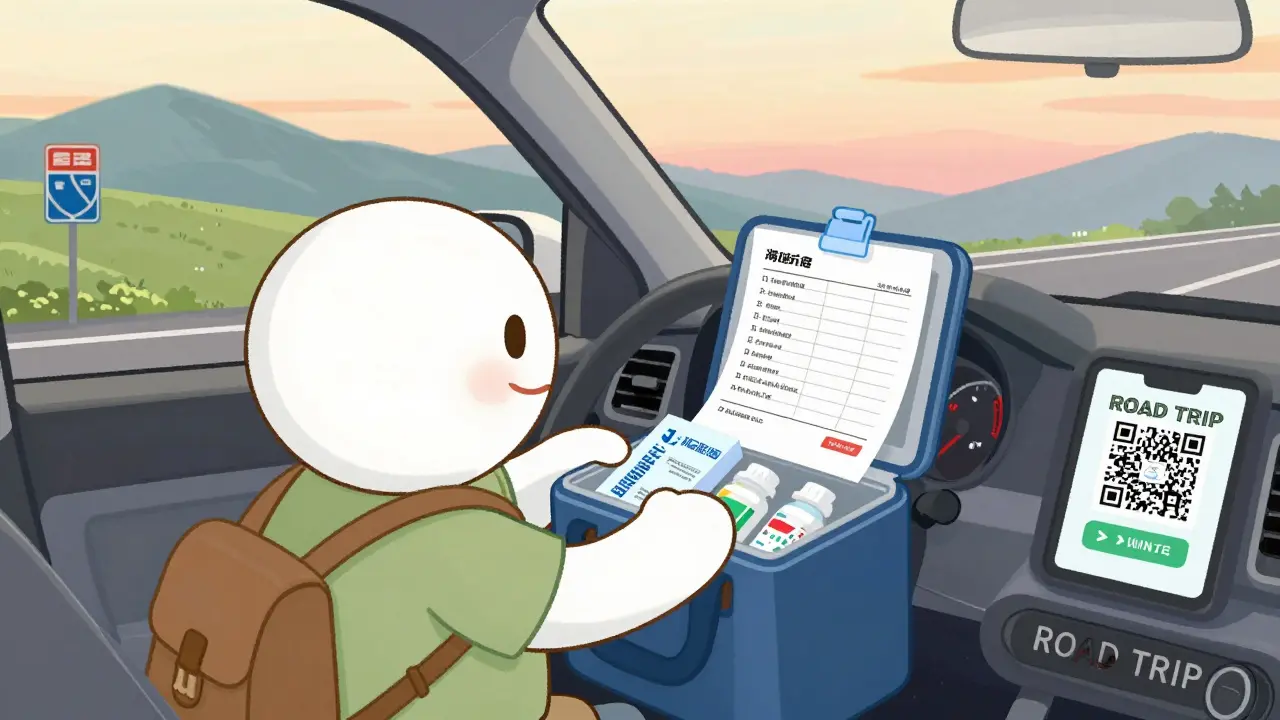
Take a photo of this list and save it in your phone’s notes. Add a QR code if your doctor’s office provides one-many clinics now use them to link to official documentation. In 2023, 12% of travelers had trouble explaining their meds to foreign medical staff. Having this list means you won’t need to guess what’s in your pills.
Cruise vs. Road Trip: Know the Difference
Cruise lines have stricter rules than road trips. Royal Caribbean, Carnival, and Norwegian require you to declare controlled substances (like opioids or stimulants) 30 days before sailing. Some require physician documentation even for common meds like Adderall. At ports, customs officers may check your meds against your passport name. If your bottle says “John Smith” but your passport says “Jonathan Smith,” you’ll be delayed.On road trips, the bigger issue is state laws. In 13 states, even medical marijuana is illegal. If you’re driving through them with any cannabis product-even CBD oil with trace THC-you could face fines or arrest. The AAA says 67% of travelers have had medication issues crossing state lines. Stick to non-restricted meds when crossing borders. If you’re unsure, call the state police non-emergency line before you enter.
Temperature Matters for Some Meds
If you take insulin, epinephrine, or certain biologics, heat can ruin them. The FDA says 41% of these medications lose effectiveness if exposed to temperatures above 86°F for more than a few hours. Don’t leave them in your car. Use a UV-protective cooler case that keeps meds cool for up to 72 hours. Many pharmacies now sell these for under $20. Or, keep them in your carry-on bag next to your phone or wallet-body heat helps maintain stable temps.What Not to Do
- Don’t pack meds in checked luggage. The FAA reports a 0.02% loss rate, but if your bag gets lost, your meds go with it.
- Don’t rely on shipboard pharmacies. They’re expensive, may not have your brand, and can’t refill controlled substances.
- Don’t mix meds from different people. Even if it’s your spouse’s allergy pill, if it’s not in your name, it’s illegal to carry.
- Don’t forget your travel insurance. 28% of cruise medical emergencies require evacuation, and the average cost is $48,000. Make sure your policy covers medication-related emergencies.
Final Checklist Before You Go
- ✅ All meds in original containers with labels
- ✅ 2 extra days of meds (3+ for critical meds)
- ✅ Digital and printed medication list (with generic names)
- ✅ Doctor’s letter if carrying controlled substances
- ✅ Medications in your carry-on, packed last
- ✅ Temperature-sensitive meds in a cooling case
- ✅ Copies of prescriptions or refill authorizations
It takes about 2.5 hours to do this right. But it saves you from hours of stress, fines, or worse-running out of life-saving medicine halfway across the ocean. Whether you’re cruising the Caribbean or driving to the Grand Canyon, this system works. No guesswork. No surprises. Just peace of mind.
Can I put my pills in a pill organizer for a cruise?
You can, but only if the organizer is clearly labeled with your full name, the medication name, dosage, and time of day. Cruise lines like Royal Caribbean require all medications to be in original containers. If you use a pill organizer, keep the original bottles in your carry-on as backup. Never rely on unlabeled containers-they’re a common reason for denied entry at ports.
Do I need a doctor’s note for my medications?
For most routine prescriptions, no. But if you’re carrying controlled substances (like opioids, stimulants, or sedatives), yes. Some countries require a letter from your doctor explaining why you need them. Even if you’re not leaving the U.S., some states (like Texas or Florida) ask for documentation if you’re carrying ADHD meds. It’s better to have one than to be turned away.
Can I bring my insulin on a plane?
Yes. Insulin and other injectables are allowed in carry-on luggage with no quantity limits. Keep them in their original packaging and bring a doctor’s note if you have it. TSA agents may ask to inspect them, but they won’t confiscate them if they’re clearly labeled. Never pack insulin in checked bags-it can freeze or overheat.
What if my medication is banned in the country I’m visiting?
If your medication is banned, you need to get a special permit before you go. The International Association for Medical Assistance to Travellers (IAMAT) says 42% of common medications require permits in certain destinations. Contact the embassy of your destination country and ask for their import rules. Your doctor can help you apply for an exception. Don’t risk bringing it without approval-you could be denied entry or fined.
Should I use a travel pharmacy service?
Yes, if you’re taking multiple daily meds. CVS and Walgreens now offer free travel repackaging services. They’ll put your pills into labeled blister packs with your name, the date, and time. These are approved by cruise lines and TSA. It’s faster than doing it yourself and reduces errors. Just call ahead-some locations require an appointment.
13 Comments
Original containers only. No exceptions. I've seen too many people get turned away at customs because they thought a pill organizer was 'fine'. It's not.
Thank you for this comprehensive guide. As someone who manages chronic health conditions while traveling, I cannot emphasize enough the importance of carrying both digital and physical copies of your medication list. It has saved me on multiple international trips. Preparation is not optional-it is essential for safety and dignity.
I just packed for my 10-day cruise and used the CVS blister packs-life changer. 😊 Also threw in a tiny cooler for my insulin and taped a note to it that says 'LIFE-SAVING MEDS DO NOT THROW OUT'. The TSA agent actually smiled. 🙌 Pro tip: label everything like your life depends on it-because it does.
Wow. So we're supposed to carry a doctor's note just to have Adderall? Next they'll make us carry a notarized letter for Advil. This country is a joke.
A well-structured and thoughtful article. The emphasis on original packaging and temperature control is particularly prudent. In my experience, even minor discrepancies between prescription labels and passport names can lead to significant delays at international ports. A proactive approach, as outlined here, is both practical and respectful of regulatory frameworks.
lol i just throw all my pills in a ziplock and call it a day. never had a problem. who even checks? i mean really. the only time they care is if you look suspicious. im not suspicious. im just a guy with allergies and high blood pressure. chill out.
I’ve traveled to over 20 countries with chronic illness. The real issue isn’t the rules-it’s the lack of global standardization. Why does one country accept a U.S. prescription while another treats it as contraband? It’s arbitrary. But since we live in this system, this guide is one of the few practical tools we have. Respect to the author for not just warning, but equipping.
The philosophical underpinning of this guidance reveals a deeper truth: personal autonomy in health is not a right, but a negotiated privilege contingent upon bureaucratic compliance. One does not simply 'pack' medication; one performs an act of legitimacy through the ritual of labeling, documentation, and submission to institutional authority. The original container becomes a sacrament; the doctor's letter, a holy writ. We are not merely travelers-we are petitioners before the altar of pharmacological sovereignty.
I’ve been doing long-haul road trips for 18 years, and I’ve seen everything. People think they’re being smart by dumping their pills into a pill organizer because it’s 'convenient'. But convenience doesn’t mean legality. I once saw a guy get detained in New Mexico because his 'daily med pack' had no labels. Turns out, he was carrying his wife’s blood pressure meds. He didn’t even realize they were in his bag. That’s not negligence-that’s ignorance. And ignorance gets you fined, deported, or worse. The advice here isn’t just good-it’s survival. If you’re not following this, you’re gambling with your health and your freedom. Don’t be that guy.
I’m a nurse and I’ve worked on cruise ships. I can confirm: the most common medical emergency isn’t injury-it’s someone running out of meds because they packed them in checked luggage. Please, for your own sake, keep them with you. And if you’re on insulin? Don’t even think about checking it. I’ve seen it melt in the cargo hold. It’s heartbreaking.
So I gotta carry a doctor’s letter for my ADHD meds? Cool. Next thing you know they’ll want a signed affidavit from my therapist explaining why I need coffee. At this point, I just carry my meds in a tin labeled 'MAGIC DUST' and hope for the best.
I used to think this was overkill until I got stuck in a Mexican airport with no access to my meds because my bottle was unlabeled. Took 12 hours and a $200 pharmacy bill to get a replacement. This guide? It’s not advice. It’s insurance.
I just got back from a 14-day cruise. I followed every step here. Kept my insulin in a cooler, labeled my blister packs, had the doctor’s letter for my thyroid med. Nothing happened. No hassles. No stress. Just peace of mind. This isn’t about being paranoid. It’s about being prepared. And honestly? That’s just smart.