
Palliative Care in Cancer: Pain Control and Quality of Life Guide

Imagine living with a constant, grinding ache that makes it hard to sleep, eat, or enjoy time with your family. For many people facing a cancer diagnosis, this isn't just a metaphor; it is their daily reality. Yet, despite the availability of effective treatments, millions still suffer unnecessarily because they don't understand what palliative care is a specialized medical care focused on providing relief from the symptoms and stress of a serious illness like cancer. There is a widespread myth that palliative care is only for the end of life. This could not be further from the truth. In fact, integrating these services early can actually help you live longer and better.
What Is Palliative Care Really?
Palliative care is often confused with hospice care, but they are distinct concepts. While hospice focuses on comfort at the very end of life when curative treatment has stopped, palliative care is available at any stage of a serious illness. You can receive it alongside chemotherapy, radiation, or surgery. The goal is simple: improve your quality of life by managing symptoms like pain, nausea, fatigue, and anxiety. Major organizations, including the World Health Organization (WHO), define it as an approach that improves the quality of life of patients and their families facing problems associated with life-threatening illness.
The evidence supporting this approach is strong. Studies cited by the American Society of Clinical Oncology (ASCO) show that when specialty palliative care teams get involved within eight weeks of diagnosis, patients see a 20-30% improvement in quality of life metrics. Even more striking, some research indicates a median survival benefit of 2.5 months for metastatic cancer patients who receive early palliative care alongside standard oncology treatment. It’s not about giving up; it’s about adding life to your days.
Understanding Cancer Pain Management
Pain is one of the most common and distressing symptoms of cancer, affecting an estimated 70-90% of advanced cancer patients. However, data from the National Cancer Institute (NCI) suggests that 80-90% of this pain can be effectively controlled. The key lies in systematic assessment and treatment. The first step is always quantification. Clinicians use a 0-10 numerical rating scale, where 0 is no pain and 10 is the worst imaginable pain. This isn't just a number game; it guides the entire treatment plan.
A comprehensive assessment looks beyond intensity. It evaluates the location, quality (burning, stabbing, aching), timing, and factors that make the pain better or worse. The European Society for Medical Oncology (ESMO) guidelines emphasize documenting this at every clinical encounter. Why? Because cancer pain changes. A tumor might grow, pressing on a nerve, or treatment side effects might emerge. Regular reassessment ensures the treatment evolves with your condition.
The WHO Analgesic Ladder: A Step-by-Step Approach
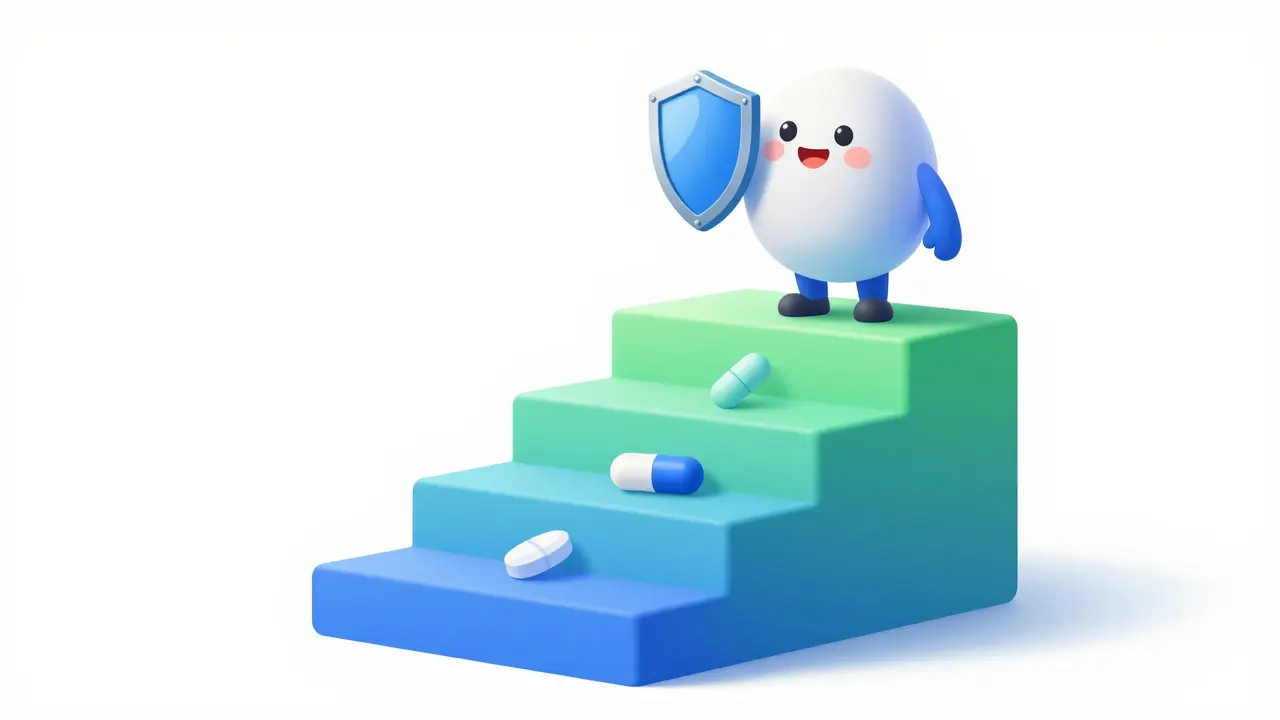
To manage pain effectively, doctors follow the WHO analgesic ladder, which is a three-step guideline for prescribing pain medication based on severity. This framework, established in 1986 and updated in 2018, remains the gold standard globally. It starts with the least potent medications and moves up as needed.
- Step 1 (Mild Pain): Non-opioid analgesics are used first. This includes acetaminophen (maximum 4,000 mg/day) or NSAIDs like ibuprofen (400-800 mg three times daily). These drugs target inflammation and general discomfort.
- Step 2 (Moderate Pain): If non-opioids aren't enough, weak opioids are added. Codeine (30-60 mg every 4 hours) is a common choice here. It provides stronger relief without the heavy sedation of stronger drugs.
- Step 3 (Severe Pain): For severe pain, strong opioids like morphine are prescribed. Starting doses might be 5-15 mg orally every 4 hours. Crucially, these are given on a schedule, not just "as needed," to keep pain levels steady. Breakthrough doses, usually 10-15% of the total daily dose, are available for sudden spikes in pain.
The National Comprehensive Cancer Network (NCCN) guidelines specify that opioids should be titrated carefully. Doctors increase the dose by 25-50% every 24-48 hours until pain control is achieved. Reassessment within 24 hours is mandatory for severe pain to ensure safety and efficacy.
Beyond Pills: Adjuvants and Radiotherapy
Opioids are powerful, but they aren't the only tool in the box. Different types of cancer pain require different approaches. Neuropathic pain, caused by nerve damage, often doesn't respond well to opioids alone. Here, adjuvant medications shine. Anticonvulsants like gabapentin (100-1,200 mg three times daily) and antidepressants like duloxetine (30-60 mg daily) can calm overactive nerves.
For bone pain, particularly from metastases, corticosteroids like dexamethasone (4-16 mg daily) reduce swelling around the bone. Additionally, localized radiotherapy is highly effective. The WHO recommends single fractions of 8 Gy or multiple fractions totaling 20-30 Gy for bone metastases. This can shrink tumors pressing on bones and provide significant relief. Bisphosphonates, such as zoledronic acid (4 mg IV every 3-4 weeks), also strengthen bone and reduce fracture risk.
Addressing Barriers and Fears
Despite clear guidelines, barriers remain. One major issue is provider knowledge gaps. A study by Cancer Care Ontario found that 40% of oncology nurses lacked current pain management certification. Another huge barrier is patient fear. Surveys by the NCI reveal that 65% of patients fear addiction, leading them to underreport pain. This is a critical misunderstanding. Addiction involves compulsive drug-seeking behavior, while physical dependence is a normal physiological response to long-term opioid use. In palliative care, the goal is comfort, not euphoria, and addiction is rare when opioids are used as prescribed for pain.
Cultural factors also play a role. Research shows that 28% of Asian and Hispanic patients may underreport pain due to cultural stoicism. Open communication between patients, families, and care teams is essential to overcome these hurdles. Providers must create a safe space where discussing pain is normalized and encouraged.
| Organization | Primary Focus | Key Recommendation |
|---|---|---|
| WHO | Pharmacological & Radiotherapeutic | Three-step analgesic ladder; radiotherapy for bone mets |
| NCCN | Comprehensive Assessment | Mandatory pain screening; psychosocial evaluation |
| ASCO | Early Integration | Integrate palliative care within 8 weeks of diagnosis |
| ESMO | Assessment Tools | Use validated tools like Brief Pain Inventory |

Emerging Trends and Future Directions
The field is evolving rapidly. The 2022 ASCO update strengthened its call for early integration, citing 17 studies showing significant benefits. ESMO's 2023 update addresses new challenges, such as pain from immunotherapy-induced arthritis. Technology is also changing the landscape. Smartphone apps for real-time pain tracking have shown a 22% improvement in documentation accuracy in a 2021 JCO study. This data helps doctors adjust treatments more precisely.
Genetic testing for CYP450 enzyme variants is another frontier. These genes affect how your body metabolizes opioids. Knowing your genetic profile can help doctors choose the right drug and dose from the start, avoiding trial and error. Artificial intelligence is being explored to predict individual pain trajectories, allowing for proactive rather than reactive care. With 12 novel non-opioid agents currently in Phase II/III trials, the future holds promise for even more targeted, side-effect-free pain relief.
Practical Steps for Patients and Families
If you or a loved one is dealing with cancer pain, take action. First, ask for a palliative care consultation early. Don't wait until symptoms become unmanageable. Second, keep a pain diary. Note the time, intensity, type of pain, and what helped. This information is invaluable for your care team. Third, educate yourself on the difference between addiction and dependence. Understanding this can alleviate fear and encourage honest communication. Finally, involve your support system. Palliative care supports the whole family, offering resources for caregivers and addressing emotional distress.
Is palliative care the same as hospice?
No, they are different. Hospice is for people nearing the end of life who have stopped curative treatment. Palliative care can be provided at any stage of a serious illness, alongside curative treatments like chemotherapy or surgery, to manage symptoms and improve quality of life.
Will taking opioids for cancer pain lead to addiction?
Addiction is rare when opioids are used as prescribed for cancer pain. Physical dependence, where your body adapts to the medication, is expected and managed medically. Addiction involves compulsive use despite harm, which is uncommon in palliative settings where the goal is comfort, not euphoria.
When should I ask for a palliative care referral?
You can ask for a referral at any point after a cancer diagnosis. Guidelines suggest early integration, ideally within eight weeks of diagnosis, especially if you are experiencing significant pain, fatigue, or emotional distress. Early involvement leads to better outcomes and quality of life.
What is the WHO analgesic ladder?
It is a three-step guide for treating pain. Step 1 uses non-opioids like acetaminophen for mild pain. Step 2 adds weak opioids like codeine for moderate pain. Step 3 uses strong opioids like morphine for severe pain. Doctors move up the ladder based on your pain level and response to treatment.
How do I track my pain effectively?
Use a pain diary or smartphone app. Record the time, intensity (0-10 scale), location, type (burning, aching), and what alleviates it. This detailed data helps your healthcare team tailor your medication and non-pharmacological interventions for maximum relief.